
Everything Parents Need to Know About Children’s Glasses
Updated AUG 13, 2026 • 6 min read

| Quick Answer: Can You Order Kids’ Glasses Online? Yes – for most standard prescriptions, ordering children’s glasses online is a reliable option. Parents should have a current prescription, an accurate PD measurement, and a frame that fits the child’s face properly. Children with prism prescriptions, active eye conditions, or glasses that are part of a broader treatment plan may benefit from professional fitting and in-person guidance. For everyone else, this guide covers everything you need to get it right. |
Why You Can Trust This Guide?
Written with input from a board-certified ophthalmologist, this guide reflects current practice in pediatric eyewear. No jargon – just a clear walkthrough of what actually matters when choosing and ordering glasses for a child.
Introduction
Finding out your child needs glasses is rarely the hard part. Navigating everything that comes after – which frame holds up, whether the fit is right, what to look for in lenses, what to do about sports – is where most parents need a hand. This guide covers the full picture in one place, from understanding the prescription to choosing glasses your child will actually wear.
What This Guide Covers
- The Eye Exam: What a school screening misses and when to schedule a full exam
- The Prescription & PD: Understanding the numbers and measuring pupillary distance for kids
- Frame Selection: Material, fit, and age-specific considerations
- Lens Selection: What to look for and why polycarbonate is widely recommended for kids
- Special Situations: When glasses are part of a broader eye care plan
- Sports & Sun Protection: When a second pair makes sense
- Compliance: Practical strategies for keeping glasses on
- Common Mistakes: What to avoid when ordering
- Pre-Order Checklist: Five things to verify before placing an order
- Quick Reference Table: Age-based recommendations at a glance
Start Here: The Eye Exam
Why a School Screening Isn’t the Whole Picture?
School vision screenings are a useful first pass, but they are not designed to replace a full eye exam. The American Academy of Ophthalmology recommends that children have their vision assessed from infancy, with regular check-ups throughout childhood and a full comprehensive exam whenever a concern arises or a screening is inconclusive.
If you’ve noticed your child squinting, sitting closer than usual to screens, or rubbing their eyes more than seems normal, those are good reasons to schedule a full exam.
For a detailed breakdown of what to expect at each stage: when to get your child’s eyes tested?
Understanding the Prescription
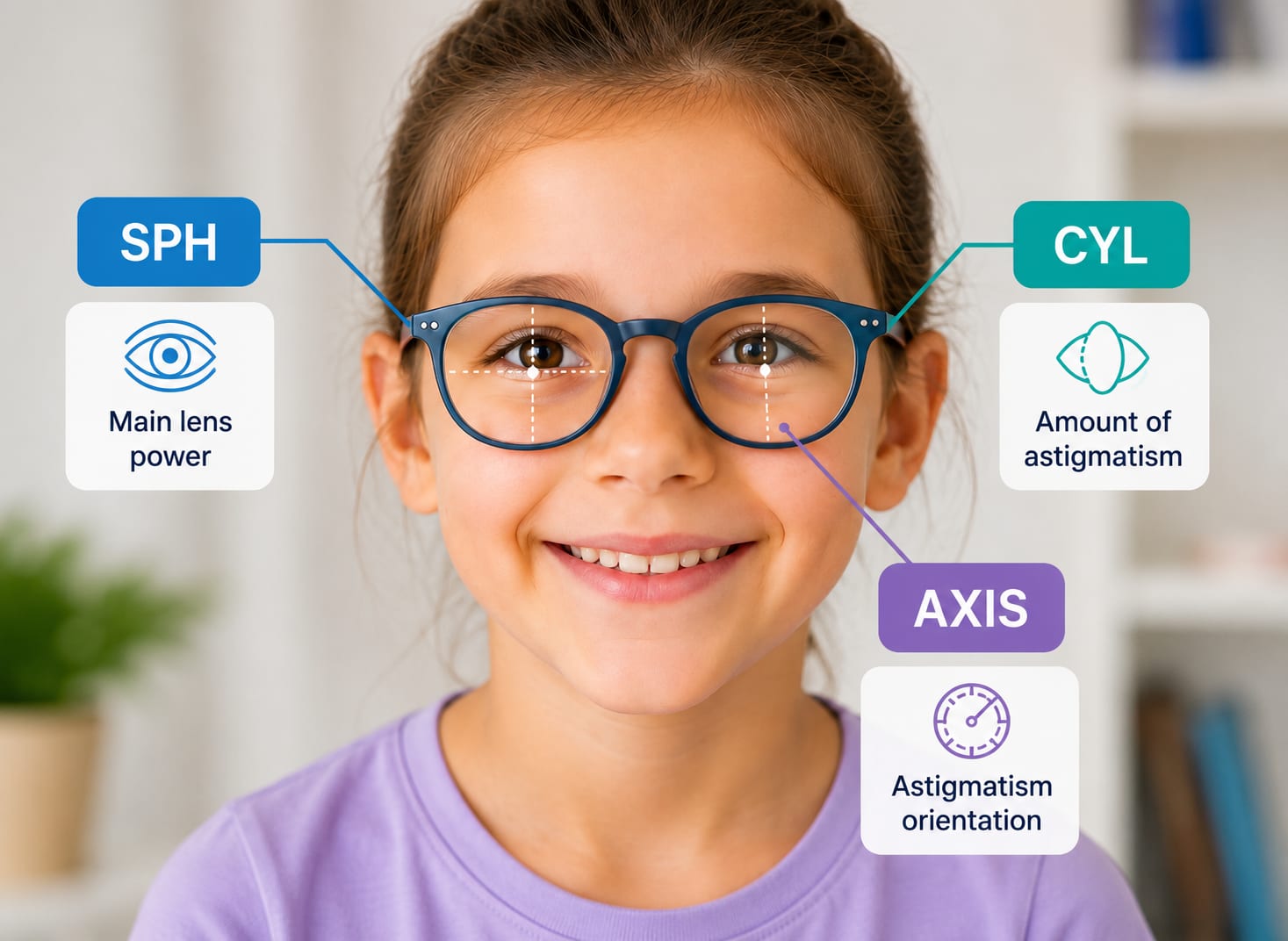
A child’s prescription uses the same format as an adult’s – Sphere (SPH), Cylinder (CYL), and Axis. Properly prescribed glasses help children see clearly and, where relevant, support normal visual development. Getting the numbers right from the start is what makes the rest of the glasses-buying work.
One thing that surprises some parents: children are often examined with the help of dilating eye drops, which temporarily relax the eye’s focusing muscles and give the doctor a more accurate picture of the true prescription. If the numbers seem stronger than expected, this is usually why – it’s a more precise measurement, not automatically a cause for concern.
PD: The Measurement Most Parents Don’t Know About
Alongside the prescription, ordering glasses online requires one additional number: the pupillary distance, or PD. This is the distance in millimeters between the centers of your child’s pupils, and it determines where the optical center of each lens sits within the frame. Get it right and the glasses work exactly as intended. Get it wrong and even a perfectly written prescription can feel off.
Measuring PD for children is similar to the adult process, but worth doing carefully – younger children can be harder to keep still, and smaller faces mean less margin for error. Most online providers offer a digital PD tool, which works well for standard prescriptions. For younger children or more complex prescriptions, having the PD measured by a professional is a worthwhile extra step.
Choosing the Right Frame
Frame Material: More Practical Than It Sounds
For children, frame material is mostly a question of durability and comfort. The right choice depends on their age and how they use their glasses day to day.
- TR90 (flexible nylon): A popular choice for younger children. It’s lightweight, bends under pressure rather than snapping, and returns to its original shape – well-suited for the routines of a younger child’s day.
- Acetate: A good option for older children and teenagers. It’s more structured, holds adjustments well, and comes in a wider range of styles – which matters more as kids develop their own preferences.
- Metal: Often chosen by older children and teens who prefer a thinner, more traditional frame style. Spring hinges add extra flexibility at a common point of failure, helping the frame withstand everyday use.
For a detailed age-by-age comparison, including what to look for and what to avoid: frame materials for kids.
Getting the Fit Right
A frame that doesn’t fit comfortably won’t get worn. Poor fit is one of the most common reasons children resist their glasses, and it’s worth getting right before anything else. Three things to check:
- Frame width: Should sit comfortably across the face without pressing inward at the temples or sitting too loose.
- Bridge fit: Some younger children may benefit from adjustable nose pads, which can help the frame sit more securely on faces that are still developing. A bridge that sits too low will cause the whole frame to tilt.
- too low will cause the whole frame to tilt.
- Temple length: Should rest flat along the side of the head without digging in. For younger children, cable temples – which curl gently around the ear – help keep glasses in place and make them a little harder for curious hands to pull off.
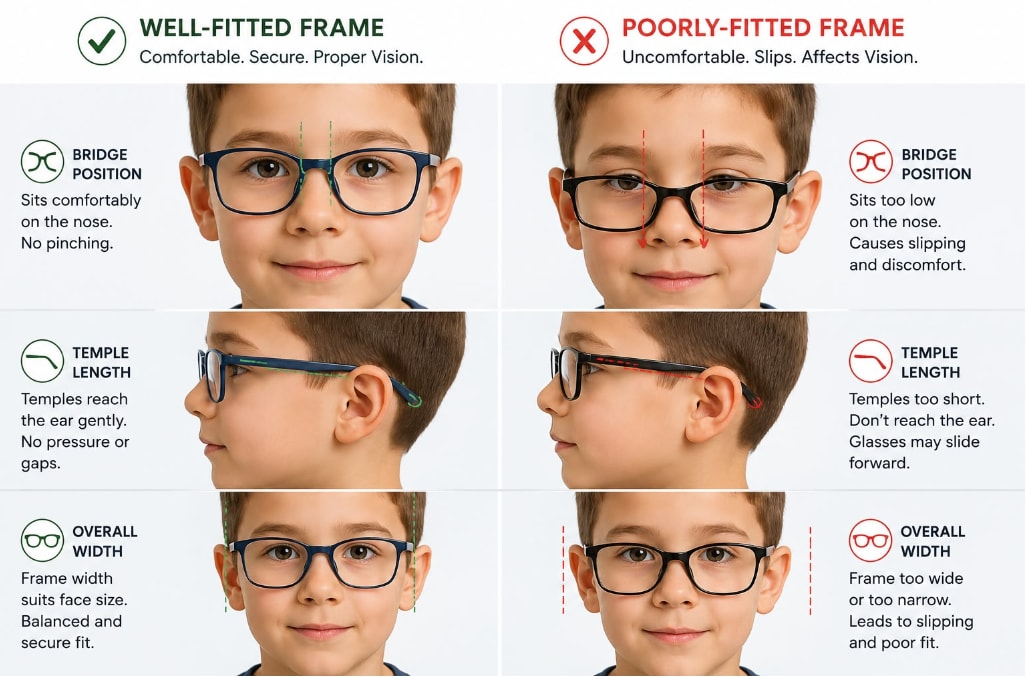
For a practical at-home fit checklist: how kids’ glasses should fit.
A Note on Toddlers (Ages 1–4)
Toddlers are genuinely their own category. Young children often have flatter nasal bridges and lower-set ears, which means standard children’s frames often don’t sit correctly. Frames built for this age group typically include strap harnesses or elastic bands for retention and cable temples for a secure fit. Getting glasses to stay on a toddler is half the challenge – and the right frame design makes a real difference.
For everything specific to this age group: eyewear for toddlers.
Choosing the Right Lens
Why Polycarbonate Is a Widely Recommended Choice for Kids
When it comes to children’s lenses, polycarbonate is one of the most commonly recommended materials among eye care professionals. It’s lighter than standard plastic, has built-in UV protection without any added coating, and is significantly more impact-resistant – which matters particularly with active kids. Trivex is another option with similar properties and is worth discussing with your eye care provider if you’re weighing choices.
| Good to know: Polycarbonate includes built-in UV protection – a useful bonus for children who spend a lot of time outdoors. Many standard plastic lenses don’t include this unless a separate UV coating is added. |
For a full explanation of lens materials and what to consider for children’s eyewear: polycarbonate lenses for kids.
Special Situations
Some children are prescribed glasses simply to see more clearly at distance or near. Others may be prescribed glasses as part of a broader eye care plan – for conditions such as eye alignment issues or a prescription that is changing more quickly than usual. If your child falls into one of these categories, follow the recommendations provided by your eye care professional closely, and discuss any questions you have – including which frames and lenses are most appropriate – before placing an order.
| A note on screen time and vision: Parents often ask whether screen use can affect how a child’s vision develops. While prescription changes in childhood can be influenced by many factors, regular eye exams remain the most reliable way to monitor any changes over time. If you have specific concerns, your eye care provider is the right person to discuss them with. |
Sports and Sun Protection
Sports Glasses: When a Dedicated Pair Makes Sense
Standard prescription frames are built for everyday wear, not for sports. If your child plays any kind of ball sport or is regularly in situations where impact is a real possibility, a dedicated pair of sports glasses is worth considering. These are designed to stay on during activity and to handle the demands of sports better than regular frames.
For sport-specific guidance and what to look for: sports glasses for kids.
Managing UV Exposure
Children spend a lot of time outdoors, and it’s worth thinking about UV protection. Two options worth knowing about:
- Transitions lenses for kids – Lenses that darken automatically in sunlight and clear indoors. Convenient because one pair covers both situations. One thing to be aware of: they typically don’t activate behind car windshields, since windshield glass filters the UV that triggers the reaction.
- Prescription sunglasses for kids – The better choice for beach days, skiing, or any extended outdoor activity where consistent sun protection matters. Wrap-style frames provide the broadest coverage.
Keeping Glasses On
Getting a child to wear their glasses regularly is one of the most common challenges parents face. Glasses that aren;t worn can’t correct vision – and for some children, consistent wear is an important part of their overall eye care plan. The right approach varies a lot depending on the child’s age and what’s actually behind their reluctance to put them on.
The most common physical reason for resistance is simple discomfort from a frame that doesn’t fit well. Self-consciousness at school age is another reason that often comes up. And sometimes, it’s just a habit.
For age-specific strategies and guidance on when to loop in the prescribing doctor: encouraging your child to wear their glasses.
Common Mistakes Parents Make When Ordering Kids’ Glasses
Most problems with children’s glasses online are preventable. These are the ones that come up most often:
- Using an outdated prescription. Prescriptions have an expiration date. Ordering from an old one means the lenses may no longer match your child’s vision needs.
- Guessing the PD. PD is a precise number, not an estimate. A wrong PD can make even a correct prescription feel off. Always measure, don’t guess.
- Choosing frames that are too large. Oversized frames look appealing but create fitting problems, especially for younger children with smaller faces. A frame that’s too wide will sit crooked and constantly slide.
- Prioritizing style over fit. Style matters, especially for older kids who care about how they look, but fit should always come first. A stylish frame that doesn’t sit correctly won’t stay on.
- Skipping sports eyewear when it’s needed. Regular glasses aren’t designed for sports. If your child is active, a dedicated pair is the right call – not an afterthought.
Pre-Order Checklist
Before placing your order, run through these five points:
☐ Prescription is current – issued within the past 12 months by a licensed eye care professional
☐ PD has been measured – using a digital tool or professional measurement instead of just estimating
☐ Frame size matches the child’s face – width, bridge, and temple length all checked
☐ Lens material confirmed – polycarbonate or Trivex recommended for most children
☐ Special situations flagged – if glasses are part of a treatment plan, confirm choices with the prescribing doctor first
Quick Reference by Age Group
The most relevant starting point, by age:
| Age Group | Key Priority | Frame Type | Deep Dive |
| Ages 1–4 | Retention + safety | Cable temples, strap harness | Toddler Eyewear Guide |
| Ages 5–10 | Durability + fit | TR90 flexible or acetate | Frame Materials Guide |
| Ages 11–16 | Style + compliance | Metal or acetate | Encouraging Wear Guide |
| All Ages – Sports | Impact protection | Polycarbonate + strap | Sports Glasses Guide |
When to Visit a Professional Instead
Online ordering works well for most standard prescriptions. A few situations where an in-person fitting is the better choice:
- Very young children (under 3): Facial proportions change quickly and benefit from regular in-person re-measurement.
- Prescriptions with prism: Prism correction requires precise lens placement that a licensed optician should verify directly.
- Glasses as part of a treatment plan: Any child whose glasses are part of active care for an eye condition should have eyewear selected under professional guidance.
- Sudden or unexpected prescription changes: Worth a conversation with the prescribing doctor before placing a new order.
FAQ’s
At what age can a child start wearing prescription glasses?
There’s no minimum age. When a prescription is identified early, glasses can be fitted right away. Starting early gives children the best opportunity to see clearly and support normal visual development.
How often does a child’s prescription change?
More often than an adult’s, particularly during growth periods. Many children who wear corrective lenses are seen annually, although some may require more frequent follow-up depending on their prescription or overall eye health. Your eye care provider will advise on the right schedule.
What if my child refuses to wear their glasses?
Start by checking fit – an uncomfortable frame is the most common physical reason for resistance and is easily addressed. Beyond that, the right approach depends on the child’s age and what’s driving the reluctance.
Can kids wear contact lenses?
Contact lenses are an option for some older children and teenagers, depending on maturity, prescription, and eye health. This is a decision best made in conversation with your child’s eye care provider, who can assess whether contacts are appropriate and which type would suit their needs.
Does screen time make eyesight worse?
This is an active area of research without a simple yes-or-no answer. What we do know is that children’s vision can change as they grow, which is one reason regular eye exams are important. If you have specific concerns, your eye care provider is the right person to discuss them with.
Is it safe to order kids’ glasses online?
For most standard prescriptions, yes. Reputable online providers can produce prescription eyewear to the same standards used throughout the optical industry, provided accurate prescription and fitting information is supplied. The things that matter most are the same regardless of where you order: a current valid prescription, an accurate PD, the right frame size, and choosing lenses that suit your child’s needs.
| Disclaimer: This article is for informational purposes only and is not medical advice. The information presented is general in nature and may not apply to your individual circumstances. Consult a licensed eye care professional for personalized recommendations. Never disregard or delay professional medical advice based on this article. GlassesUSA makes no warranties regarding the information presented. Reliance is at your own risk. The eye care professional featured in this article is a paid spokesperson for GlassesUSA. All images in this article were generated using artificial intelligence (AI). |
Published July 13, 2026|Updated August 13, 2026
