
Transitions Lenses for Kids: What Parents Need to Know
Updated AUG 16, 2026 • 7 min read

| Quick Answer: Photochromic lenses – often called Transitions lenses after one of the leading brands – darken automatically in UV light and clear indoors. For children, they may remove the need for a separate pair of sunglasses and typically include built-in UV protection. The main limitation most parents don’t know about: standard photochromic lenses generally don’t activate behind car windshields, because windshield glass filters much of the UV that triggers the darkening reaction. These lenses may be suitable for school and mixed indoor/outdoor use, but may not be the optimal choice if in-car sun exposure is a consideration. |
Why You Can Trust This Guide?
Written with input from a board-certified ophthalmologist. Technical information about photochromic lens behaviour is based on generally documented material properties and manufacturer specifications , which may vary by brand and product line.
Introduction
Photochromic lenses are one of those things that sound almost too convenient: glasses that darken in sunlight and clear indoors, automatically, without needing to carry a second pair. For parents of children who wear glasses, the appeal is obvious – one pair, a lot less hassle.
Think of photochromic lenses as a convenience layer – useful in most everyday situations, but not a one-for-one substitute for sunglasses in every scenario. They work well for a specific set of situations, and have real limitations that are worth understanding before deciding. For a direct comparison with dedicated prescription sunglasses, see: prescription sunglasses for kids.
How Photochromic Lenses Work ?
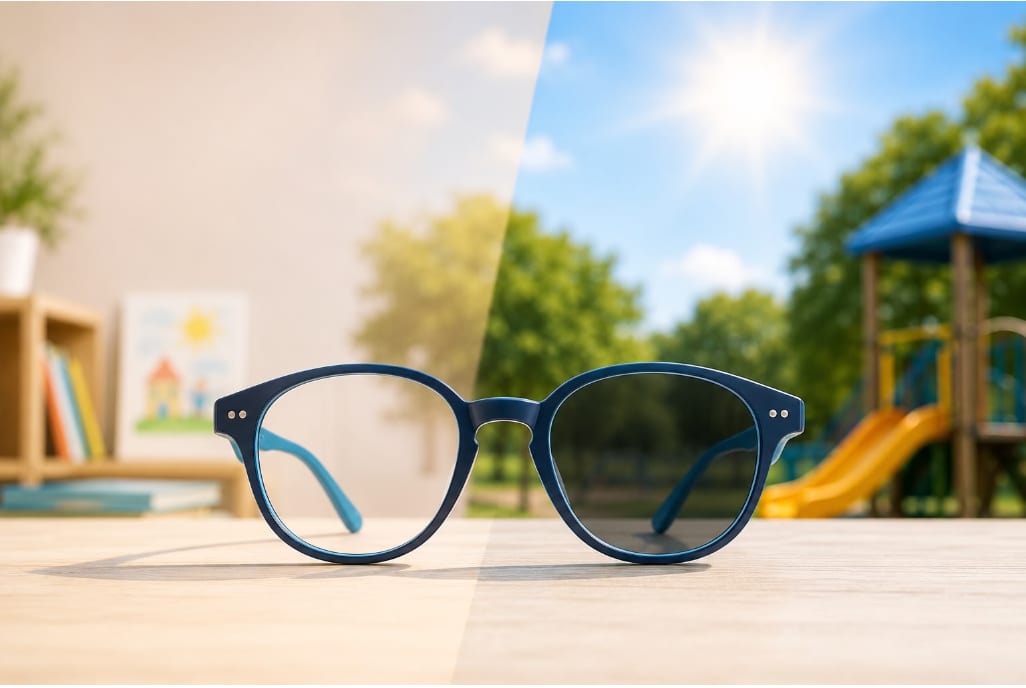
Photochromic lenses contain molecules embedded in the lens material that change structure when exposed to ultraviolet (UV) light. When UV is present – such as when outdoors during the day – the molecules darken the lens. When UV is absent – indoors, or at night – the molecules return to their original structure and the lens clears. In routine pediatric ophthalmology practice, photochromic lenses are often considered a practical option for children, particularly where managing two pairs of glasses is a challenge.
The time it takes for the lens to darken is typically approximately 30–60 seconds when moving from indoors to bright sunlight. Going back to a clear lens, when moving back indoors, typically takes around 2–3 minutes. Both times can vary depending on temperature, lens brand, and environmental conditions – cold conditions slow the process slightly; hot conditions may limit how dark the lens gets.
| UV protection: Many photochromic lenses include built-in UV protection, similar to polycarbonate or Trivex lenses. The UV protection is generally present whether the lens is dark or clear. Consumers should verify UV protection specifications with the lens manufacturer or eye care provider. |
The Car Windshield Limitation – The #1 Misunderstanding Parents Have
This is the most important limitation to understand – and it’s one most parents find out about only after ordering – definitely worth knowing about before you decide.
Most modern car windshields are designed to block UV radiation – often over 95% of it, in many vehicles. Since standard photochromic lenses activate primarily in response to UV light, they generally don’t darken significantly inside a car. A child sitting in the back seat on a bright day may not be receiving the sun protection the lenses might appear to offer from the outside.
| What this means in practice: If your child is driven to school every morning in sunshine, or spends significant time in the car on sunny days, standard photochromic lenses may not adequately address that exposure. For car journeys specifically, a dedicated pair of prescription sunglasses, or clip-on sun lenses may be a more reliable option. Consult with your eye care provider for personalized recommendations. |
There are newer photochromic formulations – such as Transitions XTRActive – that respond to both UV and visible light and may achieve some darkening behind a windshield. If this is a specific concern for your family, it’s worth asking your eye care provider about these options when ordering.
When Photochromic Lenses Work Well for Children?
In the right situations, photochromic lenses are genuinely convenient:
- Mixed indoor/outdoor days: A child who goes from the classroom to recess, then back inside again, may not have to switch between regular glasses and sunglasses throughout the day.
- Kids who tend to lose things: One pair of glasses is easier to keep track of than two. For families already replacing the occasional lost water bottle, jacket, or pair of glasses, that’s a practical advantage.
- Everyday outdoor use: Walking to school, playing outside, or spending time outdoors with family are all situations where photochromic lenses may provide UV protection and comfortable vision without a separate pair of sunglasses.
- Younger children: Expecting a six-year-old to keep track of both prescription glasses and prescription sunglasses may be unrealistic. For many younger children, having one pair that does both jobs may simply be easier.
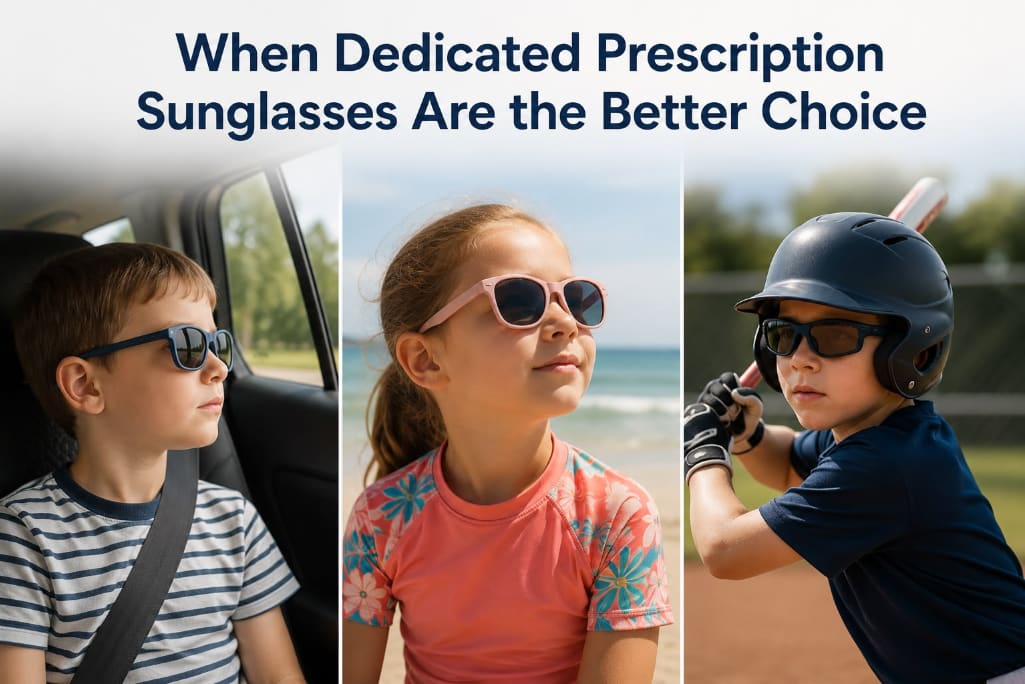
When Dedicated Prescription Sunglasses Are the Better Choice
Photochromic lenses are convenient for many children, but there are situations where a dedicated pair of sunglasses may still make sense:
- Frequent car travel in sunny conditions: Standard photochromic lenses generally don’t darken effectively behind a windshield, so they may not provide the same comfort as sunglasses during long drives.
- Long periods outdoors in bright sunlight: At the beach, on the ski slopes, or during all-day outdoor activities, some families prefer the consistent tint of prescription sunglasses rather than relying on lenses that need time to activate.
- Sports: Sports: For ball sports and other activities where eye injuries are a possibility, dedicated sports eyewear is typically the better choice. Regular frames with photochromic lenses are generally not designed to provide the same level of impact protection or even glare reduction. See: sports glasses for kids.
For a full guide to when and how to choose dedicated sunglasses: prescription sunglasses for kids.
Transitions vs. Prescription Sunglasses: At a Glance
| Category | Transitions / Photochromic | Dedicated Prescription Sunglasses |
| Convenience | One pair covers indoors and outdoors | Second pair to manage |
| UV protection | Up to 100% – typically built into material (verify with manufacturer) | 100% – built into material |
| In the car | Minimal darkening (standard lenses) | Full tint, always |
| Sustained outdoor activity | Works well – consistent activation | Better – fixed tint, no delay |
| Transition time | ~30–60 sec to darken; 2–3 min to clear | Instant – always the same |
| Hot conditions | May not reach full darkness in extreme heat | Unaffected |
| Best for | Mixed indoor/outdoor days, school use | Beach, skiing, sustained outdoor sport |
Practical Considerations When Ordering
- Compatible with polycarbonate and Trivex: Both lens materials – often recommended for children – can typically be made photochromic as well.
- Lens lifespan: Photochromic performance typically remains effective for approximately 2–3 years, after which the lenses may darken more slowly or reach a lighter maximum tint. Actual lifespan may vary based on usage and environmental factors. Lens replacement when the prescription changes will usually address this.
- Prescription updates: When a child’s prescription changes, the photochromic lenses need to be replaced along with it. Budget for this the same way you would for standard lens replacement.
- Frame compatibility: Photochromic lenses are generally available in most frame types, including the flexible TR90 frames commonly used for younger children. Availability may vary by provider.
FAQ’s
Are Transitions lenses safe for children?
Photochromic lenses are available in polycarbonate and Trivex – materials often recommended for children’s lenses – and typically include built-in UV protection. There’s generally no safety concern specific to the photochromic technology itself, but consumers should verify specific product safety certifications with manufacturers or eye care providers.
Will the lenses darken enough at school?
Outdoors, yes – standard photochromic lenses darken meaningfully in UV light. Indoors under artificial lighting, they remain clear. The transition happens automatically when the child moves between environments.
My child is in the car a lot. Will the lenses protect their eyes?
Standard photochromic lenses generally don’t darken significantly inside a car because windshield glass blocks most UV. If in-car sun protection is a priority, either a dedicated pair of prescription sunglasses or a newer photochromic lens type that responds to visible light (such as XTRActive) may be a more reliable option. Consult your eye care provider for specific recommendations.
Can photochromic lenses replace sunglasses entirely?
For most everyday situations – yes, they may be a practical substitute. For sustained outdoor activity in high UV environments, or for car journeys in sunshine, a dedicated pair of prescription sunglasses may provide more consistent coverage. Many families use photochromic lenses as the primary solution and keep a dedicated pair for specific high-exposure situations. Individual needs vary, so consult with your eye care provider for personalized advice.
My child’s lenses don’t look dark even when they’re outside. Is something wrong?
Not necessarily. Several factors affect how dark photochromic lenses get: temperature (hot conditions reduce maximum darkness), the UV intensity of the specific environment, and the age of the lenses. Most photochromic lenses darken noticeably in direct sunlight but may appear lighter in shade or on overcast days – UV still reaches the eye in those conditions, just at lower levels. If the lenses seem unusually light even in direct sun, and they’re more than 2–3 years old, the photochromic function may be declining and it’s worth checking with the prescribing optician.
Is it normal for one lens to darken faster or darker than the other?
Small differences in activation between the two lenses can occur – particularly if one lens is a different thickness or prescription strength than the other. A noticeable and consistent difference is worth mentioning to the optical provider, as it may indicate a quality issue with the specific lens. Minor variation is generally within normal range.
Do photochromic lenses work for sport?
Photochromic lenses can be used in sport, but the frame matters as much as the lens. For any ball sport or contact activity, the frame should be sports-certified – standard frames with photochromic lenses generally don’t provide adequate impact protection. Consult with your eye care provider about appropriate sports eyewear. See: sports glasses for kids.
Photochromic lenses are a practical, well-established option for many children. One pair may cover most situations. Be aware of the windshield limitation before you order; for many everyday uses, they can perform well. Consult your eye care provider to determine if photochromic lenses are right for your child.
| Disclaimer: This article is for informational purposes only and is not medical advice. The information presented is general in nature and may not apply to your individual circumstances. Consult a licensed eye care professional for personalized recommendations. Never disregard or delay professional medical advice based on this article. GlassesUSA makes no warranties regarding the information presented. Reliance is at your own risk. The eye care professional featured in this article is a paid spokesperson for GlassesUSA. |
Published July 13, 2026|Updated August 16, 2026
