
Sports Glasses for Kids: What Parents Need to Know
Updated AUG 16, 2026 • 7 min read

| Quick Answer: Regular prescription glasses are typically not designed for sports. Even if they have impact-resistant lenses, the frames themselves may not be designed to handle the bumps, collisions, and flying balls that come with many activities. If your child plays sports, dedicated sports glasses are generally the safer choice. Look for eyewear that meets the ASTM F803 safety standard, which was developed specifically for sports such as basketball, soccer, baseball, softball, tennis, racquetball, field hockey, and lacrosse. Some sports may have their own sport-specific safety requirements. Always consult with a qualified eye care professional before making a purchasing decision. |
Why You Can Trust This Guide?
Written with input from a board-certified ophthalmologist. Recommendations are based on published ASTM and AAO standards – not just general advice about ‘protective eyewear’.
Introduction
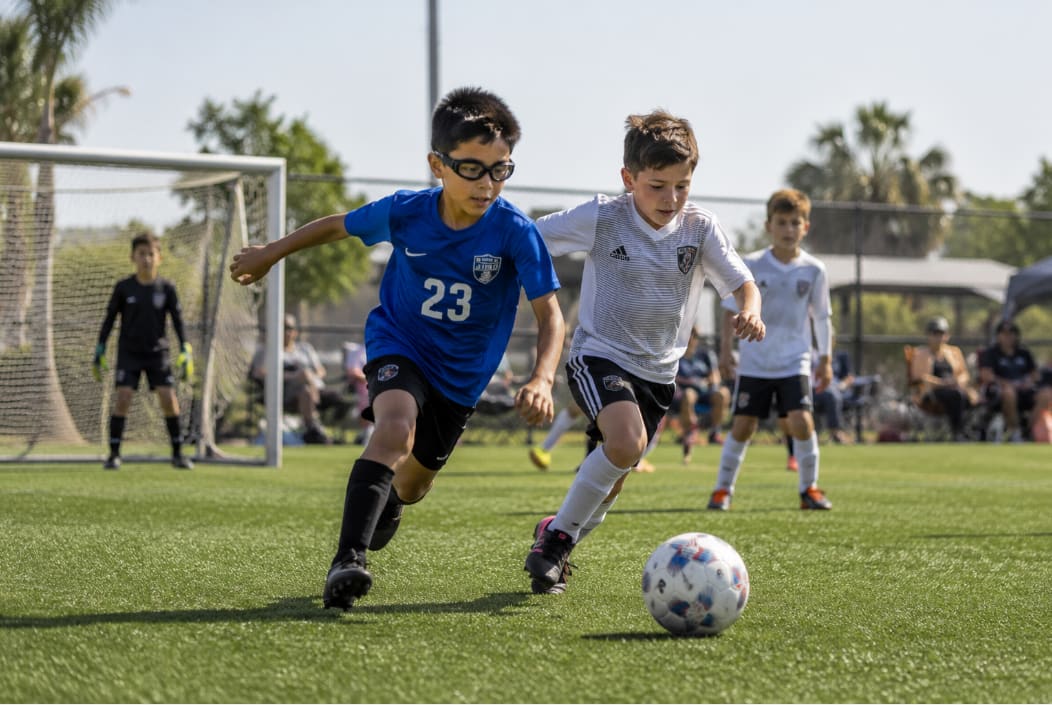
Many parents assume impact-resistant lenses, like polycarbonate lenses, make regular glasses safe for sport. The lens may resist impact – but the frame may not be designed to absorb or redirect sports-level forces. A regular frame can potentially shatter, deform, or drive a lens toward the eye and face on impact, which may cause injury,.. For many parents, that becomes a concern the first time a child takes a ball to the face during PE, practice, or a game. Sports-certified eyewear is built for that scenario – it’s a different category of product, not just a stronger version of regular glasses.
If you’re still working through the broader glasses decision, our complete parent’s guide to children’s glasses covers the full process. This article focuses specifically on sport.
Why Regular Glasses Aren’t Enough for Sport?
There’s a common misunderstanding worth clearing up: meeting ANSI Z80.3 (the standard for regular prescription glasses) does not mean a frame is suitable for use in sports . The American Academy of Ophthalmology has noted that regular prescription eyewear – including safety glasses rated to ANSI Z87.1, which is the occupational safety standard – may not provide adequate eye-injury prevention in sports participation.
| Clinical note: many serious eye injuries in children’s sports may be preventable – and the right eyewear is one of the simplest ways to help reduce that risk. The frames matter as much as the lenses. A polycarbonate lens in a regular frame can still cause injury on impact, because the frame itself may not be built to manage that force. Sports-certified frames are designed to stay intact and help protect the whole orbital area, not just the lens. |
The practical implication: if your child needs vision correction for sports, there are two main options to consider: prescription sports glasses or sports goggles worn over contact lenses. Regular prescription glasses – even with premium lenses – are typically not designed to provide the same level of protection. Consult with an eye care professional to determine the best option for your child’s specific needs.
The ASTM F803 Standard: What It Means in Practice
The ASTM F803 standard , , developed by ASTM International and endorsed by both the American Academy of Ophthalmology and the American Academy of Pediatrics, defines testing requirements for protective sports eyewear. Certification requires the frame and lens to survive high-velocity impact from sport-specific projectiles – a baseball at 55 mph for youth players, a racquetball at 90 mph – at multiple angles, without the lens contacting the eye during testing.
What ASTM F803 covers: basketball, soccer, baseball (fielders), racquet sports, field hockey, women’s lacrosse, and volleyball. Other sports have their own standards – see the reference table below.
| The key thing to look for: the ASTM certification mark on the frame itself. A frame that claims to be ‘sports-rated’ without this marking hasn’t been independently certified to the standard. |
Sport-by-Sport Reference
Different sports have different standards. Use this table to identify the right type of protection for your child’s activity:
| Sport | Eye Injury Risk | Applicable Standard | Frame Type |
| Basketball, soccer, baseball, racquet sports, field hockey, lacrosse | High | ASTM F803 | Sports goggles / wrap frame |
| Youth baseball (batters/base runners) | High | ASTM F910 | Helmet with face guard |
| Ice hockey | High | ASTM F513 | Helmet with certified cage/visor |
| Skiing / snowboarding | Moderate–high | ASTM F659 | Ski goggles with UV protection |
| Swimming | Low (chemical/UV) | No impact standard | Prescription swim goggles |
Note: For sports not listed here – martial arts, cycling, gymnastics – consult with an eye care professional about appropriate protection. Not every activity has a specific standard, but that doesn’t mean protection isn’t needed.
What to Look for When Choosing Sports Glasses
Choosing sports glasses doesn’t have to be complicated. Once you’ve found eyewear designed and certified for your child’s sport, there are just a few key features worth checking – most reputable sports frames will meet them.
Frame Design
Sports frames are built differently from everyday frames – and that difference is the point. Look for:
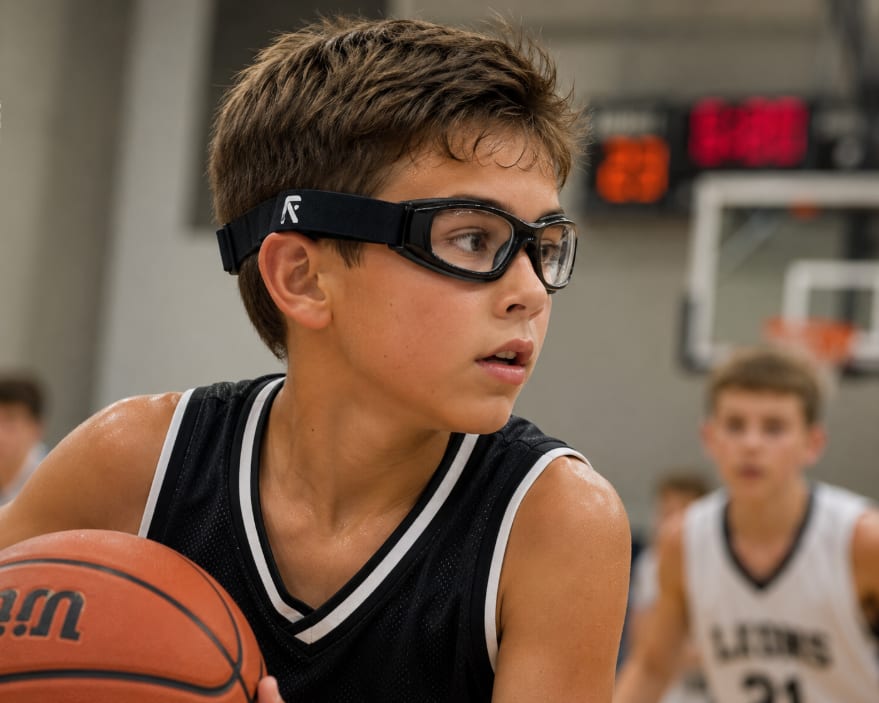
- Wraparound or close-fitting design: Reduces the gap between the frame and the face. A ball that clips the side of a regular frame can still reach the eye – a wrap frame reduces that exposure significantly.
- Padded or cushioned bridge and temples: Absorbs impact force and reduces the chance of the frame itself causing injury. Most quality sports frames include foam or rubber padding around the orbital area.
- Strap or elastic retention system: Helps keep the glasses in place while running, jumping, and changing direction. For younger children especially, a secure fit is essential.
- ASTM certification marking: Check that the eyewear meets the appropriate ASTM safety standard for the sport your child plays.
Lens Material
For sports glasses, polycarbonate or Trivex lenses are generally the preferred lens materials. Both are lightweight, impact-resistant, and commonly used in certified sports glasses. (The ASTM standard specifically requires polycarbonate or Trivex lenses).
For a full explanation of why these materials are often recommended for children, see: polycarbonate lenses for kids.
Prescription Considerations
If your child wears glasses every day, prescription sports glasses are available for most prescriptions. A few things worth knowing:
- Lens thickness at the edges: ASTM F803-certified frames require a minimum of 3mm centre lens thickness. This is thicker than standard prescription lenses, which affects how higher prescriptions are handled.
- Higher prescriptions: Strong prescriptions may have additional fitting considerations. An experienced optical provider can help determine the best option.
- Over-goggles: Some parents opt for sports goggles designed to be worn over regular glasses. These can be used in some situations, though dedicated prescription sports glasses generally provide better fit, comfort and protection.
What About School PE and Casual Play?
Parents often wonder whether sports glasses are only necessary for organized sports, or if they also make sense for school PE, backyard games, and casual play with friends.
The honest answer: the risk doesn’t disappear just because the activity isn’t competitive. A ball kicked during PE can hit just as hard as one kicked during a league match. The main difference is how often a child is exposed to that risk. A child who plays football twice a week in an organised setting has a different risk profile than one who occasionally kicks a ball around.
| As a general rule, if a ball can reach the face at speed – football, basketball, lacrosse, pickleball,, tennis, etc – protective eyewear is worth considering, whether the setting is competitive or casual. If there’s a ball involved, assume there’s eye risk. |
Frequently Asked Questions
Can my child just wear their regular glasses for sport?
Regular prescription glasses are generally not designed for sport and may not provide adequate protection against impact. This applies even to glasses with polycarbonate lenses – the concern relates to the frame construction and certification, not just the lens material. For sports where eye injuries are a possibility, dedicated sports eyewear is typically a safer choice. Consult with an eye care professional for personalized recommendations.
My child’s sport doesn’t require eye protection. Should I still get sports glasses?
Many youth sport leagues don’t mandate eye protection – but the absence of a rule doesn’t mean the absence of risk. The AAO notes that many youth sports leagues don’t require protective eyewear despite potential injury risks. Ultimately, it’s up to parents to decide what’s appropriate for their child. If you’re unsure, an eye care professional can help you evaluate the potential risks and benefits for your child’s specific sport and circumstances
How do I know if sports glasses are ASTM certified?
Look for the ASTM marking stamped on the frame itself – typically inside the temple arm or on the frame front. The specific standard will be indicated (F803, F910, etc.). Certified sports eyewear should display the relevant ASTM marking on the frame. If you can’t find it, check with the manufacturer or retailer before purchasing.
Do sports glasses need to be replaced after an impact?
It is generally recommended to inspect the eyewear after any significant impact. . Even if it looks fine after a hit, the frame may not perform the same way on a subsequent impact. Replace it if there’s any sign of damage or concern. The same principle applies to cycling helmets after a fall. When in doubt, consult with an eye care professional or the manufacturer.
Will my child actually wear sports glasses?
Often, yes – if they’re comfortable. A frame that pinches, slips, or feels awkward during play probably won’t stay on for long. That’s why proper fit matters just as much as protection. It also helps to involve your child in choosing the style. Sports glasses come in a range of designs, and children are often more enthusiastic about wearing something they helped pick out. For older kids, it can help to think of sports glasses as part of their equipment, just like shin guards or a mouthguard.
What’s the difference between sports goggles and sports glasses?
Sports goggles typically feature a sealed or semi-sealed design that fits close to the face, often with foam padding and a strap system – designed for higher-impact or dusty environments. Sports glasses have a more open frame design and are more commonly used for ball sports. Both can meet ASTM F803 certification; the right choice depends on the specific sport and the child’s preference for comfort.
The goal is simple: a child who needs glasses shouldn’t have to choose between seeing clearly and staying protected during sports. The right pair of sports glasses helps them do both.
| Disclaimer: This article is for informational purposes only and is not medical advice. The information presented is general in nature and may not apply to your individual circumstances. Consult a licensed eye care professional for personalized recommendations. Never disregard or delay professional medical advice based on this article. GlassesUSA makes no warranties regarding the information presented. Reliance is at your own risk. The eye care professional featured in this article is a paid spokesperson for GlassesUSA. All images in this article were generated using artificial intelligence (AI). |
Published July 8, 2026|Updated August 16, 2026
