
Eye Safety for Kids: Why Polycarbonate Lenses Matter
Updated AUG 16, 2026 • 5 min read

| Quick Answer: Polycarbonate and Trivex are the two lens materials most widely recommended for children’s glasses. Both offer significantly higher impact resistance than standard plastic (CR-39), and both include built-in UV protection as part of the material itself – no additional coating required Polycarbonate is widely available and slightly thinner; while Trivex is a bit lighter and offers better optical clarity. For most children, either material is a strong choice for everyday eyewear, prescription or not. |
Why You Can Trust This Guide?
This guide was written with input from a board-certified ophthalmologist and draws on established optical dispensing practice. The material comparisons are based on documented properties of each lens material – not marketing claims.
Introduction
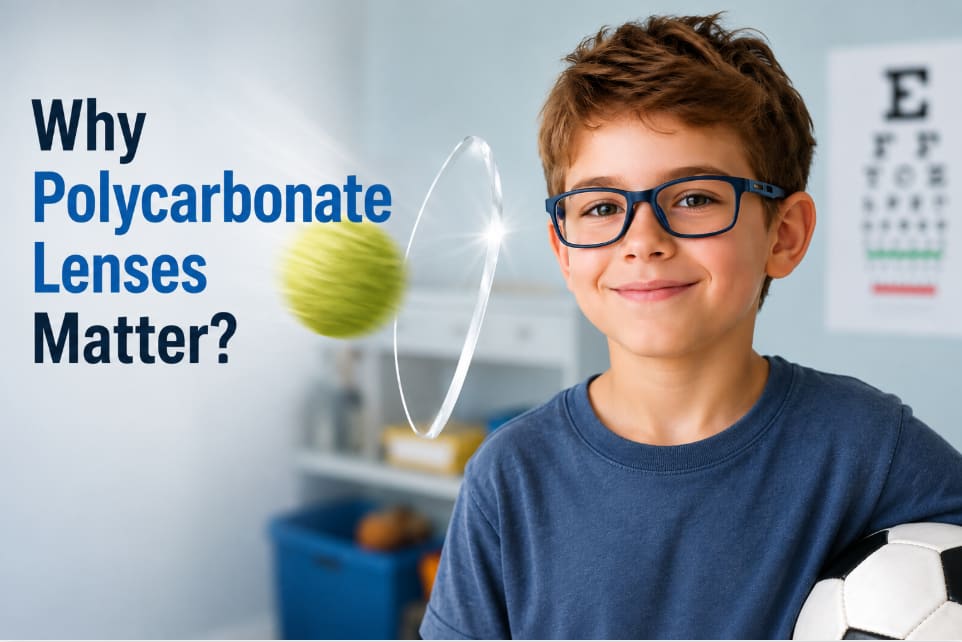
When parents order glasses for a child, the lens material is easy to overlook. The frame gets most of the attention – the style, the color, whether they’ll survive the school run. But the lens is where the correction actually happens, and for children it’s worth a few extra minutes of thought.
Kids are more physically active than adults, spend more time outdoors, and are more likely to drop or sit on their glasses. Those facts alone explain why most eye care professionals tend to recommend a different lens material for children than for adults. If you’re still at the start of the glasses selection process, our complete kids’ eyewear guide covers the full picture, while this article focuses on lens material specifically.
Why Standard Plastic Isn’t Typically Recommended for Children
Standard plastic lenses – most commonly known as CR-39 – are the workhorse of the optical industry for good reason. They’re optically excellent and well-suited to most adult prescriptions. For children, though, two practical factors make them a less obvious first choice:
- Impact resistance: CR-39 lenses offer better impact resistance than glass, but significantly less than polycarbonate or Trivex. Under a meaningful impact, CR-39 can crack. For a child who plays sport, drops their glasses regularly, or is simply active – this is a relevant consideration.
- UV protection: CR-39 does not inherently block UV radiation and requires a coating to be added. Polycarbonate lenses, on the other hand, block UV rays within the material itself, without an additional coating. The American Academy of Ophthalmology confirms that polycarbonate lenses block UV rays without an additional coating, unlike standard plastic lenses.
None of this makes CR-39 a poor material – for an adult choosing glasses for office work, it’s a perfectly sensible option. For a child who plays sports, uses their glasses outdoors, and occasionally forgets they’re wearing them, the decision is different. That’s the reason most eye care professionals start with polycarbonate or Trivex for children’s prescriptions rather than standard plastic.
| Clinical note – Norman Saffra MD FAAO: During childhood, the eye is still developing – both structurally and in terms of UV tolerance. The crystalline lens of a young eye transmits more UV light than an adult’s, and children tend to spend more time outdoors. Choosing a lens material that addresses both factors without relying on added coatings is a straightforward approach for pediatric eyewear. |
Polycarbonate: The Widely Used Standard
What It Is
Polycarbonate is a thermoplastic material that was originally developed for industrial and safety applications – including helmet visors and safety shields – before being adapted for optical use. It has been widely used in children’s eyewear and sports glasses for decades.
Key Properties
- Impact resistance: Polycarbonate is significantly more impact-resistant than standard plastic. It absorbs impact energy by flexing slightly rather than cracking – a property that makes it well-suited to environments where accidental impact is a realistic possibility.
- UV protection: UV absorption is built into the material chemistry of polycarbonate. It blocks UV radiation up to 380–400 nm without the need for an additional coating.
- Weight and thickness: Polycarbonate has a refractive index of approximately 1.586, which allows for thinner lenses than CR-39, particularly in stronger prescriptions. It’s also lighter than standard plastic.
- Availability: Polycarbonate is available in a wide range of prescription lens designs, including single vision, bifocal, and progressive lenses. It’s also compatible with most lens treatments, tints, and photochromic coatings. For active children, it’s also the lens material of choice in dedicated sports glasses for kids.
The One Tradeoff Worth Knowing
Polycarbonate has a lower Abbe value (approximately 30) than most other lens materials. The Abbe value is a measure of how well a material handles chromatic dispersion – essentially, how cleanly it separates different wavelengths of light. A lower Abbe value means slightly more color fringing at the periphery of the lens.
In practice: most children won’t notice any difference in everyday wear – particularly with low to moderate prescriptions. It’s worth being aware of, but for most kids it’s not going to be an issue.
| Good to know: Polycarbonate’s surface is softer than CR-39, which makes it more susceptible to surface scratches. A scratch-resistant coating is typically applied during manufacturing and is standard on most polycarbonate lenses – it’s worth confirming this is included when ordering. |
In practice: always confirm a scratch-resistant coating is included when ordering polycarbonate lenses for a child. It usually is – but worth checking.
Trivex: The Alternative Worth Knowing About
What It Is
Trivex was introduced in 2001 by PPG Industries, originally developed from materials used in military visual armor applications. It’s a urethane-based material produced through a cast-molding process – slower than polycarbonate’s injection molding, which contributes to its better optical properties.
How It Compares to Polycarbonate
- Impact resistance: Trivex and polycarbonate offer comparable impact resistance for most practical purposes. Both are significantly stronger than CR-39.
- Optical clarity: Trivex has a higher Abbe value (approximately 43–45 vs. polycarbonate’s ~30), which means less chromatic aberration and sharper peripheral vision. For children with higher prescriptions or those who are sensitive to visual quality, this can be a meaningful difference. In practical terms, most children will see well with either material, but Trivex may provide slightly crisper vision, especially in stronger prescriptions.
- Weight: Trivex is slightly lighter than polycarbonate by density (specific gravity ~1.11 vs. ~1.20). In practice, the weight difference is small – but for frames worn all day, small differences in weight can matter for comfort.
- Thickness: Polycarbonate lenses are approximately 10% thinner than Trivex for the same prescription, due to its higher refractive index.
- Scratch resistance: Trivex is generally considered somewhat more scratch-resistant than polycarbonate – a practical difference when glasses are handled by a child. Its higher tensile strength also makes it a better fit for rimless frames, where drilling through the lens creates a stress point. See our guide on frame materials for kids for more on frame types.
- Availability and cost: Polycarbonate is more widely available and typically less expensive. Trivex is worth asking about, but not all providers offer it across all lens designs.
| Polycarbonate vs. Trivex – the short version: Both are appropriate choices for children’s eyewear. Polycarbonate is the more widely available and slightly thinner option. Trivex offers better optical clarity and is marginally lighter, but is less universally available and typically costs more. The right choice depends on the specific prescription, what the child’s eye care provider recommends, and what’s available at the point of ordering. |
In practice: if polycarbonate is what’s available and it suits the prescription, it’s an excellent choice. If your provider offers Trivex – particularly for a child who’s sensitive to visual quality or has a stronger prescription – it’s worth asking about.
Lens Material Comparison at a Glance
The table below highlights the key differences between polycarbonate and Trivex lenses. While both are excellent choices for children’s eyewear, each material has its own strengths.
| Material | Impact Resistance | UV Protection | Optical Clarity (Abbe) | Weight | Recommended for Kids? |
| Polycarbonate | Very high | Built-in | ~30 (lower) | Light | Yes – widely used |
| Trivex | Very high | Built-in | 43–45 (higher) | Very light | Yes – strong alternative |
| CR-39 (standard plastic) | Moderate | Coating required | 58 (high) | Medium | Not typically recommended |
| Glass | Low | Varies | 58+ (high) | Heavy | Not recommended |
UV Protection: Why It Matters for Children Specifically
UV protection is often thought of as a sunglasses concern, but it matters for everyday prescription glasses too – particularly for children. Kids spend more time outdoors than adults, and a young eye lets more UV pass through than an adult’s.
The American Academy of Ophthalmology recommends safety lenses made from polycarbonate for children’s eyewear, noting specifically that polycarbonate lenses should be at least 2 mm thick for daily wear.
With polycarbonate or Trivex, UV protection is simply part of the lens – no extra coating needed, and nothing that degrades over time.
Starting UV protection early – and in a form that doesn’t depend on an additional coating that can wear away – is a straightforward, low-effort decision with long-term benefit. With polycarbonate or Trivex, it’s simply built in. For children who spend significant time outdoors, prescription sunglasses for kids offer dedicated UV coverage alongside the correction.
Both polycarbonate and Trivex absorb UV within the material itself – up to 380–400 nm. This protection doesn’t wear away with surface scratches or cleaning. CR-39 lenses do not block UV without an added UV-blocking coating.
Coatings: What’s Worth Adding
Lens materials and coatings each play a different role. The material provides the foundation, including impact resistance and UV protection, while coatings add features that can improve day-to-day wear. Knowing the difference can make it easier to choose the options that matter most for your child.
- Scratch-resistant coating: Polycarbonate’s surface scratches more easily than some other materials. A scratch-resistant coating is typically applied during manufacturing – but still worth confirming when purchasing.
- Anti-reflective (AR) coating: Reduces surface reflections – useful for children who spend time under fluorescent lighting at school or in front of screens.
- Blue light filtering: An optional coating that filters a portion of the blue light spectrum from screens. The research on its clinical benefit is still developing, and conflicting opinions exist as to the actual benefits – at this time it’s a comfort option, not a safety requirement, and doesn’t replace UV protection.
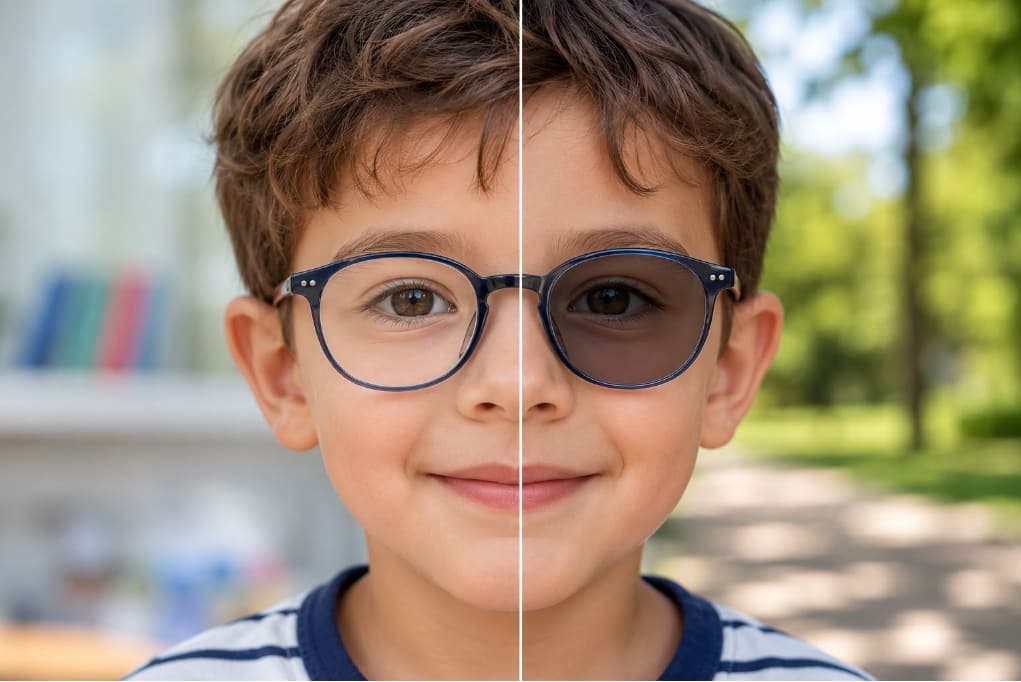
- Photochromic lenses (Transitions): Causes the lens to darken in UV light and clear indoors. Compatible with both polycarbonate and Trivex. For a full overview of how these work for children – including the car windshield limitation – see our guide to Transitions lenses for kids.
For most parents, this decision comes down to availability and comfort rather than optical differences. Polycarbonate is widely available, well-understood, and suitable for the vast majority of children’s prescriptions. Trivex is worth asking about if optical clarity is a priority. Either way, the lens material choice pairs nicely with frame material and how the frame fits to determine the overall quality of the finished pair.
FAQ’s
Is polycarbonate required for children’s glasses?
No. However, most eye care professionals recommend polycarbonate as the starting point for children’s lenses, and it’s widely considered the sensible default option for pediatric eyewear. Trivex is an equally suitable alternative. The main reason standard plastic (CR-39) is less commonly recommended for children is that it is not as impact-resistant as polycarbonate or Trivex.
My child’s glasses came with CR-39 lenses. Should I replace them?
Not necessarily. Many children wear CR-39 lenses without issues. Whether it’s worth switching depends on factors such as your child’s age, activity level, and prescription. If you’re unsure, it’s worth discussing with your child’s eye care provider. For a broader look at choosing eyewear for kids, see our complete guide to children’s glasses.
What does Abbe value actually mean?
The Abbe value measures how well a lens material manages chromatic dispersion, which can sometimes cause subtle color fringing around the edges of vision. . A higher Abbe value means less dispersion and clearer peripheral optics. CR-39 and glass have Abbe values in the high 50s; Trivex is around 43–45; polycarbonate is approximately 30. In everyday use, most children won’t notice a significant difference, especially with lower prescriptions.
Do polycarbonate lenses need a UV coating?
No. UV protection is built into the material chemistry of polycarbonate (and Trivex), not applied as a surface treatment. This means the UV protection doesn’t degrade with use or surface scratches.
Are Trivex lenses available in progressive or bifocal designs?
Yes. Trivex can be made in progressive, bifocal, and other prescription lens designs, although the available options may be more limited than with polycarbonate. Availability varies by provider, so it’s worth checking before you order if Trivex is your preferred lens material.
| Disclaimer: This article is for informational purposes only and is not medical advice. The information presented is general in nature and may not apply to your individual circumstances. Consult a licensed eye care professional for personalized recommendations. Never disregard or delay professional medical advice based on this article. GlassesUSA makes no warranties regarding the information presented. Reliance is at your own risk. The eye care professional featured in this article is a paid spokesperson for GlassesUSA. All images in this article were generated using artificial intelligence (AI). |
Published July 13, 2026|Updated August 16, 2026
