
Best Eyewear for Toddlers (Ages 1–4): A Practical Parent’s Guide
Updated AUG 13, 2026 • 8 min read

| Quick Answer: Toddler eyewear is its own category – not just smaller children’s glasses. The priorities are retention (keeping them on), durability (holding up to daily wear), and a fit that works on a face that hasn’t fully developed its bridge yet. The right frame for a toddler uses a flexible material like TR90, cable temples or a strap harness, a low or adjustable bridge, and polycarbonate or Trivex lenses. |
Why You Can Trust This Guide?
Written with input from a board-certified ophthalmologist. Frame feature recommendations are based on recognized optometric practices for infant and toddler eyewear fitting.
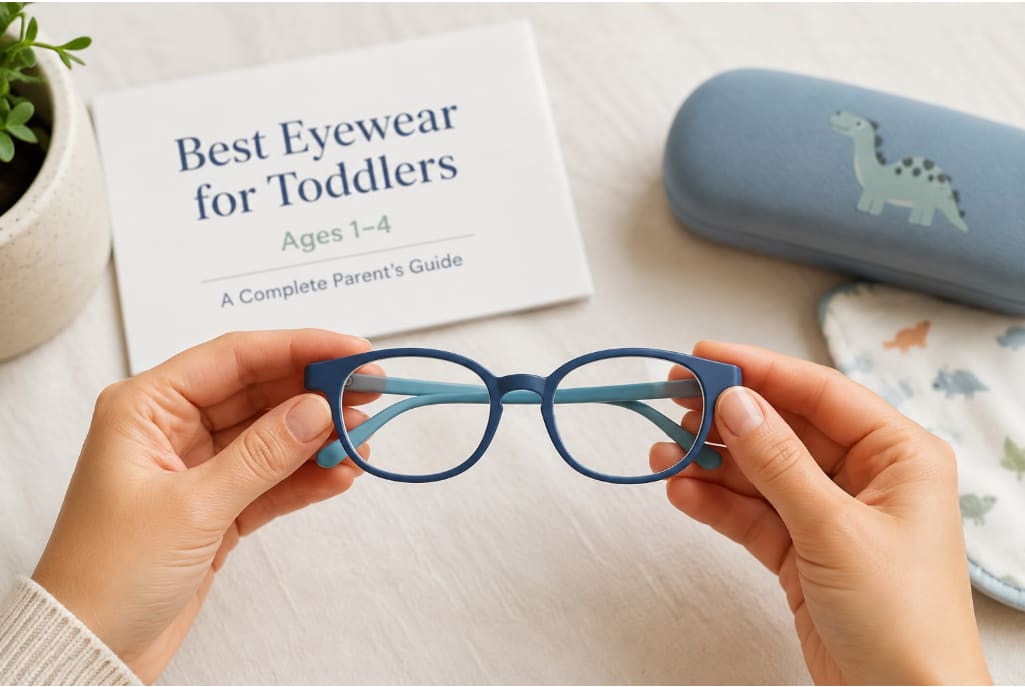
Introduction
Getting eyeglasses for a toddler is one of those experiences that no parenting book quite prepares you for. It can be a stressful experience for both child and caregiver. A toddler getting his first pair of glasses, has no idea why something keeps appearing on their face and looks for every reason to take it off.
The good news: toddler eyewear has improved significantly. There are frames designed specifically for this age group – with the right materials, the right retention features, and the right proportions for a young face. Knowing what to look for makes the difference between glasses that get worn and glasses that spend most of their time on the floor.
This guide covers everything specific to ages 1–4. For the broader picture of children’s eyewear, see our complete parent’s guide to children’s glasses.
Why Toddlers Are Their Own Category?
Standard children’s frames – even those labeled for young children – are often designed with a 5-year-old in mind, not a two-year-old. The facial structure of children change dramatically as a child grows and gets older. These differences in facial structure matter when it comes to getting a proper fitting frame. ,There are 4 main differences:
- Flatter nasal bridge: A toddler’s nasal bridge is significantly flatter than an older child’s or adult’s. A standard bridge may sit too high, causing the frame to tilt or slide down the face.
- Lower-set ears: Temple length and curvature need to match a toddler’s smaller head and facial proportions. When they don’t, the glasses may slip or sit unevenly.
- Smaller overall face width: Even a slightly oversized frame can slip, shift, or fit unreliably on a toddler’s face.
- Developing skull bones: Soft flexible materials avoid pressure on skull bones that are still developing in the youngest children, particularly those under 18 months.
| Clinical note – Norman Saffra MD FAAO: For very young children – infants and early toddlers – the frame fit needs to be assessed with particular care. A frame that seems ‘close enough’ on a two-year-old will not perform the same way as one that’s actually fitted correctly. If in doubt, an in-person fitting with an optician who has experience with paediatric eyewear is time well spent. |
What to Look for: The Toddler Eyewear Checklist
Use this checklist when comparing toddler frames:
| Feature | Why It Matters | What to Look For |
| Frame material | Durability, comfort, and feel | TR90 or soft flexible plastic – not rigid acetate or metal |
| Temple type | Helps keep glasses in place | Cable temples (curl around ear) or strap/harness system |
| Bridge fit | Toddlers have flatter nasal bridges | Low or adjustable bridge – avoid high fixed bridges |
| Frame width | Smaller faces need a precise fit | Lens width ~40–46 mm for ages 1–4 |
| Lens material | Safety and UV protection | Polycarbonate or Trivex – not standard plastic |
| Hinge type | Reduces breakage at stress point | Spring hinges or hingeless/cable design |
Retention: The Most Important Feature Nobody Talks About
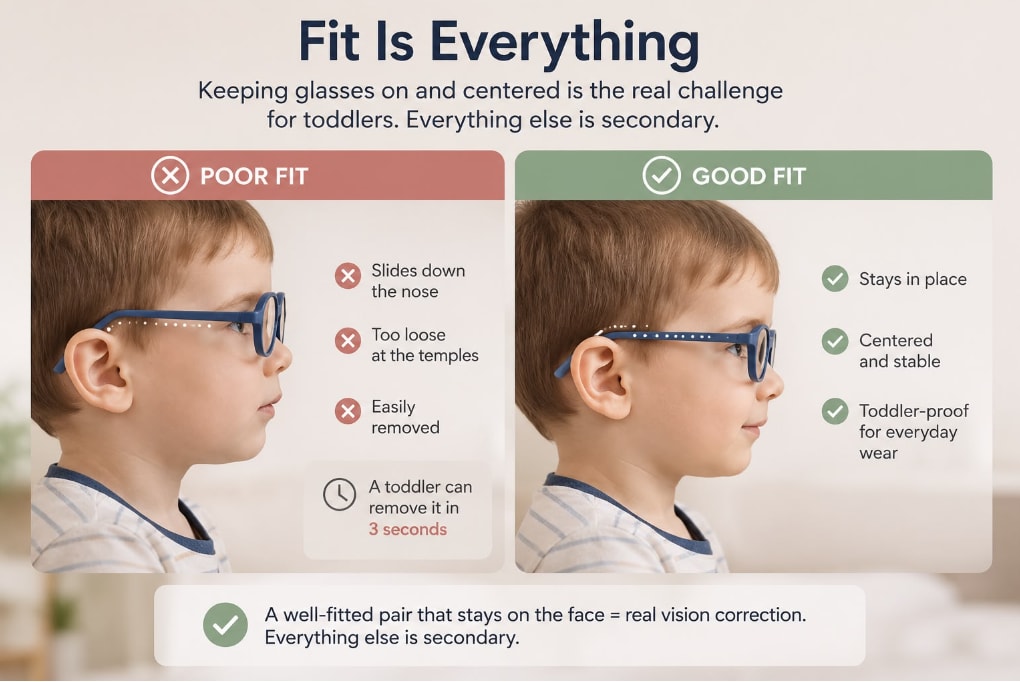
Keeping the glasses on the child’s face and properly centered is the challenge that defines toddler eyewear. Everything else – material, lens quality, fit accuracy – is secondary to whether the glasses stay on the face. A perfectly fitted pair that a toddler can remove in three seconds serves no useful purpose.
Cable Temples
Cable temples curve fully around the ear rather than resting against the side of the head. They provide a more secure fit than standard temples because they wrap around the ear instead of simply resting against the side of the head. They’re harder for a toddler to pull off, and they keep the frame in position even during active movement.
The sizing of cable temples matters, as a cable temple that’s too short will pull the ear forward uncomfortably; one that’s too long will slip around. An optician can adjust the bend for a more personalized fit.
Strap and Harness Systems
A strap that runs around the back of the head provides the most secure way to keep glasses in place – particularly useful for younger children or those who are especially determined to remove their glasses. Most toddler-specific frames either include a strap or are designed to be compatible with one.
Some families use both – cable temples for everyday wear and a strap for outdoor play, sports, or other times when keeping glasses in place is more challenging.
| Safety note: Choose straps specifically designed for infants and toddlers. Avoid styles with small parts that could detach, or long cords that pose a choking or strangulation risk. Age-appropriate products should be clearly labeled for infant or toddler use. |
Frame Material for Toddlers
TR90 flexible nylon is the standard recommendation for this age group. It bends under impact and returns to shape, which matters a great deal when the frame is regularly dropped, sat on, or pulled at. It’s also lightweight, which reduces pressure on a young face, and generally hypoallergenic. For a full comparison of frame materials across all age groups: frame materials for kids
Rigid acetate and standard metal are not well-suited to toddlers. Acetate can crack under the kind of stress toddler glasses routinely experience. Metal can bend permanently and has edges that may pose a concern for very young children. Spring hinges improve the durability of metal frames significantly, but TR90 remains the more practical starting point for ages 1–4.
Lens Material
Polycarbonate and Trivex are the recommended lens materials for toddlers. They’re the preferred choice for all children, but the benefits are especially important at this age, when drops, bumps, and rough handling are part of everyday life. Standard plastic (CR-39) is not recommended. For a full explanation: polycarbonate lenses for kids.
Both polycarbonate and Trivex include built-in UV protection – relevant for toddlers who spend time outdoors, since UV exposure begins accumulating from an early age.
Sizing: Getting the Numbers Right
Toddler frames have their own size range. As a general guide – individual variation is normal, and these should be used as a starting point rather than a rule:
- Lens width: Approximately 40–46 mm for ages 1–4. Younger toddlers will typically be at the lower end of this range.
- Bridge width: Approximately 14–16 mm. Low-bridge designs are specifically built for the flatter nasal bridges common in this age group.
- Temple length: Approximately 115–125 mm. Cable temples are measured differently from standard temples – length matters less than the correct bend position behind the ear.
| The fit check that matters most for toddlers: Put the glasses on and watch what happens when the child looks down. If the frame drops forward off the nose, the bridge is too wide or the retention system isn’t doing its job. This is the single most useful practical test. |
For a complete fit guide including the three key measurements and handling common problems: how kids’ glasses should fit.
Keeping Glasses on a Toddler
Even with the right frame, keeping glasses on a toddler consistently takes effort. This is normal, and gets easier with time.
- Start as early as possible after prescription. The longer glasses are delayed after the prescription is issued, the more established the habit of not wearing them becomes.
- Put them on at the same moment every morning. Consistency builds habit. ‘Glasses go on when we wake up’ , same as shoes go on before going outside.
- Use immediate distraction. Hand the child something engaging the moment the glasses go on. The goal is to get past the initial removal reflex.
- Consistency across all settings matters. A child who wears their glasses at home but not at nursery or with grandparents may take longer to adapt than one who wears them throughout the day. Make sure everyone involved in their care understands when and how the glasses should be worn.
- Don’t turn it into a confrontation. Calm and matter-of-fact works better than insistent. The glasses go on – that’s just what happens.
For more detailed age-specific strategies, including what to do when a toddler really won’t cooperate: encouraging your child to wear their glasses.
Online Ordering vs. In-Person Fitting for Toddlers
For most children’s prescriptions, online ordering is a practical and reliable option. For toddlers – particularly children under 3, or those with more complex prescriptions – an in-person fitting is worth considering.
The reason is straightforward: toddler facial proportions vary more, and there’s less room for error when it comes to fit. An optician who fits toddler glasses regularly can spot details that are difficult to assess from measurements alone – the ideal bend for cable temples, whether a bridge sits properly on a child’s nose, and whether the frame needs adjustment before it leaves the office.
This doesn’t mean online ordering (especially for a spare pair) is wrong for toddlers – many families order online successfully. It simply means that for the youngest children, an in-person fitting often leads to a better fit from the start when it’s available and convenient.
| Practical tip: If ordering online, look for providers that include a generous adjustment or exchange policy specifically for children’s frames. A frame that doesn’t fit correctly on arrival needs to be addressed – not worn as-is. |
FAQ’s
My toddler was just prescribed glasses. Where do I even start?
Start with the frame features in the checklist above – TR90 material, cable temples or strap harness, low bridge. Then focus on fit: the frame should sit across the face without touching the cheeks, the bridge should sit comfortably on the nose without the frame tilting, and the temples should not be pulling the ears forward. If you’re unsure, book a fitting with an optician who has experience with toddler eyewear.
My toddler keeps pulling their glasses off. Is this normal?
Yes – completely. Toddlers remove glasses reflexively because it’s a new sensation. It’s not a sign the prescription is wrong or the glasses don’t fit. Consistency and distraction are the most reliable tools. Most toddlers adapt within a few weeks to a few months with consistent encouragement. If removal is constant and nothing is working, check fit first – a frame that’s uncomfortable will be taken off more persistently.
Do toddler glasses need to be replaced often?
Frame replacement for toddlers tends to happen more frequently than for older children – both because faces are changing quickly and because toddler glasses take more physical punishment. Prescription changes may also require new lenses within a year. Budget for more frequent updates than you might expect, and look for frames at a price point that makes this realistic.
Can I order toddler glasses online?
Yes, with care. Make sure you have accurate measurements, understand the return and adjustment policy, and make sure the lenses are polycarbonate or Trivex. For children under 2 or those with more complex prescriptions, an in-person fitting gives you more control over the initial outcome – but online ordering is a practical option for many families.
What if the toddler’s glasses keep sliding down?
This is usually caused by one of two things: the bridge is too wide for the child’s nose, or the temples or strap aren’t keeping the glasses securely in place. Both are fixable. An optician can adjust the bridge or nose pads, and can advise on whether the retention system needs to change. Don’t just push the glasses back up repeatedly and hope for the best. For troubleshooting slide downs: how kids’ glasses should fit.
| Disclaimer: This article is for informational purposes only and is not medical advice. The information presented is general in nature and may not apply to your individual circumstances. Consult a licensed eye care professional for personalized recommendations. Never disregard or delay professional medical advice based on this article. GlassesUSA makes no warranties regarding the information presented. Reliance is at your own risk. The eye care professional featured in this article is a paid spokesperson for GlassesUSA. |
Published July 13, 2026|Updated August 13, 2026
