
Prescription Sunglasses for Kids: What Parents Need to Know
Updated AUG 16, 2026 • 6 min read

| Quick Answer: Children who wear prescription glasses need UV protection outdoors just as much as non-prescription wearers – arguably more, because a child’s eye transmits more UV light than an adult’s. The main options are dedicated prescription sunglasses, photochromic (Transitions) lenses, and clip-ons. For sustained outdoor activity – beach days, skiing, extended outdoor sport – dedicated prescription sunglasses with a wrap-style frame provide the most comprehensive protection. |
Why You Can Trust This Guide?
Written with input from a board-certified ophthalmologist. UV recommendations are grounded in published guidance from the American Academy of Ophthalmology and the American Academy of Pediatrics.
Introduction
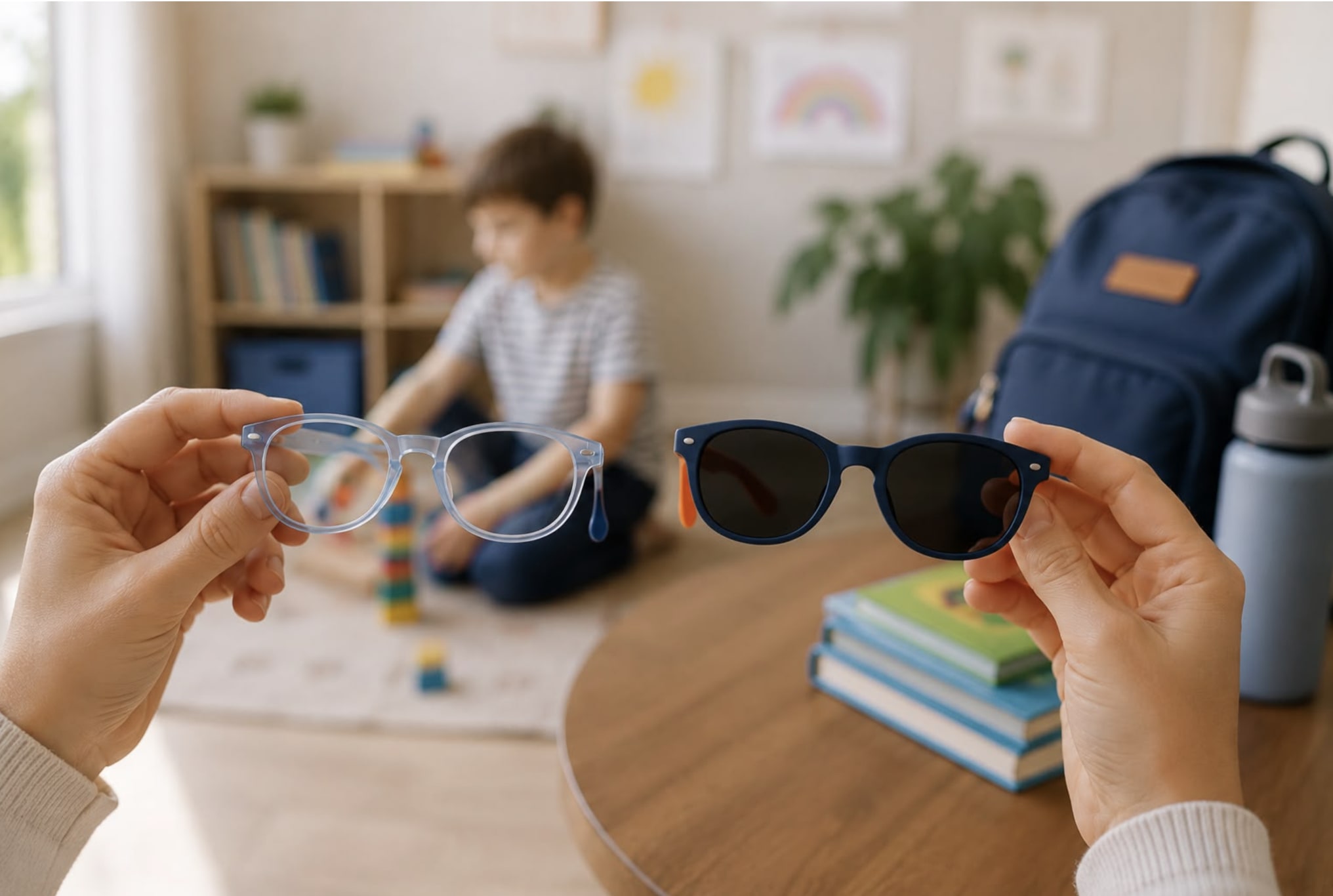
Most parents think about sunglasses as something their child wears when it’s bright outside. That’s not wrong – but for a child who already wears prescription glasses, the question gets slightly more complicated. Regular prescription glasses don’t provide sun protection. And asking a child to swap between two pairs of glasses is easier said than done.
This guide covers why UV protection matters specifically for children, what the practical options are, and how to choose. If you’re also considering photochromic lenses as an alternative, see: Transitions lenses for kids – this article focuses on dedicated sunglasses and when they’re the better choice.
Which Option Is Right for Your Child?
The decision is less about convenience and more about the consistency of UV exposure in your child’s daily routine. Use this as a starting point:
| Primary Situation | Recommended Option | Why |
| School + mixed indoor/outdoor days | Transitions / photochromic lenses | One pair, adapts automatically |
| Beach, skiing, extended outdoor activity | Dedicated prescription sunglasses | Consistent tint, no activation delay |
| Regular car journeys in sunshine | Dedicated prescription sunglasses | Photochromic lenses don’t activate behind windshields |
| Active outdoor sport | Prescription sports sunglasses (ASTM-rated) | Impact protection + UV – see sports glasses guide |
| Occasional use / budget option | Clip-on sunglasses | Lower cost, manageable for infrequent use |
Why UV Protection Matters More for Children
The American Academy of Ophthalmology notes that UV exposure is cumulative over a lifetime, and is a known risk factor for cataracts and other eye conditions. On top of that, children typically spend more time outdoors than adults, and the crystalline lens of a young eye lets more UV through to the retina than an adult’s does.
| Clinical note – Norman Saffra MD FAAO: UV damage to the eye is silent and painless in the short term – there’s no sensation that tells a child (or a parent) that it’s happening. The benefit of consistent UV protection in childhood and through life is a long-term one, which is exactly why it’s easy to overlook. Starting early makes sense. |
The Options: What’s Available for Children Who Wear Glasses
There’s no single right answer here – the best option depends on your child’s age, lifestyle, and how often they’re outdoors. The table below gives a quick overview:
| Option | UV Protection | Best For | Main Limitation |
| Prescription sunglasses | 100% (built-in) | Sustained outdoor activity, beach, skiing | Second pair to manage and keep track of |
| Transitions / photochromic lenses | 100% (built-in) | Mixed indoor/outdoor days, school use | Don’t activate behind car windshields |
| Clip-on sunglasses | Varies by product | Budget option, occasional use | Easy to lose, may not fit all frames |
| Sports sunglasses (prescription) | 100% (built-in) | Active outdoor sport | Sport-specific use only |
Dedicated Prescription Sunglasses
A separate pair of prescription sunglasses is the most reliable option for sustained outdoor use. The child has a pair of glasses that’s always ready for outdoor conditions – no transition time, no activation limitations, consistent tint level regardless of the light source.
The practical challenge is management: it’s another pair to keep track of, and younger children in particular tend to lose things. For families with a child who spends significant time outdoors – sports, beach, travel – the protection benefit usually outweighs the inconvenience.
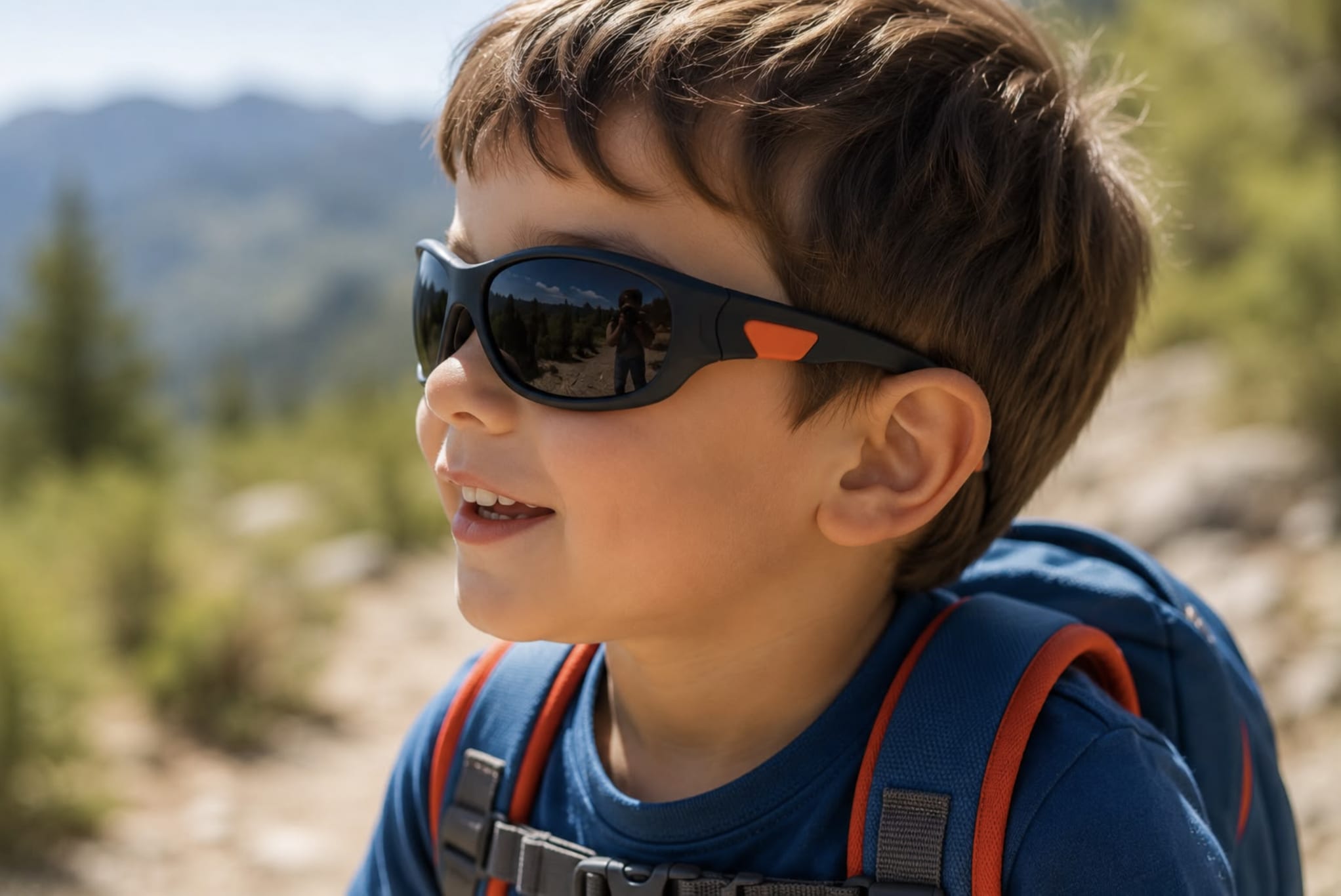
- Frame style: Wrap-style or close-fitting frames provide the most coverage. A standard frame with gaps at the sides allows UV to enter from an angle – particularly relevant for children playing a sport or snobarding or skiing.
- Lens material: Polycarbonate or Trivex – both have built-in 100% UV protection, without needing a separate coating.
- Tint: Gray tints preserve color accuracy and are a reliable all-purpose choice. Brown or amber tints enhance contrast, which some children find useful for sports. Both provide effective sun protection – the difference is mainly how they affect color perception and contrast.
Clip-Ons
Clip-on sunglasses attach to the front of regular prescription frames to add UV protection. They’re a practical budget option and work well for occasional use. The limitations are worth knowing: they add weight to the frame, they’re easy to lose (and most children will lose them at some point), and the fit depends entirely on whether a clip-on is available for the specific frame.
For a kid who only needs sun protection occasionally and doesn’t engage in sustained outdoor activity, clip-ons are a reasonable choice. For regular outdoor use, a dedicated pair provides better coverage and more reliability.
Photochromic Lenses
Photochromic lenses – often referred to by the brand name Transitions – darken automatically in UV light and clear indoors. They’re convenient for mixed-use days and remove the need for a separate pair entirely. The key limitation most parents don’t know about: they don’t activate behind car windshields, because windshield glass filters the UV that triggers the darkening reaction. For a child who spends a lot of time in the car, this matters. For a full comparison: Transitions lenses for kids.
When Dedicated Sunglasses Make the Most Sense
Photochromic lenses handle most everyday situations well, but dedicated sunglasses are worth the extra pair in these specific scenarios:
- Beach or poolside: Water and sand reflect sunlight from multiple directions, creating intense glare and UV exposure. A dedicated pair of prescription sunglasses provides immediate, consistent shading as soon as a child steps outdoors.
- Skiing and snowboarding: Snow reflects large amounts of UV light, and UV exposure increases at higher altitudes. Prescription ski goggles or goggles with prescription inserts provide the level of coverage needed in these conditions.
- Extended outdoor sport: A child spending hours on a tennis court, football field, or baseball field benefits from a consistent tint that doesn’t need time to adjust. For sports specifically, dedicated prescription sports sunglasses with certified impact resistance are the appropriate choice. See: sports glasses for kids.
- Sunny vacations and high-UV climates: When a child is spending most of the day outdoors, a dedicated pair of prescription sunglasses offers simple, reliable protection without relying on lenses changing tint as conditions change.
One Thing Parents Often Forget: Updating the Prescription
Children’s prescriptions change – sometimes quickly. A pair of prescription sunglasses ordered alongside regular glasses may be out of date within a year or two. It’s worth making a note to check whether the sunglass prescription needs updating whenever the regular prescription is reviewed.
Wearing prescription sunglasses with an outdated prescription causes the same eye strain as wearing outdated regular glasses – it just tends to get noticed less because the child associates the discomfort with being outside rather than with the glasses themselves.
FAQ’s
At what age should children start wearing sunglasses?
UV exposure is cumulative from birth, so there’s no minimum age to start from. For very young children who aren’t yet wearing glasses, a wide-brimmed hat combined with time in the shade is often the most practical approach. From the point at which a child starts wearing prescription glasses, UV protection outdoors is worth building into the plan.
My child’s regular glasses have polycarbonate lenses. Don’t those already provide UV protection?
They do – polycarbonate lenses block UV radiation inherently. But regular prescription glasses don’t have a tint, which means they don’t reduce the overall brightness or glare that comes with outdoor exposure. UV protection and glare reduction are separate things. For comfortable outdoor vision in bright conditions, a tinted lens adds meaningful benefit beyond the UV protection alone.
Do prescription sunglasses need a separate coating for UV protection?
If the lenses are polycarbonate or Trivex, UV protection is built into the material – no separate coating needed, and nothing that can wear off. For other lens materials, a UV coating may be applied, but polycarbonate and Trivex are the standard recommendation for children’s lenses regardless, so this typically isn’t a concern.
Are darker lenses better for UV protection?
No. Lens darkness affects visible light transmission, NOT UV protection. UV protection comes from the lens material or an applied coating – not from how dark the tint appears. A quality polycarbonate lens with a light grey tint provides the same UV protection as one with a very dark tint.
Can my child wear their prescription sunglasses for sport?
Prescription sunglasses provide UV protection and vision correction, but they’re not sports-certified unless specifically rated to the ASTM F803 standard. For sports, the frame construction matters as much as the lens. See: sports glasses for kids for what to look for.
For a child who already wears prescription glasses, UV protection outdoors is a practical consideration that’s easy to build into the routine. The right option depends on how and where the child spends time outdoors – the decision table above gives a starting point.
| Disclaimer: This article is for informational purposes only and is not medical advice. The information presented is general in nature and may not apply to your individual circumstances. Consult a licensed eye care professional for personalized recommendations. Never disregard or delay professional medical advice based on this article. GlassesUSA makes no warranties regarding the information presented. Reliance is at your own risk. The eye care professional featured in this article is a paid spokesperson for GlassesUSA. All images in this article were generated using artificial intelligence (AI). |
Published July 13, 2026|Updated August 16, 2026
