
When to Get Your Child’s Eyes Tested: A Parent’s Guide
Updated AUG 16, 2026 • 6 min read

| Quick Answer: Newborns typically have a brief screening examination for abnormalities at birth in most hospitals, with assessments of visual developments that continue with the pediatrician at every routine well-child visit through infancy, and a formal vision screening between ages 3 and 5. From school age onward, every 1–2 years is the standard – annually for any child who wears glasses. These are the common routine schedules. BUT, If you or your pediatrician notice any concerning issues such as difficulty seeing, a wandering eye, or even – squinting, eye rubbing, sitting too close to screens – don’t wait for the next scheduled check and make an appointment with an eye care professional |
These recommendations reflect standard pediatric ophthalmology screening practice used in routine clinical care.
Why You Can Trust This Guide?
Reviewed for clinical accuracy by a board-certified ophthalmologist, based on AAO and AAP pediatric vision screening guidelines.
Introduction
Most parents think about eye tests as something you schedule when a child complains about their vision, struggles at school, or starts squinting at distant objects. The challenge is that many childhood vision problems develop long before a child can recognize or describe them.
A child who has never seen clearly doesn’t know what clear vision looks like. They have no reference point for what they’re missing, which is why routine vision checks begin early and continue throughout childhood.
This article explains when children should have their eyes checked, what different types of vision assessments involve, and which signs warrant a visit outside the normal schedule. For everything that comes after a prescription is issued, see our complete parent’s guide to children’s glasses
Screening vs. Comprehensive Exam: They are NOT the Same Thing
Both vision screenings and comprehensive eye exams play an important role in children’s eye care, but they’re designed to do different things.
Vision Screening
A vision screening is a quick check for the most common problems. It can be performed by a paediatrician, family doctor, school nurse, or other trained health professional. It tests a limited range of things – typically visual acuity and basic eye alignment – and is designed to identify children who need a more thorough examination.
Passing a school screening doesn’t mean a child’s vision has been fully assessed. Screenings miss a meaningful proportion of vision problems, particularly those that affect only one eye or that involve refractive errors within the normal-looking range.
Comprehensive Eye Examination
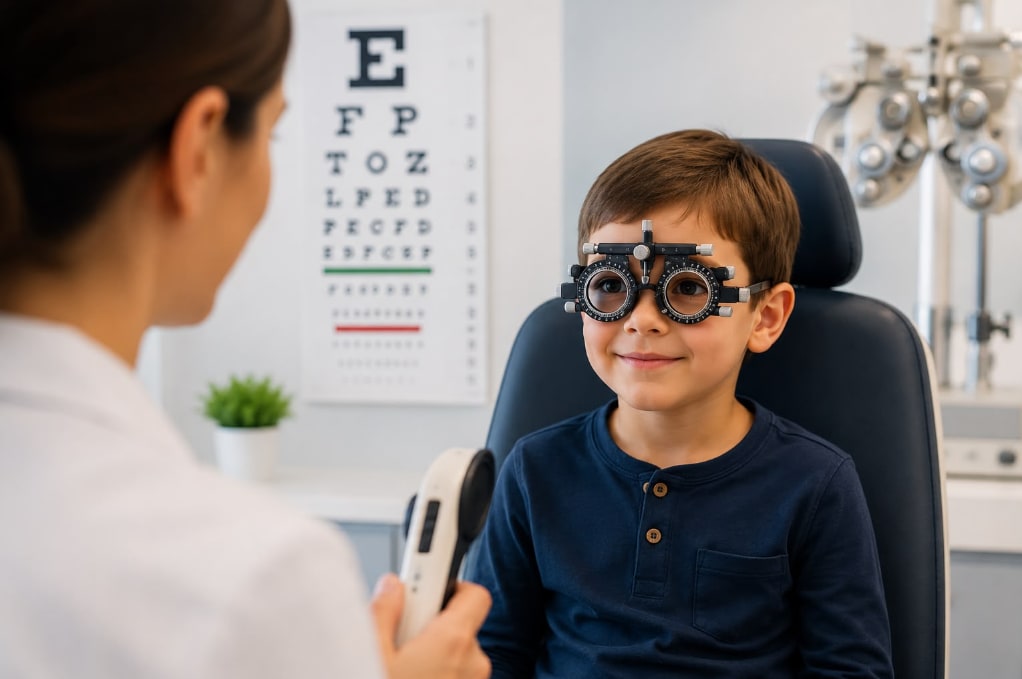
A comprehensive eye examination is performed by an eye care professional such as an ophthalmologist or optometrist. It covers visual acuity, refraction (the measurement that generates a glasses prescription), eye alignment, eye movement, and the health of the eye itself. Once a prescription is confirmed, the next decisions are lens material and frame fit – see how kids’ glasses should fit and polycarbonate lenses for kids.
| Clinical note – Norman Saffra MD FAAO: The distinction between screening and examination matters most for young children. A child who passes a school screening at age 5 but has a refractive error affecting one eye may go undetected until a comprehensive exam is done. Early detection in the preschool years has a different clinical significance than detection later – which is exactly why the schedule front-loads checks in the first few years of life. |
Recommended Schedule
The schedule below reflects guidance from the American Academy of Ophthalmology.
Individual circumstances – family history of eye conditions, premature birth, or existing health conditions – may mean more frequent checks are necessary. Always follow the specific guidance of your child’s eye care provider.
| Age / Stage | Type of Check | What’s Being Assessed |
| Newborn | Clinical examination | Basic eye health – red reflex, structural abnormalities |
| 1 month – 4 years | At each well-child visit | Eye alignment, pupil response, fixation and tracking |
| Ages 3–5 | Vision screening | Visual acuity, alignment, referral triggers for specialist exam |
| School age (6+) | Every 1–2 years | Visual acuity, refractive error, eye health |
| Child wearing glasses | Annually (or as directed) | Prescription accuracy, fit, overall eye health |
Source: Based on AAO published screening recommendations. Individual clinical circumstances may require a different schedule.
| If your child wears glasses: annual checks are the standard recommendation – not because something is necessarily wrong, but because children’s prescriptions change more frequently than adults’, sometimes quickly. A prescription that was accurate when ordered may no longer be accurate a year later. |
Signs That Warrant a Visit Without Waiting
Scheduled checks cover routine monitoring. These signs are reasons to book an appointment regardless of when the last check was:
Behavioural Signs
- Squinting frequently: Squinting narrows the field of vision and can temporarily sharpen a blurry image. A child who squints regularly to see the board, the TV, or anything at distance is showing a sign worth following up on.
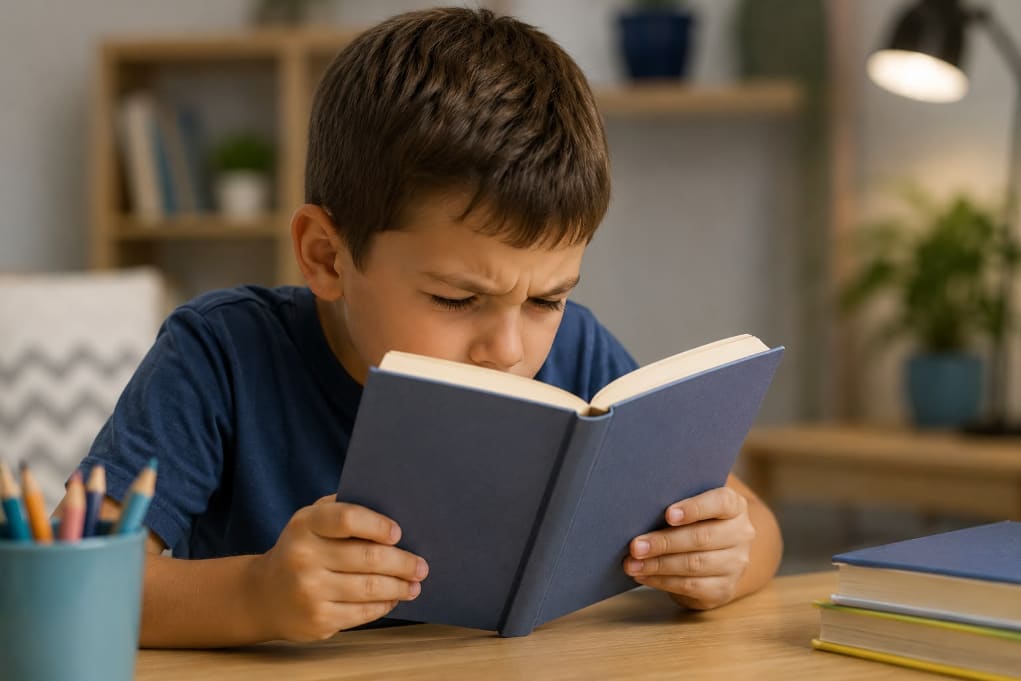
- Sitting unusually close to screens or the TV: When a child seems to compensate for poor distance vision by getting closer to the image.
- Tilting the head to one side when looking at things: Can indicate a difference in vision between the two eyes, or an eye alignment issue.
- Covering or closing one eye: A child who consistently covers one eye to see better is showing a sign that should be evaluated by a professional.
- Frequent eye rubbing when not tired: Can indicate eye strain or other visual discomfort.
- Complaints of headaches, particularly after close work: Eye strain from uncorrected refractive error often presents as headaches, particularly at the end of a school day. Persistent symptoms are a reason to book an exam, not to monitor at home. This is also worth keeping in mind if a child who already wears glasses suddenly starts resisting them – see encouraging your child to wear their glasses.
- Holding books or devices very close: If a child consistently holds books, tablets, or phones very close to their face, it may be worth having their vision checked.
Physical Signs
- Eyes that appear misaligned or don’t move together: Any persistent “funny looking “ eye movements or misalignment of the eyes should be evaluated promptly.
- One eye that appears to turn in or out: Visible most of the time, or only when the child is tired; either warrants professional assessment.
- Drooping of one eyelid: Persistent drooping of one eyelid in a child should be assessed.
- Unusual appearance of the pupil: Any white, gray, or unusual appearance in the pupil – for example, in a photograph where there’s no red-eye effect – should be checked by an eye care professional as soon as possible.
How Urgent Is Each Sign?
If you are unsure how serious a symptom is, treat it as needing an exam rather than waiting for a scheduled screening. When in doubt, book an exam.
Not every sign requires the same response:
| Sign | What to Do | Urgency |
| Squinting, sitting close to screen | Book a comprehensive eye exam | Within a few weeks |
| Head tilting, covering one eye | Book a comprehensive exam promptly | Within 1–2 weeks |
| White/grey in pupil | Seek urgent medical assessment | Same day or next day |
| Sudden vision change, eye pain, red eye | Seek medical attention immediately | Immediate |
| Seek prompt medical attention for: sudden change in vision, eye pain, red eye that doesn’t resolve, new or persistent double vision, or any sudden change in the appearance of either eye. These are not routine scheduling questions – they require same-day or urgent assessment by a medical professional. |
What Actually Happens at a Children’s Eye Exam
A lot of parents put off booking an exam because they’re not sure how it works with a young child who can’t read letters yet. The examination adapts to the child’s age, and in fact doesn’t require letter recognition.
For younger children, the optometrist or ophthalmologist uses lights, lenses, and the child’s natural responses – tracking a moving target, reacting to brightness – to assess how the eyes are working. For children old enough to engage, picture-based charts replace letter charts entirely.
Dilating eye drops are sometimes used to get a more accurate reading of the prescription. They make the pupil temporarily wider and relax the eye’s focusing muscles. The effect lasts a few hours, during which the child’s vision may be slightly blurry and sensitive to light. It sounds more dramatic than it is.
A Note on School Screenings
School vision screenings are a useful first filter – they identify children who clearly need further assessment. But passing a school screening is not the same as having adequate vision for learning.
Screenings typically test distance visual acuity in both eyes together, under controlled conditions, with a child who is cooperative and alert. They don’t test near vision, individual eye performance, eye alignment under all conditions, or the health of the eye itself. A child can pass a pediatric vision screening and still have a refractive error significant enough to affect reading, concentration, and school performance.
If your child has passed every school screening but you’re noticing signs from the list above, a school pass doesn’t outweigh what you’re observing. Trust what you see and book a comprehensive exam.
Children Who May Need More Frequent Monitoring
Some children benefit from more frequent checks than the general schedule suggests. This includes children with:
- A family history of refractive error: Children with one or both parents who wear glasses have a higher likelihood of needing vision correction themselves.
- A family history of eye conditions: Certain eye conditions have a genetic component. Your child’s eye care provider may recommend more frequent follow-up visits.
- Premature birth: Premature infants are at higher risk for several vision-related conditions, and typically receive specialist eye assessment as part of their neonatal care. For children under 4 who have been prescribed glasses, see also eyewear for toddlers.
- Existing prescription: Any child who wears corrective lenses should be seen at least annually. When a prescription changes, it’s also worth reviewing frame materials for kids – a growing child’s frame needs may change too.
- A known developmental or health condition: Several conditions are associated with a higher rate of vision problems. The child’s paediatrician or specialist can advise on appropriate eye care monitoring.
FAQ’s
What should I actually do right now if I’m concerned?
Book a comprehensive eye exam with an ophthalmologist or optometrist – not a repeat screening. If you’re unsure who to contact, start with your child’s paediatrician and ask for a referral. If you’re seeing urgent signs from the table above, prioritise accordingly. Most non-urgent concerns can be seen within a few weeks.
My child just had a school screening and passed. Do they still need a proper eye exam?
A passed screening means your child showed no obvious vision problem under the conditions of that screening. It doesn’t mean a comprehensive eye exam is unnecessary. The AAO recommends a comprehensive exam between ages 3 and 5 regardless of screening results, and regular checks through childhood. If you have any concerns – even after a passed screening – a comprehensive exam is the appropriate next step.
At what age is a child old enough for a proper eye test?
There’s no minimum age. Comprehensive eye examinations can be performed on infants – the techniques involved don’t require the child to read letters or describe what they see. The examination adapts to the child’s age and developmental stage. A newborn whose eyes appear abnormal in some way can and should be examined by an ophthalmologist.
My child never complains about their vision. Does that mean it’s fine?
Not necessarily. Children don’t always recognize when they’re having vision problems. A child who has never seen clearly has no reference point for what clear vision should look like, so they may not mention any concerns. That’s why routine vision screenings and eye exams remain important, even when a child seems to be seeing well.
How often should a child who wears glasses have their eyes tested?
Annually is the standard recommendation for children wearing corrective lenses. Children’s prescriptions change more frequently than adults’, and an accurate prescription matters both for vision quality and for the child’s comfort. When reviewing the prescription, it’s also worth checking whether prescription sunglasses need updating – an outdated sunglass prescription causes the same strain as outdated regular glasses.
My child’s teacher says they think there might be a vision problem. What should I do?
Take it seriously and book a comprehensive eye exam. Observational concerns in classroom settings often correlate with undiagnosed refractive error in children. Teachers observe children over extended periods doing close and distance visual tasks – they often notice what a brief screening misses.
Early detection gives children the best opportunity to receive help while their vision is still developing. That’s why routine vision checks begin early and continue throughout childhood. They’re not just another item on a healthcare checklist – they help ensure vision problems are identified before they have a chance to affect learning, development, or everyday life.
| Disclaimer: This article is for informational purposes only and is not medical advice. The information presented is general in nature and may not apply to your individual circumstances. Consult a licensed eye care professional for personalized recommendations. Never disregard or delay professional medical advice based on this article. GlassesUSA makes no warranties regarding the information presented. Reliance is at your own risk. The eye care professional featured in this article is a paid spokesperson for GlassesUSA. All images in this article were generated using artificial intelligence (AI). |
Published July 13, 2026|Updated August 16, 2026
