
How Kids’ Glasses Should Fit: A Parent’s Guide
Updated AUG 16, 2026 • 6 min read

| Quick Answer: How Do I Know If My Child’s Glasses Fit? A well-fitting frame sits comfortably on the nose without sliding, rests level on the face without tilting, and has temples that lie flat along the sides of the head without digging in. The eyes should sit naturally near the center of the lenses – not too high, low, or off to one side. If any of these are off, the frame may need a professional adjustment or simply be the wrong size. |
Why You Can Trust This Guide?
Written with input from a board-certified ophthalmologist, this guide covers the practical mechanics of children’s eyeglass fit – what to look for, what the numbers mean, and what to do when something’s not quite right.
Introduction
Practically speaking a frame that doesn’t fit comfortably simply won’t get worn. That’s the single most important thing to understand about children’s eyewear fit. The second important issue is how the lens sits in the frame over the eye, that’s so the glasses actually do their job. If you’re still working through the full glasses selection process, our complete parent’s guide to children’s glasses. covers every step from prescription to ordering. This article focuses on fit specifically.
The good news is that most fit problems are fixable. Glasses that slide down, pinch, tilt, or leave marks usually come down to a handful of common fit issues. In many cases, a simple adjustment by an optician is all it takes.
The Three Numbers on Every Frame
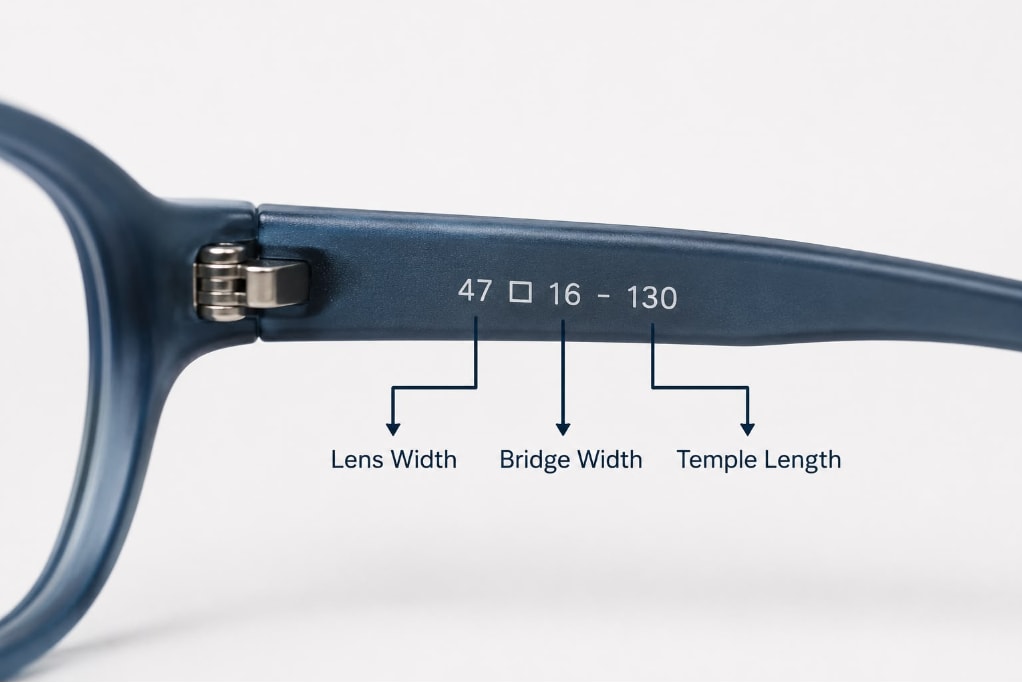
On the inside of any glasses temple (the arm), you’ll find a sequence of three numbers – for example, 46-17-125. These are the three core measurements of the frame, all in millimeters:
- Lens width (first number): The horizontal width of one lens at its widest point. For children, this typically ranges from around 40 mm for toddlers to 52 mm for older teens.
- Bridge width (second number): The distance between the two lenses – the part of the frame that rests across the nose. Children’s bridges typically range from about 14 mm to 20 mm.
- Temple length (third number): The length of each arm from the hinge to the tip. Children’s temple lengths typically range from around 115 mm for toddlers to 145 mm for teens.
| Good to know: Frame measurements are a useful starting point, but they don’t guarantee fit. Two frames with identical numbers can fit very differently depending on bridge shape, nose pad design, and temple curve – and the material of the frame affects how well it holds its shape over time. See also: frame materials for kids. |
Age-Based Size Reference
Children’s faces change quickly as they grow, so age-based sizing is always an approximation rather than an exact science. The table below provides typical frame size ranges by age group and can be a helpful starting point when shopping. Keep in mind that sizing varies between manufacturers, and two children of the same age may need very different frame sizes. When possible, a professional fitting remains the most reliable way to find the right fit.
| Age Group | Lens Width | Bridge Width | Temple Length | Notes |
| Toddlers (1–3) | 40–42 mm | 14–16 mm | 115–125 mm | Cable/strap temples |
| Preschool (3–5) | 42–46 mm | 15–17 mm | 120–130 mm | Spring hinges recommended |
| School age (6–10) | 44–48 mm | 16–18 mm | 125–135 mm | Standard or spring hinges |
| Tweens/Teens (11+) | 46–52 mm | 17–20 mm | 130–145 mm | Approaches adult sizing |
Something to think about: Size ranges are based on standard pediatric eyewear sizing conventions across the industry. Individual children may fall outside these ranges – use them as a guide, not a rule.
| Clinical note – Norman Saffra MD FAAO: Frame sizing is a starting point, not a substitute for a proper fit check. Children’s faces are not uniform within any age group – a child in the 5–10 range might fit a toddler frame width, or approach teen sizing, depending on their individual face structure. Always verify fit on the actual child, not just the numbers. |
How to Check the Fit
Quick Fit Checklist
☑ Frame sits level on the face – not tilting to one side
☑ Doesn’t slide down when the child looks down
☑ Temples rest flat along the sides of the head without pressing
☑ No red marks on the nose after wearing
☑ Child can wear the glasses comfortably for extended periods
Frame Width
The frame should sit comfortably across the face – about as wide as the child’s face. The temples should rest along the sides of the head without pressing inward or bowing outward. If you can see the temples bowing away from the head, the frame is too wide. If they’re pressing visibly against the temples, it’s too narrow.
A simple guide: the temples should sit comfortably against the sides of the head without leaving a noticeable gap or creating visible pressure.

Bridge Fit
The bridge – the part of the frame that rests across the nose – should sit securely without pinching or sliding down. Watch what happens when the child looks down: if the frame drops forward, the bridge is too wide or the nose pads need adjustment.
For younger children with flatter nasal bridges, frames with adjustable nose pads give more options for getting this right. A fixed bridge that doesn’t match the child’s nose shape often leads to glasses that keep slipping down. Before long, the child ends up pushing them back into place – or taking them off altogether.
Temple Length and Position
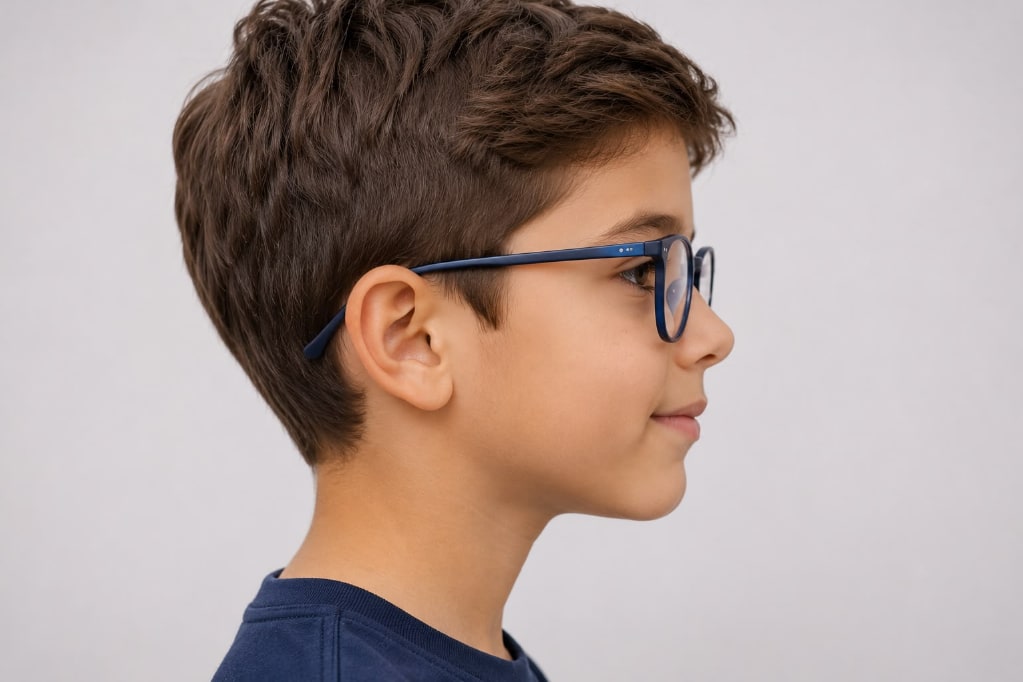
The temples should lie flat along the side of the head, reach just past the ear, and curve gently around or over it without digging in. If the tips are pressing against the skull behind the ear or leaving marks, the temple length may be too short or the curve is in the wrong place – both adjustable by an optician.
For children under 5, cable temples – which curl more fully around the ear – provide better retention than standard or spring-hinge temples. They’re harder to knock out of place, which can be particularly helpful for younger children who are still getting used to wearing glasses.
Lens Position
The lenses should sit directly in front of the eyes. In most cases, the eyes should sit near the center of the lenses, although the ideal position can vary slightly depending on the prescription and frame design. If the frame is sitting too high or low on the nose, the child ends up looking through a non center part of the lens, which can reduce the benefit of the prescribed correction.
This becomes especially important for children who wear bifocal or progressive lenses, where the reading portion needs to line up correctly when they look down to read or do close-up work. For guidance on lens material choices that pair with frame fit: polycarbonate lenses for kids.
Signs That Something Needs Adjusting
Children often won’t say they’re uncomfortable – they’ll simply take the glasses off. A few observable signs that the fit needs attention:
- Constant sliding: The glasses move down the nose during normal activity. Usually a bridge or nose pad issue.
- One side sitting higher than the other: The frame is tilting. Can be caused by uneven temples or a child’s natural ear asymmetry – common and fixable.
- Red marks on the nose: The nose pads are pressing too hard or are positioned incorrectly.
- Child pushing glasses back repeatedly: In many cases, it’s a sign that the fit needs attention rather than a habit they’ve picked up for no reason.
- Complaints of headaches after wearing: Can indicate that the temples are too tight, or that the frame is putting pressure on part of the head or behind the ears. If theses complaints continue after a frame adjustment, a follow up with your eyecare provider maybe needed.
| Worth knowing: A child who resists wearing their glasses is often trying to communicate discomfort, not being difficult. Before assuming the problem is the prescription or simple resistance, it’s worth asking whether the frame is actually comfortable and fitting correctly. |
Fit Troubleshooting Reference
Use this table to identify common fit problems and what typically needs to change:
| What You See | Likely Cause | What to Do |
| Glasses slide down nose | Bridge too wide, or nose pads need adjustment | Tighten nose pads or try smaller bridge width |
| Temples dig into ears or head | Temple length too short, or curve too tight | Optician can adjust bend; try longer temple |
| Frame tilts to one side | Temples uneven, or child’s ears are asymmetric | Professional adjustment – common and fixable |
| Red marks on nose | Nose pads too tight or sharp | Pad position and pressure adjustment by optician |
| Frame too wide – bows outward | Lens width too large for face | Size down in lens width |
| Lenses look too small for frame | Frame front too wide or tall for lens | Re-evaluate frame sizing with optician |
Using a Current Pair as Your Reference
If your child already has a pair of glasses that fits well, the three numbers on those frames are the most reliable starting point for ordering a new pair. Look on the inside of the temple arm for the sequence (e.g. 46-17-130). Most online providers let you filter or search by these measurements.
A variation of 1–2 mm in any measurement is generally fine – frames with identical numbers can still feel slightly different depending on construction. A variation of 3 mm or more in lens width or bridge width will likely produce a noticeably different fit and is worth being careful about. If you’re also choosing a dedicated pair for sport, fit requirements differ – see: sports glasses for kids.
| Good to know: Children’s faces change, sometimes quickly. A frame that fit well six months ago may not fit the same way now – particularly around the bridge and temple length. If a previously well-fitting pair has started sliding or sitting differently, a size check is worth doing before assuming the adjustment has worn out. |
A small thing that makes a bigger difference than it sounds: when a child sees a character in a book or a favourite athlete wearing glasses and you mention it casually – not as a lesson, just as an observation – it quietly normalises the whole thing. It doesn’t need to be a big moment.
When to Ask an Optician for Help?
Many fit problems can be fixed in just a few minutes by an optician. Adjustments are a routine part of children’s eyewear care, and many practices will make minor fit adjustments at no charge. Situations worth visiting an optician for:
- Frame tilting consistently to one side. Usually a simple temple adjustment.
- Red marks or pressure points on the nose or ears. Nose pad repositioning or temple curve adjustment should do the trick.
- A frame that was well-fitted but no longer sits correctly. Frames shift over time with use – a periodic check is normal maintenance.
- Any child under 5 whose frame isn’t staying on reliably. This age group benefits particularly from professional fitting, given how much the face is still developing.
For children whose glasses are part of a treatment plan, fit adjustments should be discussed with the prescribing doctor or the dispensing optician together – small fit changes can have more significance in that context.
FAQ’s
How often should a child’s glasses be checked for fit?
For younger children (under 8), checking fit every three to four months is a practical guideline – children grow quickly, and a frame that fit well at the start of a school year may need adjustment by the end of it. For older children, twice a year is generally sufficient unless you notice fit issues in between.
My child’s glasses keep sliding – what’s the most likely cause?
The most common cause is a bridge that’s too wide for the child’s nose, or nose pads that need adjustment. If the frame is sliding forward rather than down, the temples may also be too long or not curving closely enough behind the ear. An optician can usually identify and fix the specific cause in a short appointment.
Can I adjust my child’s glasses at home?
Simple fixes, like straightening a slightly bent temple, may be possible at home. But adjustments involving the bridge, nose pads, or frame shape are usually best left to an optician, who has the right tools to make changes without damaging the frame.
The glasses look straight on the table but sit tilted on my child’s face. Why?
This is more common than most parents expect. Human faces are naturally asymmetric – most people have one ear that sits slightly higher than the other, and many noses are not perfectly symmetrical. A skilled optician can adjust the temples to compensate for natural facial asymmetry so the frame sits level when worn, even if it doesn’t look perfectly flat on a table.
My child’s glasses fit when we ordered them but now they’re sliding. Do we need a new pair?
Not necessarily. Frames naturally loosen over time with regular use, particularly at the hinges. This is completely normal wear and tear; an optician can tighten the hinges and re-adjust the fit in a quick visit. It’s only worth considering a new frame if the size itself is now wrong because the child has grown, or if the frame has been damaged.
| Disclaimer: This article is for informational purposes only and is not medical advice. The information presented is general in nature and may not apply to your individual circumstances. Consult a licensed eye care professional for personalized recommendations. Never disregard or delay professional medical advice based on this article. GlassesUSA makes no warranties regarding the information presented. Reliance is at your own risk. The eye care professional featured in this article is a paid spokesperson for GlassesUSA. All images in this article were generated using artificial intelligence (AI). |
Published July 13, 2026|Updated August 16, 2026
