
How to Choose Frame Materials for Kids’ Glasses?
Updated AUG 13, 2026 • 6 min read

| Quick Answer: For younger, more active children, TR90 (flexible nylon) is a widely used starting point – it bends under impact and returns to shape. Acetate (also commonly known as plastic like) is a better fit for older children and teens who want more style options. Metal frames suit careful older kids and teenagers who prefer a slimmer look. In all cases, frame material affects durability, comfort, and how well the frame holds its shape over time – not just how it looks. |
Why You Can Trust This Guide?
This guide was written with input from a board-certified ophthalmologist and is grounded in the practical realities of pediatric eyewear fitting. We focus on what actually matters for daily wear – not just materials on paper.
Introduction
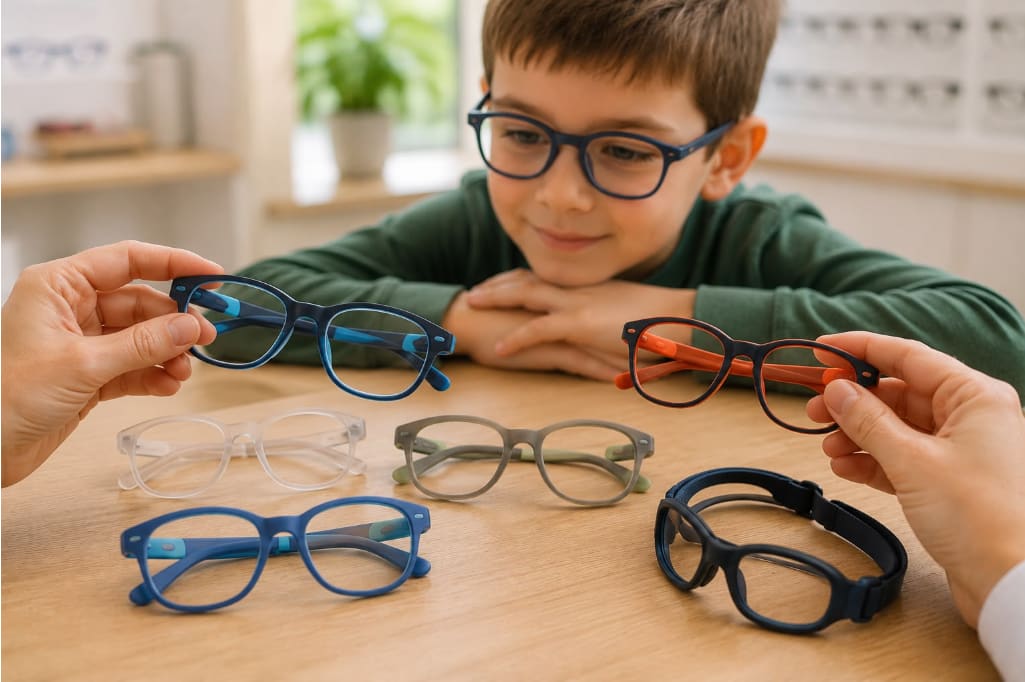
Walk into any eyewear section and you’ll find frames labeled TR90, acetate, metal, and a dozen variations in between. For parents choosing for a child – especially for the first time – those labels can be surprisingly difficult to make sense of. The frame needs to stay on, hold up to daily use, and be comfortable enough that the child actually wants to wear it.
This guide explains what each major material actually is, what it’s good at, and how to match it to your child’s age and lifestyle. If you’re working through the broader glasses decision, our complete parent’s guide to children’s glasses covers the full process – this article focuses on frame material specifically.
Materials at a Glance
A quick reference before going into more detail:
| Material | Best For | Main Strength |
| TR90 | Younger, active kids | Flexibility & impact resistance |
| Acetate | Older kids & teens | Style variety & adjustability |
| Metal | Careful older kids & teens | Slim profile & precise fit |
| Mixed / Combo | All ages (design-dependent) | Balances look and practicality |
Why Frame Material Matters More for Kids?
For adults, frame material is often a matter of comfort and style. For children, it can have more direct consequences, such as:
- Durability: Children’s frames go through far more wear and tear than adult frames – drops, rough play, being sat on. A material that can flex and recover is more likely to survive.
- Comfort and compliance: A frame that pinches, feels heavy, or irritates the skin is one a child will resist wearing. Material affects weight, how the frame feels against the sink, and how easily adjusted the fit is. For strategies on what to do when a child refuses their glasses regardless of fit: encouraging your child to wear their glasses.
- Safety: Frame material affects how a frame behaves under impact – whether it shatters, bends, or flexes. This matters especially for active children.
- Fit stability: Some materials hold adjustments better than others. A frame that drifts out of alignment frequently can become an ongoing source of frustration.
| Clinical note – Norman Saffra MD FAAO: In pediatric eyewear, the frame that gets worn is better than the frame that doesn’t. Material choices that prioritize comfort and durability over appearance tend to produce better real-world outcomes – especially in younger children. That’s not to minimize appearance, but with today’s options, comfort and durability can be accompanied by aesthetics |
TR90 – The Flexible Option
What It Is
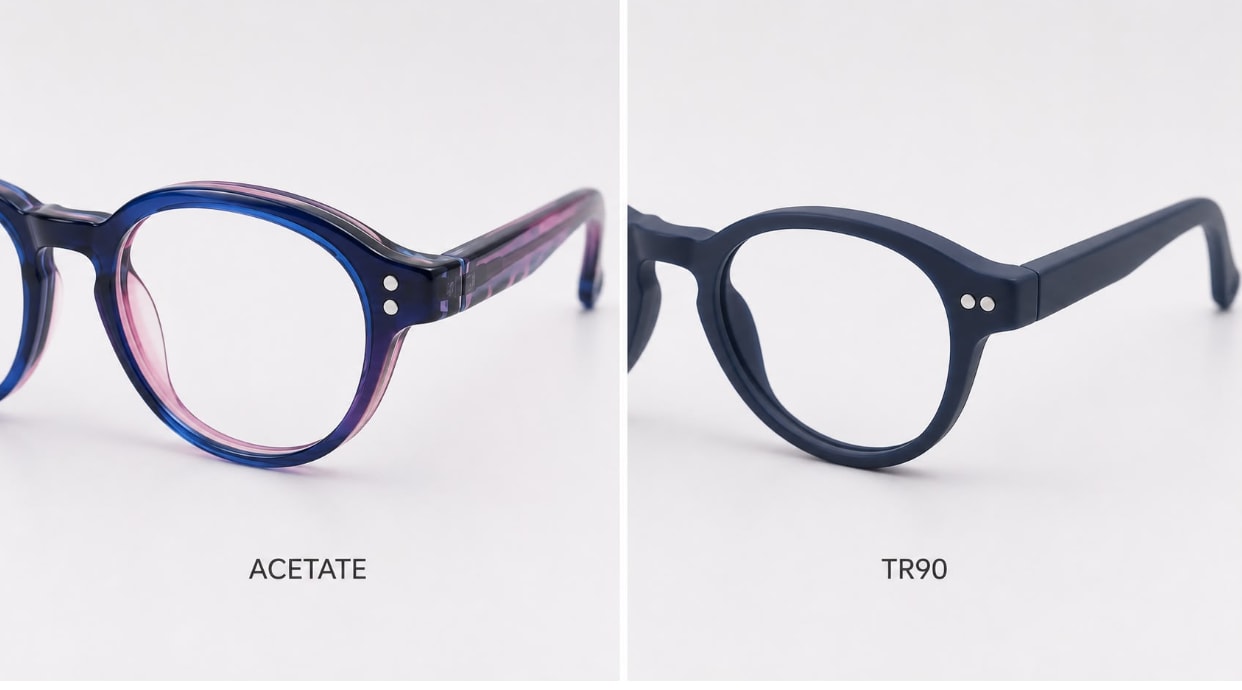
TR90 is a thermoplastic polyamide – a nylon-based material developed by Swiss chemical company EMS-Grivory. It’s sometimes referred to as “memory plastic” because of its ability to return to its original shape after being bent or twisted. It’s lightweight, flexible, and widely used in children’s frames and sports eyewear.
What It’s Good At
- Flexibility without breakage: TR90 can bend significantly under impact and spring back without cracking – a meaningful advantage for children whose frames get dropped, squeezed, or sat on regularly.
- Lightweight comfort: TR90 frames are among the lightest available, which reduces pressure on the nose bridge and ears – a real benefit for children who wear glasses all day.
- Hypoallergenic: While no material can guarantee the absence of skin irritation for every individual, TR90 is generally considered hypoallergenic and free from the most common irritants found in eyewear – making it a practical low-risk choice for most children with sensitive skin.
- Temperature resistance: The material generally handles everyday temperature changes well and is less prone to warping than many conventional plastics.
Limitations
- Style range: TR90 frames tend toward a sportier, more casual aesthetic. The color and pattern options are more limited than acetate, which may be a consideration for older children with stronger style preferences.
- Finish: TR90 typically has a matte or semi-matte finish rather than the glossy depth of acetate. Some children and parents prefer the look of acetate for this reason.
Best For
Younger children (roughly ages 3–10), active kids across all ages, and any child whose glasses are likely to go through a lot. Also a strong choice where skin sensitivity is a concern. TR90 is also the material of choice in most dedicated sports glasses for kids.
Acetate – The Versatile Option
What It Is
Acetate (cellulose acetate) is a plant-derived thermoplastic made from wood pulp and cotton fibers. It’s been used in eyewear manufacturing since the mid-twentieth century and remains one of the most widely used frame materials. It’s cut from solid sheets rather than injection-molded, which allows for richer colors, layered patterns, and a denser, more polished feel.
What It’s Good At
- Style variety: Acetate offers the widest range of colors, patterns, and finishes of any frame material. This matters more as children get older and develop their own aesthetic preferences.
- Adjustability: Acetate can be gently heated by an optician and reshaped to achieve a precise fit – a useful property when incremental adjustments are needed as a child’s face develops.
- Feel and finish: Acetate has a denser, more substantial feel compared to TR90. Many older children and teens prefer the look and feel of acetate, which many older children and teens see as a little more polished or stylish.
- Durability: With normal use, acetate frames are durable and long-lasting. They don’t deform easily from everyday handling.
Limitations
- Less flexible than TR90: Acetate is more rigid and, under significant force, more likely to crack or snap than TR90. It’s not the best choice for very young or rough-and-tumble children.
- Weight: Acetate frames are slightly heavier than TR90, though still comfortable for most children when properly fitted.
Best For
Older children and teenagers (roughly ages 8 and up) who are more careful with their glasses and who value having more style choices. Also a good option for children who find TR90’s look too sporty and want something that feels more like adult eyewear.
Metal – The Slim Option
What It Is
Metal frames for children are typically made from stainless steel, aluminum alloy, or occasionally titanium. They’re thinner and lighter than many plastic options, with a more classic look.
What It’s Good At
- Slim profile: Metal frames offer a thinner, more minimal aesthetic that many older children and teens prefer – particularly those who want glasses that don’t draw too much attention.
- Adjustability: Metal frames can be precisely adjusted by an optician, often more so than plastic frames.
- Lightweight feel: Well-made metal frames can be very light, reducing the sense of wearing glasses over long periods.
Limitations
- Less impact-resistant: Metal frames are more likely to bend permanently under impact than TR90 or acetate. A hard enough hit can deform them in ways that are difficult to fully straighten again.
- Spring hinges matter: For children, metal frames with spring hinges are significantly more practical than those with standard barrel hinges. Spring hinges flex outward when the temples are pulled wider than normal, then return to position – an important feature given how children handle their glasses.
- Potential for skin reaction: Some children are sensitive to certain metal alloys, particularly nickel. Frames labeled hypoallergenic or made from titanium or stainless steel are lower-risk options for children with skin sensitivities.
Best For
Older children and teenagers who prefer a slimmer look, are generally careful with their belongings, and want frames that feel more grown-up. Look for spring hinges as a minimum requirement.
Mixed Materials and Combination Frames
Many children’s frames combine materials – a metal front with plastic temples, or a TR90 frame with metal reinforcements at stress points. These combinations try to put together the strengths of different materials – for example, the flexibility of TR90 with the appearance of metal or acetate. They’re worth considering when no single material fully meets the requirements, or when a particular style happens to be built this way. Evaluate them the same way you would any other frame: weight, flexibility, hinge type, and how the child responds to wearing it.
Hinge Types: The Detail Most Parents Miss
The hinge is the most structurally vulnerable point on any frame – and it’s where most breakage happens with children’s glasses. It’s worth knowing a bit more about hinge types before choosing.
| Hinge Type | How It Works | Best For |
| Standard barrel hinge | Fixed pivot point, opens to 90° | Older children, careful wearers |
| Spring hinge | Flexes outward beyond 90°, springs back | Active kids, wider heads |
| Hingeless / cable temple | Wraps around ear, no hinge | Toddlers, infants |
For younger children and toddlers, cable temples – which curve around the ear rather than using a hinge – remove the hinge failure point entirely and help keep the frame on a face that might otherwise lose it repeatedly.
At a Glance: Material Comparison
*Metal with spring hinges offers moderate flexibility at the hinge; the frame itself is rigid.
| Material | Flexibility | Weight | Style Range | Best For |
| TR90 | High | Very light | Moderate | Ages 3–10, active kids |
| Acetate | Moderate | Medium | Very wide | Ages 8+, style-conscious |
| Metal | Low–moderate* | Light–medium | Wide | Teens, careful wearers |
| Mixed/Combo | Varies | Varies | Wide | All ages, depends on build |
Practical Guidance by Age Group
Ages 1-4 (Toddlers)
Toddler eyewear is its own category. The biggest challenge at this age is simply keeping the glasses on. Toddlers have smaller facial features, low-set ears, and nose bridges that are still developing, which can make a secure fit difficult. Look for TR90 frames with cable temples or strap harnesses, adjustable nose pads where possible, and the smallest frame size that fits correctly.
For a complete guide to toddler eyewear – including retention features and age-specific sizing: eyewear for toddlers.
Ages 5-10
Durability is the main priority. TR90 with spring hinges is the most practical choice for most children in this age group. Fit accuracy matters more as the face grows and changes – check that the frame still fits correctly even every few months.
Ages 11-16
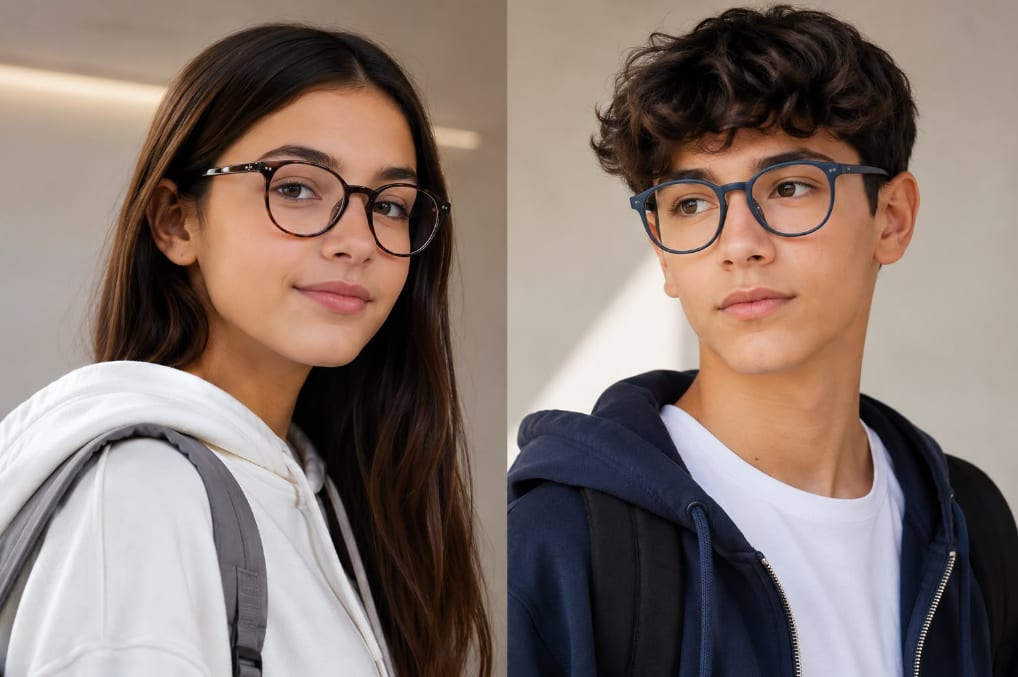
Style becomes a real factor as children move toward adolescence, and compliance with wearing glasses is often connected to how the child feels about how they look. Acetate and metal both offer a wider range of styles. If the child is still rough on their glasses, TR90 remains viable. The key shift at this age is that the child’s preference matters – a frame they’ve chosen themselves is more likely to be worn consistently. For more on this: encouraging your child to wear their glasses.
| Good to know: Frame material can influence how well a frame maintains its fit over time. TR90 frames often cope well with everyday bending and flexing, which can reduce the need for adjustments. Acetate and metal frames may need periodic re-adjustment by an optician as the child’s face develops – particularly after growth periods. |
What to Watch Out For
- Standard barrel hinges on young children’s frames: These are the most likely to fail under the kind of handling children’s glasses typically experience. Spring hinges or cable temples are much more practical.
- Oversized frames on young children: A frame that’s too wide for the face will slide down the nose constantly, regardless of material. Fit accuracy matters more than material choice when the sizing is wrong. For a full fit guide: how kids’ glasses should fit.
- Unknown alloys in metal frames: If your child has a history of skin reactions to jewelry or metal, check that the frame material is labeled hypoallergenic, titanium, or stainless steel before ordering.
- Frames without any flexibility at the temple: For children under 10, some flex at the temple – either through spring hinges or material flexibility – is a practical durability feature, not just a nice-to-have.
FAQ’s
Is TR90 better than acetate for kids?
For younger and more active children, TR90’s flexibility and impact resistance make it the more practical choice. For older children and teens who care about style variety and prefer a more substantial feel, acetate is a strong option. The right choice depends on the child’s age, how they handle their glasses, and what they’ll actually be willing to wear. Frame material pairs with lens material – see also: polycarbonate lenses for kids.
Are metal frames suitable for children?
Metal frames are suitable for older children and teenagers, particularly those who are careful with their belongings and prefer a slimmer aesthetic. Look for spring hinges as a minimum – they add meaningful durability at the most vulnerable point of the frame. For younger children, or children who are particularly hard on their glasses, TR90 or acetate are more practical.
What does hypoallergenic mean for eyeglass frames?
A hypoallergenic frame is made from materials unlikely to cause skin irritation or allergic reactions. TR90, titanium, and most acetate frames are generally considered low-risk for skin reactions. That said, no material can guarantee the absence of irritation for every child. Some metal alloys – particularly those containing nickel – are more likely to cause reactions. If your child has a known skin sensitivity, checking the specific frame materials with an optician before ordering is worth the extra step.
Can I tell what material a frame is made from by looking at it?
Not always with certainty. Acetate frames typically have a glossier finish and visible color depth or patterning. TR90 often has a matte or semi-matte finish and a more flexible feel. Metal frames are noticeably thinner and harder. The product description or frame label will confirm the material – when in doubt, check.
| Disclaimer: This article is for informational purposes only and is not medical advice. The information presented is general in nature and may not apply to your individual circumstances. Consult a licensed eye care professional for personalized recommendations. Never disregard or delay professional medical advice based on this article. GlassesUSA makes no warranties regarding the information presented. Reliance is at your own risk. The eye care professional featured in this article is a paid spokesperson for GlassesUSA. All images in this article were generated using artificial intelligence (AI). |
Published July 12, 2026|Updated August 13, 2026
