
Progressive Lenses: The Complete Guide
Updated AUG 18, 2026 • 6 min read

| Quick Summary: Progressive lenses are multifocal lenses that provide distance, intermediate, and near vision correction in a single lens, with no visible dividing line – a smooth, gradual change in power from top to bottom. They’re most commonly prescribed for people with presbyopia (the age-related change in near focusing ability that most people notice starting in and around age 40) who want one pair of glasses for everyday distance, computer, and reading needs, rather than switching between multiple pairs. They typically involve an adaptation period and are generally more complex – and often more expensive – than basic single-vision lenses, but many people find the versatility worth the trade-off. |
Introduction
Somewhere in and around age 40, reading a menu in dim light or checking a phone at arm’s length starts to feel a little harder than it used to. This is one of the most universal experiences in adult vision – and one that eventually touches nearly everyone. Progressive lenses are, for many people, the most versatile answer to it: one pair of glasses that handles distance, computer, and reading vision without a visible line or the need to switch glasses throughout the day.
This guide is the hub for everything progressive-lens-related on this site. It covers the full picture at a high level – what these lenses are, who tends to need them, how they compare to the alternatives, and what to expect when adapting to and living with them – and links out to a dedicated, in-depth article for each specific topic. Think of this page as the map; the linked articles are where the detail lives.

What Progressive Lenses Are and How They Work?
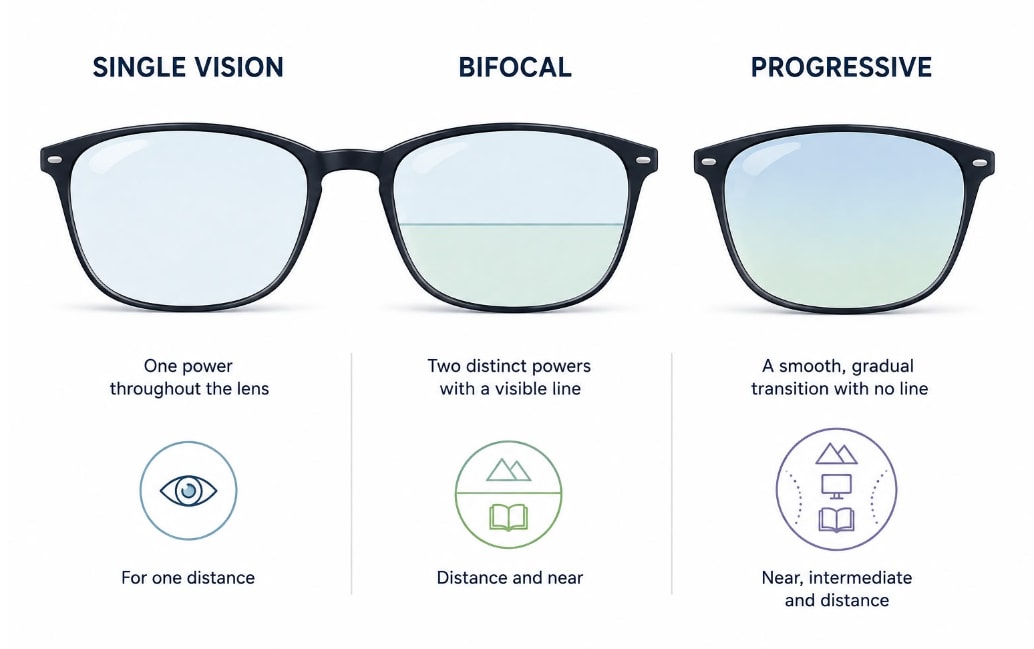
A progressive lens is a type of multifocal lens: distance correction sits at the top of the lens, intermediate correction (roughly arm’s length – a computer screen, a car dashboard) sits in the middle, and near correction for reading sits at the bottom. Unlike a bifocal, which has two distinct zones separated by a visible line, a progressive blends the power gradually across a corridor connecting the zones, so there’s no line anywhere on the lens.
This design means the same pair of glasses can handle driving, a conversation across a table, a computer screen, and a book – all without switching glasses or looking through a visible segment.
Who Progressive Lenses Are For?
Progressive lenses are generally intended for people with presbyopia. Almost everyone over the age of 40 eventually experiences presbyopia, as the eye’s natural lens gradually becomes less flexible, according to the American Academy of Ophthalmology. If you’re noticing that reading materials need to be held farther away, or that screens and menus are harder to focus on than they used to be, this is generally the underlying cause.
Not everyone with presbyopia needs a progressive lens specifically – some people are well served by simpler options. For guidance on whether a basic reading solution might be enough for your situation, see our guide prescription glasses vs. over-the-counter readers
Progressive vs. Bifocal vs. Single Vision
| Single Vision | Bifocal | Progressive | |
| Vision zones | One | Two, with visible line | Continuous — distance, intermediate, near |
| Visible line | No | Yes | No |
| Best suited for | No presbyopia, or one specific task | Distance + near, simple needs | Distance, intermediate, and near in one lens |
For a full, detailed comparison – including a practical decision framework for which option may suit your situation – see our guide: single vision vs. progressive vs. bifocal lenses.
| Common point of confusion: Progressive lenses are frequently called “no-line bifocals” in everyday conversation — but there’s also a rarer, genuinely different lens design that goes by a similar name. If you’ve heard this term and want to know exactly what it refers to, see our guide: no-line bifocals vs. traditional bifocals . |
What to Expect When Adapting to Progressive Lenses?
Many people notice meaningful improvement within the first one to two weeks of wearing new progressive lenses, though the full adjustment period varies considerably from person to person. Mild dizziness, peripheral waviness, and a sense of the floor sitting closer than expected are commonly reported during the first few days and generally ease with consistent wear.
Learning to move your head – rather than just your eyes – toward what you’re looking at is one of the most useful habits for speeding this process along.
For a full week-by-week breakdown of what many wearers experience, techniques that may help, and, importantly – when persistent symptoms are worth a call to your eye care provider, see our complete guide: how to adjust to progressive lenses.
Reading and Computer Use With Progressive Lenses
Two specific tasks tend to generate the most day-to-day questions from new progressive wearers: reading and extended computer work. Both have their own dedicated considerations.
Reading
The reading zone in a progressive lens sits at the bottom and is generally more limited than the dedicated near area of a bifocal or single-vision reading lens. Learning to position your head and gaze for this zone takes some practice. For a full guide to using the reading zone comfortably, see: how to read with progressive lenses.
Computer and Screen Use
Standard progressives divide their space across all three distances, which can make the intermediate zone used for computer screens feel more limited for people who spend many hours at a desk. Specialized office/computer progressive designs address this by dedicating more of the lens to intermediate and near vision.
Why Frame Choice Matters for Progressive Lenses?
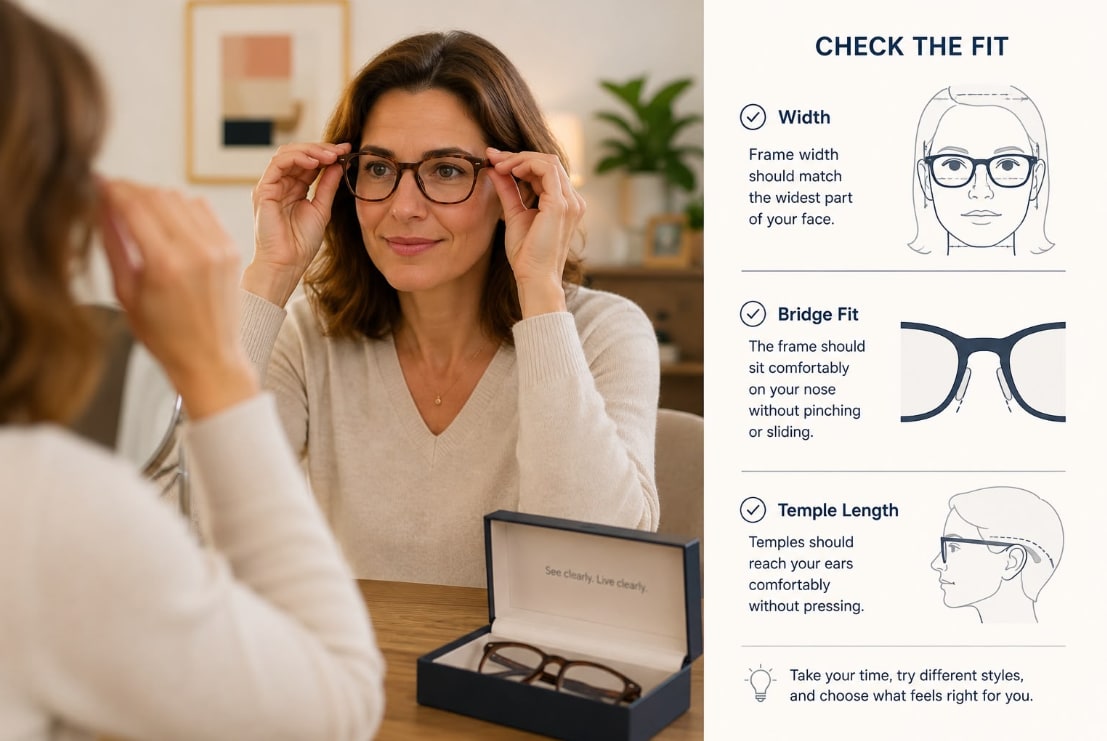
Progressive lenses have specific space requirements that single-vision lenses don’t – the frame needs enough vertical room to accommodate distance, intermediate, and near vision without compressing or cutting off any of these areas. A frame that looks perfectly normal can still be a poor match for a particular progressive design, which is one reason people can end up dissatisfied with a new pair.
Before ordering, it’s worth understanding what to check – this is covered in detail in our guide: how frame choice affects progressive lens performance.
The Trade-Offs of Progressive Lenses
Progressive lenses solve a real problem well, but they’re not without trade-offs, and it’s worth going in with a clear picture of both sides before deciding.
- Some peripheral blur is inherent to the design. The sides of the lens, particularly in the intermediate and near zones, contain some softening of focus by design — this isn’t a defect, but it is a genuine characteristic of how progressives work.
- The reading and intermediate zones are more limited than what a dedicated single-vision or bifocal lens provides for that specific distance, since a progressive divides its space across three zones rather than one or two.
- They involve an adaptation period. Most people adjust within a few weeks, but it’s a genuine adjustment, not an instant transition.
- Frame fit and measurements matter more. Getting a good result depends more on accurate PD, fitting height, and frame compatibility than it does with single-vision lenses.
- They may not be the best fit for every task. Extended computer work or very small frames are situations where a dedicated alternative – an office progressive or a different lens type – may serve better than a standard progressive.
| Who may want to consider alternatives: Progressive lenses aren’t the automatic best choice for everyone with presbyopia. Some people prefer dedicated reading or computer glasses for specific tasks, or find the adaptation period or peripheral blur genuinely frustrating rather than a minor adjustment. The right choice depends on your visual needs, prescription, and how you actually use your glasses day to day – our single vision vs. progressive vs. bifocal guide can help you think through this. |
Buying Progressive Lenses Online
Ordering progressive lenses online is a widely used and generally reliable option, provided a few things are accurate: your prescription needs to be current, your pupillary distance (PD) and fitting height need to be measured correctly, and your frame needs to be compatible with the progressive design you’re ordering. Fitting height in particular depends on how a specific frame sits on your face, not just the frame’s dimensions on paper – this is covered in more depth in our frame choice guide.
Because progressive lenses depend on precise measurements more than single-vision lenses do, it’s worth double-checking these details before placing an order rather than assuming any frame and any measurement will work.
If you’re unsure about any of these steps – your prescription, your PD, or whether a specific frame will work – checking with an eye care professional or optician before ordering is a reasonable and often free step that can prevent having to reorder later.
| Clinical note – Norman Saffra MD FAAO: When patients are dissatisfied with new progressive lenses, it’s worth checking a few common factors first: whether the prescription is current, whether measurements such as PD and fitting height are accurate, whether the frame is compatible with the lens design, and whether enough time has been allowed for adaptation. These factors are identifiable and addressable – persistent problems are a reason to have things checked, not a reason to assume progressive lenses “just don’t work” for you. |
Progressive lenses solve a genuinely common problem – the gradual loss of near focus that comes with age – in a way that can let people use one pair of glasses for many of their everyday visual needs; Getting the details right (prescription, measurements, frame, and a bit of patience during adaptation) is what separates a great experience from a frustrating one.
FAQ’s
How do I know if I need progressive lenses specifically, rather than bifocals or reading glasses?
This depends on your specific visual needs – mainly whether you need correction at more than one distance in daily life, and how much a seamless, line-free appearance matters to you.
How often does a child’s How long does it take to get used to progressive lenses? change?
Many people notice meaningful improvement within one to two weeks of consistent wear, though the full adjustment period varies from person to person and can extend longer for some. Our full adaptation guide covers what to expect week by week and when to seek help.
Can I use progressive lenses for computer work?
Standard progressives can work for computer use, though some people find the intermediate zone narrower than ideal for extended screen time. Dedicated office/computer progressive designs address this directly – see our guide to progressive lenses for computer use for the full comparison.
Will any frame work with progressive lenses?
Not necessarily. Progressive lenses need sufficient vertical space in the frame to accommodate all three viewing zones, and very small, shallow, or heavily curved frames can be a poor match for standard progressive designs. Checking frame compatibility before ordering is one of the simplest ways to avoid ending up with glasses that don’t perform well.
| Disclaimer: This article is for informational purposes only and is not medical advice. The information presented is general in nature and may not apply to your individual circumstances. Consult a licensed eye care professional for personalized recommendations. Never disregard or delay professional medical advice based on this article. GlassesUSA makes no warranties regarding the information presented. Reliance is at your own risk. The eye care professional featured in this article is a paid spokesperson for GlassesUSA. All images in this article were generated using artificial intelligence (AI). |
Published August 18, 2026|Updated August 18, 2026
