
Prescription Glasses vs. Over-the-Counter Reading Glasses
Updated JUL 15, 2026 • 3 min read

Why You Can Trust This Guide?
This guide reflects common behaviors and recommendations but is NOT a substitute for a comprehensive eye examination.. That said, many optical retailers push for the most expensive option; we take a “Trust-First” approach, identifying when affordable readers are sufficient and when a custom medically provided prescription is clinically necessary.
Introduction: Understanding Near-Vision Options
As we age, our eyes naturally lose the ability to focus on close objects, like reading a menu or checking your phone. This condition is known as age-related near vision loss (presbyopia).
While drugstore readers are a convenient quick fix, choosing between them and prescription glasses depends on your specific vision needs.
Quick Answer: OTC vs. Prescription
- OTC Readers: Best for occasional, short-term tasks (menus, labels) if both eyes have equal vision and require the same correction and you don’t have astigmatism.
- Prescription Glasses: Best for daily use, prolonged reading, screen time, or if each eye requires a different prescription or you have astigmatism.
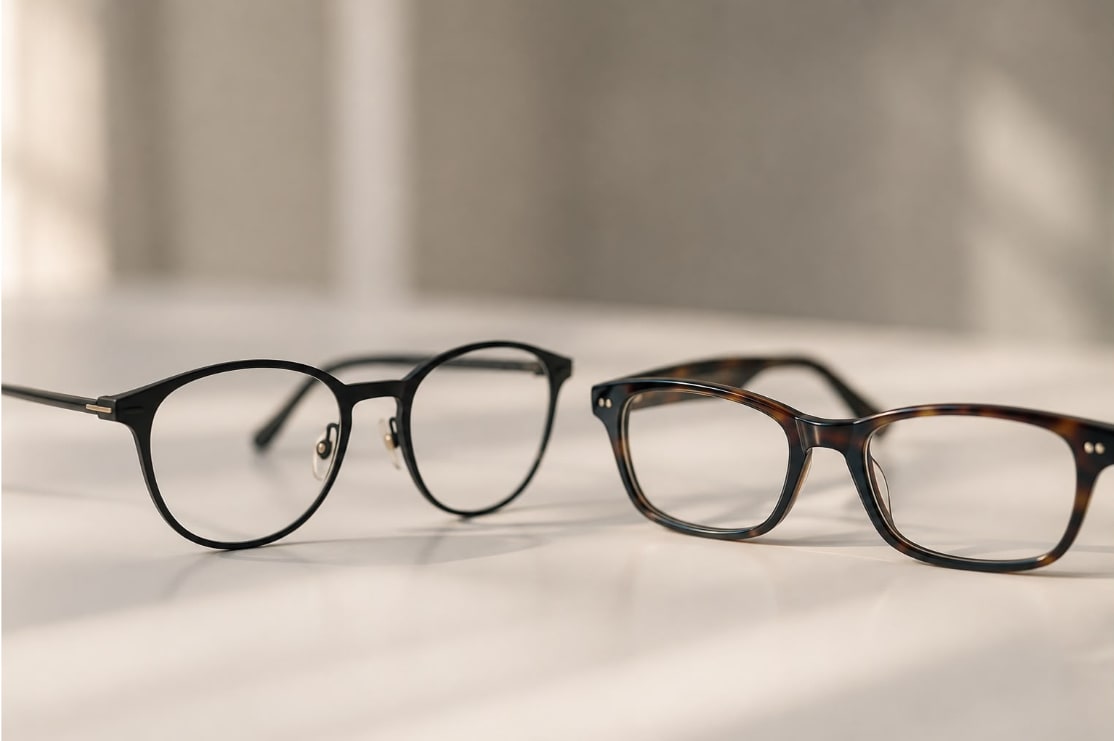
The Decision Rule: OTC or Custom Rx?
- Choose OTC Readers if: Your eyes require equal power, you have no history of astigmatism, and you only need magnification for brief, occasional tasks.
- Choose Prescription Reading Glasses if: You use glasses for daily/prolonged work, experience eye strain, or require different optical powers for each eye.
Comparison at a Glance: Custom Rx vs. OTC Readers
| Feature | Prescription Reading Glasses | OTC Readers (Drugstore) |
| Primary Use Case | All-day reading, screen work, or detailed tasks | Occasional short-term tasks (menus, labels) |
| Power Accuracy | Custom to each eye (e.g., +1.25 L / +1.50 R) | Identical power in both lenses |
| Astigmatism | Corrected via Cylinder/Axis values | Not corrected |
| Optical Alignment | Custom aligned with your specific PD | Generic center (assumed average) |
| Lens Quality | Optical-grade; minimal distortion | Injection-molded; higher distortion risk |
When OTC Readers Become Limiting
OTC readers are convenient, but they’re not designed for every situation. If you experience discomfort despite wearing them, it is usually due to one of these clinical factors:

- The Imbalance Factor
Most people require a slightly different prescription for each eye. OTC readers force both eyes into the same power, which can lead to a “visual tug-of-war” where your brain struggles to fuse two slightly different images. - Uncorrected Astigmatism
Drugstore readers provide simple spherical magnification. If you have astigmatism (irregular corneal shape), a simple magnifier cannot provide truly crisp focus. For more on this, see our prescription interpretation guide. - Improper Optical Alignment
Every pair of prescription glasses is built based on your Pupillary Distance (PD). OTC readers use a “standard” center. ( a one siize fits all approach) If your pupils don’t align perfectly with that center, you may be looking slightly off-center, which can lead to discomfort such as eye strain, headaches, or mild visual imbalance.
The Risks of “Power Creep”
Using the “wrong” power won’t cause permanent anatomical damage to your eyes, but it creates a cycle of chronic eye strain.
- Induced Headaches: Your muscles overcompensate for poor alignment, often leading to tension headaches.
- Power Creep: Some users buy progressively stronger OTC readers to “fix” the blur, unknowingly increasing the strain because the underlying astigmatism or imbalance isn’t being addressed.
In our complete guide for ordering glasses online we view prescription readers as a specialized tool for productivity, while OTC readers remain a handy backup for occasional use.
FAQ’s
Can OTC readers damage my eyes?
No. They will not cause permanent damage. However, using an incorrect power can lead to persistent eye strain, discomfort, and fatigue.
Are “computer glasses” the same as readers?
Not exactly. Computer glasses are typically optimized for intermediate distance (20–25 inches), whereas readers are optimized for close-up reading (12–14 inches).
Should I get progressives instead of readers?
If you find the constant “on-and-off” nature of readers frustrating, glasses with progressive lenses are the modern clinical solution for seeing clearly at all distances with a single pair.
Disclaimer: This article is for informational purposes only and is not medical advice. The information presented is general in nature and may not apply to your individual circumstances. Consult a licensed eye care professional for personalized recommendations. Never disregard or delay professional medical advice based on this article. GlassesUSA makes no warranties regarding the information presented. Reliance is at your own risk. The eye care professional featured in this article is a paid spokesperson for GlassesUSA.
All images in this article were generated using artificial intelligence (AI).
Published June 10, 2026|Updated July 15, 2026
