
How Frame Choice Affects Progressive Lens Performance
Updated AUG 18, 2026 • 6 min read

| Progressive lenses need enough vertical space in the frame to provide distance, intermediate, and near vision without compressing or cutting off any of these areas. Standard progressive designs often require more vertical frame height than specialized short-corridor designs, which are built specifically for smaller frames – the exact minimum varies by lens design and manufacturer. Small, very shallow, or heavily curved frames can be a contributing factor when someone feels their new progressives aren’t working well, even when the prescription itself is accurate. Checking frame dimensions and fit before ordering is one of the simplest ways to reduce the risk of compatibility problems. |
Introduction
A common and frustrating experience: someone orders progressive lenses, picks a frame they love, and ends up with glasses that never quite work – a cramped reading area, or a constant need to tilt their head to find clear vision. Some peripheral blur is inherent to progressive lens designs, but an unsuitable frame size, shape, or fit can make the usable viewing areas feel more restricted than intended. Often, the lens prescription itself is fine. The problem is the frame.
Progressive lenses have specific space requirements that single-vision lenses simply don’t. A frame that looks perfectly normal – even one that would work fine with any other lens type – can be genuinely incompatible with a progressive design. This guide explains exactly what to check before ordering, so the frame you love and the lens you need actually work together.
For general guidance on finding the right frame size for your face, see our guide to choosing frame size; this article focuses specifically on how frame choice affects progressive lens function. For the broader picture, see our complete guide to progressive lenses.
Why Frame Height Matters More for Progressives Than Other Lenses
A single-vision lens has one uniform power across the entire surface – the frame’s size and shape generally have less impact on how the lens provides its prescribed power across the lens. A progressive lens is different: it needs enough vertical room to provide distance, intermediate, and near vision, with a gradual corridor connecting these viewing areas, all within the boundaries of the frame.
If a frame doesn’t provide enough vertical space for a particular progressive design, the available lens options may be more limited. If a shorter-corridor design is used, it may involve trade-offs such as a narrower or less forgiving intermediate area. If the frame is incompatible with the available lens designs, however, adaptation or a prescription change will not solve the underlying fit issue.
Understanding Fitting Height
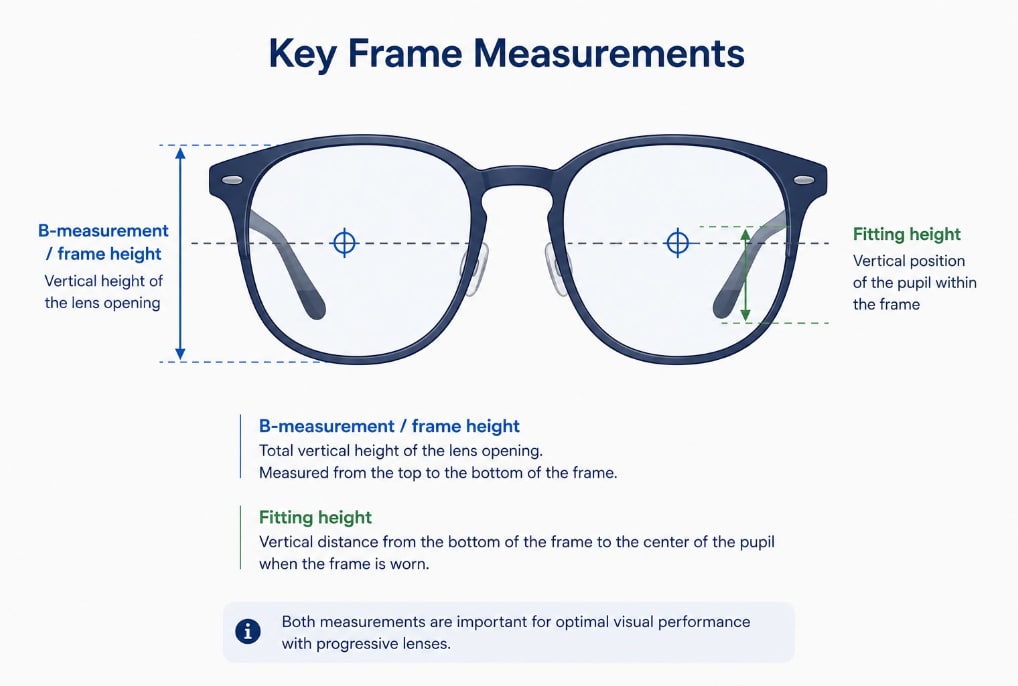
Two related measurements matter when fitting progressive lenses: the frame’s B-measurement, which describes the vertical height of the lens opening, and the fitting height, which describes where the wearer’s pupil sits vertically within that frame. Both help determine whether a particular progressive design can be properly positioned.
Getting the fitting height right is what allows the lab to center each viewing zone correctly relative to your natural line of sight, and it depends on how the specific frame sits on your specific face.
| Good to know: Fitting height requirements have generally decreased over the decades as lens designs have improved – older guidance called for taller frames than many modern short-corridor designs require. Even so, most standard progressive designs still need meaningfully more vertical room than a very small or shallow frame provides. |
General Height Guidelines
Standard progressive designs often require sufficient vertical height to accommodate the lens design, while some short-corridor designs are specifically engineered for smaller frames. The exact minimum height varies by lens design and manufacturer, but as a general rule of thumb:
- Standard progressive designs: Often require more vertical height than short-corridor designs, though the exact minimum should always be checked for the specific lens design and manufacturer.
- Short-corridor or “compact” progressive designs: Built specifically for smaller frames, some can function in frames with meaningfully less height – though typically with a narrower, less forgiving intermediate zone as a trade-off.
If you’re drawn to a smaller or more fashion-forward frame, it’s worth asking directly whether a short-corridor progressive design is available and appropriate for your prescription, rather than assuming any progressive lens will fit any frame you like.
Frame Width and the Corridor
Height isn’t the only dimension that matters. Frame width also matters: a very narrow frame can limit the usable horizontal field of view, while the frame’s shape and curvature can affect how noticeable peripheral distortion feels.
- Narrow frames: Can provide less horizontal room for clear vision, making precise positioning and small head movements more important.
- Heavily curved or wraparound frames: The curvature can introduce additional distortion at the edges of progressive zones, which is less of a concern with single-vision lenses.
- Rimless and semi-rimless frames: Depending on the frame construction and how well they are fitted and maintained, they may be more susceptible to movement or changes in positioning, which can matter for the precise alignment required by progressive lenses.
What to Check Before Ordering Online
Because progressive lenses depend on precise frame-and-lens interaction, a few checks before ordering can meaningfully reduce the chance of ending up with glasses that don’t perform well:
| Frame Spec | Why It Matters for Progressives | What to Look For |
| Frame height (B-measurement) | Determines how much vertical room exists for all three viewing zones | Check the minimum fitting height specified for the specific progressive design |
| Frame construction and stability | Frame construction and stability can affect how consistently the lenses remain positioned | Look for a frame with a stable, secure fit and construction appropriate for the lens design |
| Fit and positioning | A frame that slides or shifts changes where your eyes align with the lens zones | Look for a frame that sits securely and can be adjusted to maintain a consistent position |
| Overall frame shape | Strongly curved or heavily angled frames can distort the viewing zones at the edges | Moderately curved, traditional shapes tend to be more forgiving |
| Clinical note – Norman Saffra MD FAAO: Patients sometimes return with concerns about their progressive lenses assuming the prescription is wrong, when the issue may instead relate to the frame’s size, shape, fit, or compatibility with the lens design. Before assuming a prescription needs to be redone, it’s worth having an optician check the frame against the requirements for the specific lens design – this is a simpler and often overlooked first step. |
Frame choice isn’t just an aesthetic decision when it comes to progressive lenses – it’s a functional one. Checking a few key specifications before ordering, or discussing them with an optician, is one of the simplest ways to make sure the frame you love and the lens you need actually work well together.
FAQ’s
Can I use any frame I want with progressive lenses?
Not necessarily. While many standard-sized frames work fine, frames that are notably small, heavily curved, or very shallow vertically may not provide enough room for a standard progressive design. If you have a specific frame in mind, checking its lens height against the requirements of the lens design you’re considering – or asking your optician directly – is worth doing before ordering.
Are there progressive lenses designed for small frames?
Yes, short-corridor or compact progressive designs exist specifically for this purpose. They generally involve a trade-off – a narrower, less forgiving intermediate zone – compared to standard designs in a taller frame. Whether this trade-off is worthwhile depends on your specific prescription and how much you prioritize a smaller frame versus a wider field of clear vision.
Why can fitting height be different from the frame’s listed dimensions?
Fitting height depends on how a specific frame sits on your specific face – not just the frame’s dimensions on paper. Two people wearing the identical frame can have meaningfully different fitting heights based on their facial structure. This is part of why progressive lens fitting often benefits from in-person measurement, even when the frame itself is ordered online.
My new progressives don’t seem to work well even though my prescription hasn’t changed. Could the frame be the issue?
It’s worth considering. If a new frame is notably smaller, more curved, or a different shape than your previous glasses, that alone could account for reduced performance – separate from whether the prescription or lens itself was made correctly. This is worth discussing with your optician before assuming something went wrong with the prescription.
| Disclaimer: This article is for informational purposes only and is not medical advice. The information presented is general in nature and may not apply to your individual circumstances. Consult a licensed eye care professional for personalized recommendations. Never disregard or delay professional medical advice based on this article. GlassesUSA makes no warranties regarding the information presented. Reliance is at your own risk. The eye care professional featured in this article is a paid spokesperson for GlassesUSA. All images in this article were generated using artificial intelligence (AI). |
Published August 18, 2026|Updated August 18, 2026
