
How to Adjust to Progressive Lenses: What to Expect Week by Week
Updated AUG 18, 2026 • 5 min read

| Many people notice meaningful improvement within the first one to two weeks of wearing new progressive lenses, although the full adjustment period varies considerably from person to person and can extend longer for some. Mild dizziness, peripheral waviness, and a sense of the floor sitting closer than expected are commonly reported during the first few days and generally ease with consistent wear. Symptoms that are severe, that involve true spinning dizziness, or that are not improving after a few weeks of consistent wear are a reason to contact your eye care provider – not something to wait out further. |
Introduction
If you’ve just picked up your first pair of progressive lenses and the first few days feel a little off – some waviness at the edges of your vision, a moment of dizziness when you look around quickly, the sense that the floor is closer than it should be – you’re not imagining it, and you’re not alone. This is a commonly reported experience for new progressive wearers.
What’s less commonly explained is how to tell the difference between a typical adjustment period and something that needs attention, and what may help the process along. This guide walks through what many wearers experience week by week, a technique that many find helpful for adaptation, and – importantly – when it’s time to stop waiting and call your eye care provider.
For the broader picture of progressive lenses: types, cost, and how to choose – see our complete guide to progressive lenses.
If you’re still deciding between lens types, our comparison of single vision vs. progressive vs. bifocal lenses.

Why Progressive Lenses Require an Adjustment Period?
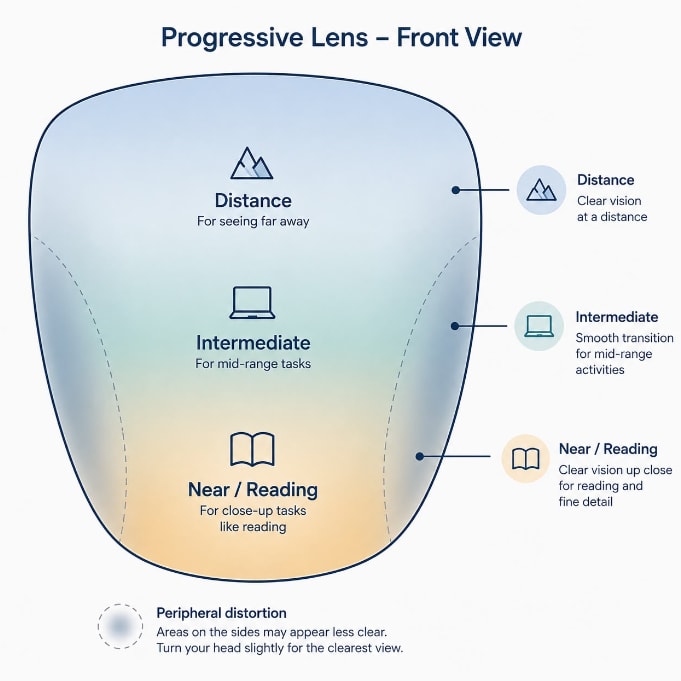
Progressive lenses correct distance, intermediate, and near vision within a single lens, with the power changing gradually from top to bottom. Unlike single-vision lenses, where the correction is uniform across the entire lens, progressives have zones – and the areas between those zones, particularly at the edges, contain some optical distortion by design.
Adapting to progressive lenses can take anywhere from about a week to a couple of months, and using correct head and eye positioning – rather than the habits formed with single-vision glasses – may help shorten that process, according to the American Academy of Ophthalmology.
In practice, this means your visual system needs to learn a new way of using the lens: looking through specific zones for specific tasks, rather than moving your eyes freely the way you would with single-vision glasses. That learning process is the adaptation period.
The Three Zones, and Why They Matter for Adaptation?
Understanding the layout of a progressive lens makes the adaptation process considerably easier to work with.
- Distance zone (top of the lens): Used for seeing clearly at distance – driving, watching TV, general awareness of your surroundings.
- Intermediate zone (middle): Used for arm’s-length tasks – a computer screen, the dashboard of a car, a conversation across a table.
- Near / reading zone (bottom): Used for close-up tasks – reading, using a phone, needlework.
The zones blend into each other rather than being sharply divided, and the sides of each zone contain some softening of focus – this is an inherent feature of progressive lens design, not a flaw in your particular pair. For many new wearers, part of the adaptation process involves learning which zone to use for different tasks and developing new head-movement habits.
How to Use Your Head Position to Adapt to Progressive Lenses?
One of the most useful techniques for new progressive wearers: turn your head toward what you want to look at, rather than relying on eye movements alone.
With single-vision glasses, the whole lens is one correction, so glancing sideways with just the eyes works fine. With progressives, that same glance moves your line of sight through the narrower, less clear part of the lens. Turning your head so your nose faces the object keeps your line of sight in the clearer central corridor of the lens.
- Looking at something across the room: Look through the upper portion of the lens – this is the distance zone.
- Working at a computer or dashboard: Look through the central portion of the lens. this is the intermediate zone. If you spend long hours at a screen, standard progressives may feel limiting here: see our guide on progressive lenses for computer use.
- Reading or looking at your phone: Lower your gaze to use the lower portion of the lens – this is the near/reading zone.
- Looking to the side: Turn your head, not just your eyes, so your line of sight stays within the clearer central corridor.
- You may need to adjust your head position slightly to find the clearest area for a given task – this varies somewhat by individual and by the specific lens design.
| In practice: Most of the adjustment is habit-forming rather than something you actively think through indefinitely. Many wearers find that after the first week or two, the correct head position happens automatically without conscious effort. |
Week-by-Week: What Many Wearers Experience
| Period | What Many Wearers Report | What Tends to Help |
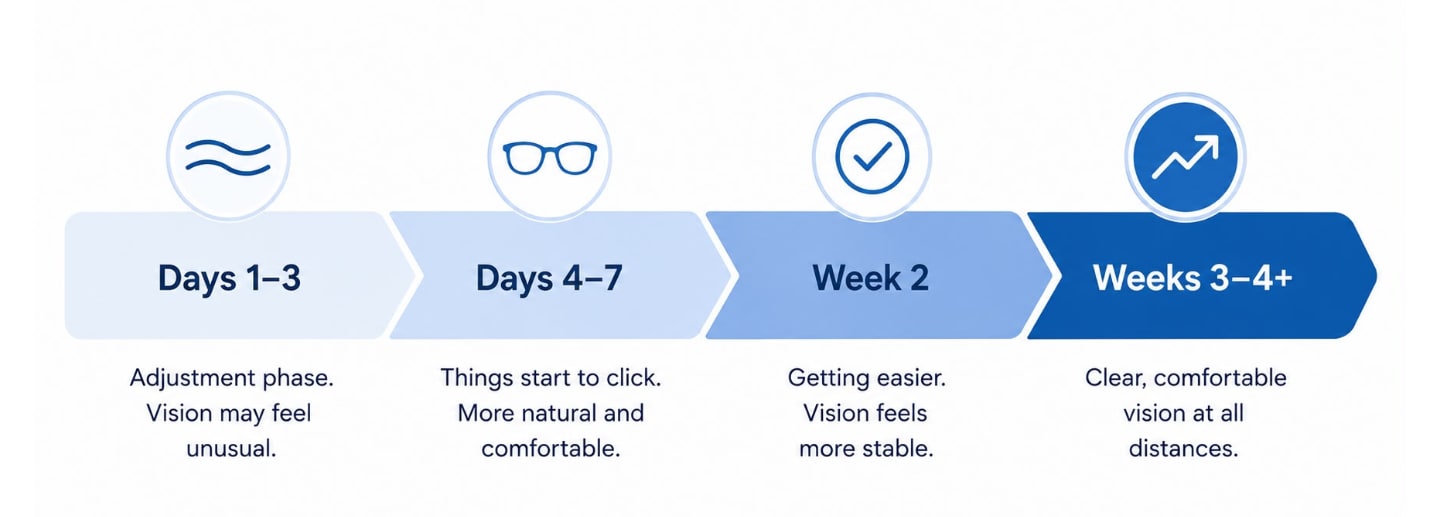
| Days 1–3 | Mild dizziness, a sense of the floor appearing closer, peripheral waviness (sometimes called the “swim” effect) | Wear consistently; avoid switching back to old glasses |
| Days 4–7 | Noticeable improvement for many; peripheral distortion becomes less distracting as head-movement habits form | Practice the nose-pointing technique deliberately |
| Week 2 | Many wearers report the lenses starting to feel close to automatic; reading position becomes more natural | Spend focused time on near tasks (reading, phone) to reinforce the reading zone |
| Weeks 3–4 | Further refinement, particularly for stronger prescriptions or first-time progressive wearers | Continue consistent wear; note any symptoms that aren’t improving |
| Beyond 4 weeks | Many people are comfortable by this point, though some may need longer to fully adapt | If symptoms persist, worsen, or show no meaningful improvement, contact your eye care provider |
| Clinical note – Norman Saffra MD FAAO: Consistent wear tends to matter more than any single technique. Alternating frequently between old and new glasses during the adjustment period may make the adaptation process less consistent. Wearing the new lenses as close to full-time as reasonably possible during the first two weeks is generally considered a helpful approach. |
What’s Commonly Reported vs. What Warrants a Call to Your Eye Care Provider
Distinguishing a typical adjustment experience from something that needs professional attention is one of the most useful things to understand before your first week even begins.
Commonly Reported During Adaptation
- Mild dizziness, particularly when looking around quickly or moving your head
- A sense that the floor or nearby objects appear closer than expected
- Peripheral waviness or softness at the edges of the lens
- Some initial awkwardness with stairs or curbs until head positioning becomes automatic
- Mild eye strain or a slight headache during the first few days, particularly with extended close work
| Contact your eye care provider if you experience: severe or persistent headaches; true spinning dizziness (as opposed to mild disorientation); double vision; significantly blurred vision at all distances; symptoms that are getting worse rather than better over time; or any of the above still present after roughly two to four weeks of consistent wear. These are reasons to be seen – not signs to wait out further. |
This list is general guidance and is not a substitute for professional evaluation. If something feels wrong to you, particularly if it’s affecting your ability to drive or move around safely, it’s reasonable to contact your eye care provider regardless of how long you’ve been wearing the lenses.
When the Issue May Be the Fit, Not the Adaptation
Not every difficulty with progressive lenses is simply a matter of waiting out the adjustment period. Some issues stem from how the lenses were measured or fitted rather than from the adaptation process itself:
- Incorrect fitting height: The point on the lens where your eye naturally looks through needs to be measured precisely for progressives. If a frame is too small or the measurement was off, the usable zones may be too narrow – this is a fitting issue, not something that resolves with more time.
- Pantoscopic tilt or frame position: How the frame sits on your face affects where the zones line up with your line of sight. A frame that has shifted or wasn’t adjusted correctly can create ongoing distortion.
- Prescription changes since the last exam: If your prescription has changed meaningfully since your last exam, this can compound adaptation difficulty independent of the lens design itself.
Frame choice affects progressive lens performance more than many buyers expect – this is covered in more depth in our guide to how frame choice affects progressive lens performance. If you’re still experiencing difficulty after the typical adjustment window, an optician can check whether the issue is fit-related rather than adaptation-related.
What If You Still Can’t Get Used to Your Progressive Lenses?
If the typical adjustment window has passed and things still don’t feel right, there’s a clear next path to follow rather than continuing to wait:
- Check the fit. Ask your optician to verify the fitting height, frame position, and whether the frame itself is appropriate for progressive lenses. This is one of the most common and most fixable causes of ongoing difficulty.
- Have your prescription verified. If vision remains blurred at any distance, a prescription check rules out a measurement issue.
- Ask about lens design options. Some progressive designs have wider viewing zones than others, which some wearers find easier to adapt to – this is worth discussing with your optician if adaptation has been unusually difficult.
- Contact your eye care provider if symptoms are severe, worsening, or still present well beyond the typical adjustment window. This isn’t a sign of failure – it simply means it’s time for a professional check rather than more waiting.
Adjusting to progressive lenses is a process most wearers move through successfully, and knowing what to expect tends to make it considerably less unsettling. The distinction that matters most: mild, improving symptoms during the first few weeks are commonly reported and generally resolve; symptoms that are severe or not improving are worth a conversation with your eye care provider.
You can browse our full range of progressive, bifocal, and multifocal glasses
FAQ’s
Is it normal to feel dizzy with new progressive lenses?
Mild dizziness is commonly reported by new progressive wearers, particularly during the first few days, and tends to ease with consistent wear as your visual system adapts. That said, dizziness that is severe, that involves a true spinning sensation, or that isn’t improving after 2-3 weeks is worth discussing with your eye care provider rather than assuming it will resolve on its own.
How long does it typically take to adapt to progressive lenses?
Many people notice meaningful improvement within one to two weeks of consistent wear, though the full adjustment period varies considerably from person to person – some reports range from about a week to a couple of months, depending on the individual, the prescription, and the lens design. Stronger prescriptions and first-time progressive wearers often take longer than those switching between progressive designs.
Can I speed up the adaptation process?
Wearing the lenses consistently – rather than switching back to old glasses – and practicing the head-position technique described above are the two things most commonly associated with faster adaptation. If screen use causes discomfort during the adjustment period, taking regular breaks and letting your eyes rest can help. There’s no guaranteed way to shorten the process for every individual.
My reading vision still isn’t clear after a week. Is that normal?
The reading zone often takes practice to locate consistently, since it requires a different head position than looking at a computer or driving. For specific tips on positioning for the reading zone, see our guide: how to read with progressive lenses. If reading vision is still unclear after several weeks of practicing correct positioning, it’s worth having the fit checked by your optician.
Should I stop wearing my progressives if I feel dizzy?
Brief breaks are reasonable if symptoms are uncomfortable – take the glasses off, rest, and try again later. But switching back to old glasses for extended periods during the adaptation window may slow the process. If dizziness is severe or persistent, this is a reason to contact your eye care provider rather than a reason to simply stop wearing the lenses without guidance.
| Disclaimer: This article is for informational purposes only and is not medical advice. The information presented is general in nature and may not apply to your individual circumstances. Consult a licensed eye care professional for personalized recommendations. Never disregard or delay professional medical advice based on this article. GlassesUSA makes no warranties regarding the information presented. Reliance is at your own risk. The eye care professional featured in this article is a paid spokesperson for GlassesUSA. All images in this article were generated using artificial intelligence (AI). |
Published August 18, 2026|Updated August 18, 2026
