
Single Vision vs. Progressive vs. Bifocal: Which Is Right for You?
Updated AUG 18, 2026 • 4 min read

| Single vision lenses correct one distance and are typically appropriate if you don’t have presbyopia or only need correction for one task (like reading). Bifocals correct two distances (distance and near) with a visible dividing line, and are often a lower-cost option for people who mainly need help with reading and don’t spend much time on intermediate tasks like computer work. Progressive lenses correct distance, intermediate, and near vision in one lens with no visible line, and tend to suit people who want a single, versatile pair for daily life, though they generally come at a higher cost and typically involve a longer adaptation period. Your eye care provider’s exam findings and your day-to-day visual needs are the best guide to which option fits your situation. |
Introduction
If you’ve been told you need multifocal correction – or you’re simply trying to understand your options before an eye exam – the choice between single vision, bifocal, and progressive lenses can feel more complicated than it needs to be. Each one solves a different problem, and understanding what each is actually built to do makes the decision much more straightforward.
This guide walks through what each lens type is, who each one tends to suit, and a practical framework for thinking through the decision. For the full picture of progressive lenses specifically – including cost and adaptation – see our complete guide to progressive lenses.
What Each Lens Type Actually Corrects
Single Vision Lenses
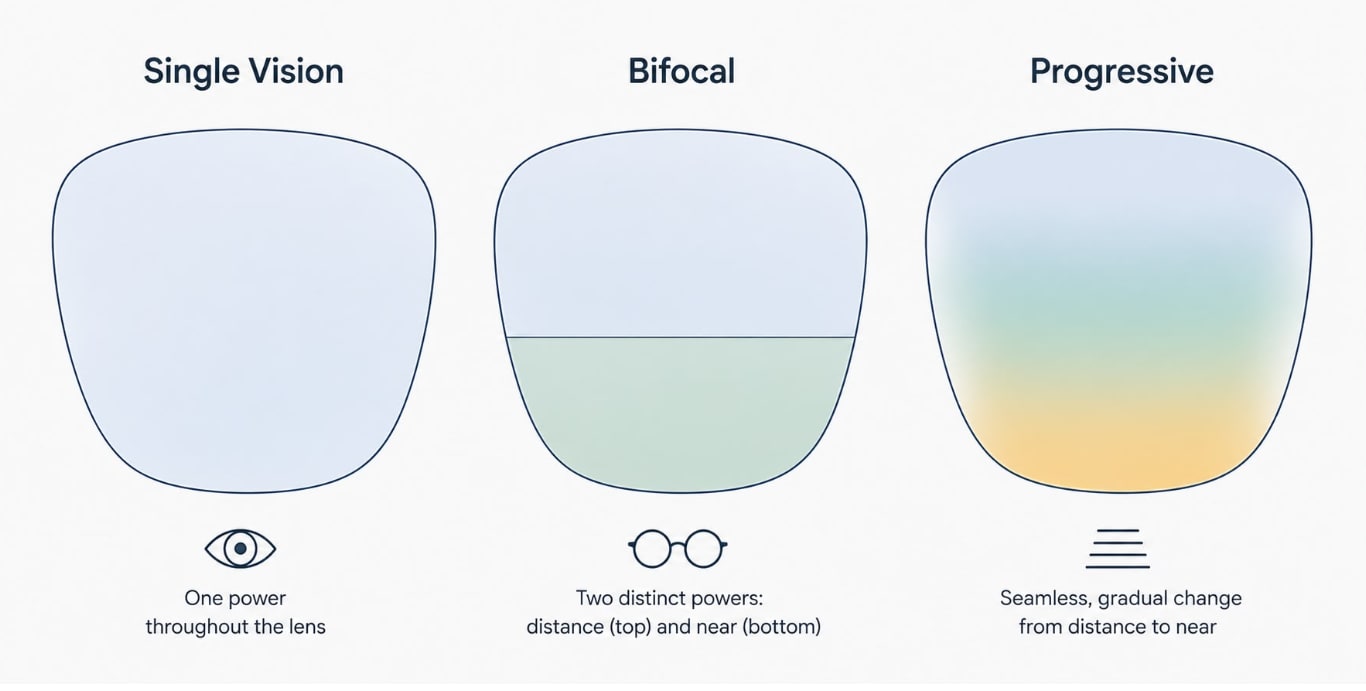
A single vision lens has one uniform prescription power across the entire lens, correcting one focal distance – typically either distance vision (for driving, general use) or near vision (for reading). This is the simplest lens design and generally the most affordable.
Single vision lenses for distance are often appropriate for people who don’t yet have presbyopia (the age-related change in near focusing ability that many people notice starting in an around age 40), or for people who want a dedicated pair for one specific task – for example, a dedicated pair of reading glasses, or computer galsses used alongside a second pair of distance glasses (if needed) or contact lense.
Bifocal Lenses
A bifocal lens contains two distinct powers in one lens, separated by a visible line: the upper portion corrects distance vision, and the lower segment – usually smaller and positioned toward the bottom – corrects near vision for reading. Moving your eyes between the two zones produces what’s often called an “image jump,” a noticeable shift as your line of sight crosses the dividing line.
Traditional bifocals don’t include a dedicated intermediate zone, which can make computer-distance tasks less convenient for some wearers – unless a trifocal design is used, which adds a third zone. Bifocals are often less expensive than progressives, although pricing varies by lens design, materials, features, and retailer. Because the two viewing zones are clearly defined rather than gradually blended, some people find bifocals relatively straightforward to adapt to.
Progressive Lenses
A progressive lens blends distance, intermediate, and near correction into a single lens with no visible dividing line – the power changes gradually from top to bottom. This is why progressives are sometimes called “no-line bifocals”, although the design and experience differ meaningfully from a traditional bifocal.
Progressives typically cost more than single vision or bifocal lenses and generally involve a longer adaptation period, since the zones blend together and the sides of the lens contain some inherent softening of focus. For a full breakdown of what that adaptation process tends to look like, see our guide: how to adjust to progressive lenses.
| Common point of confusion: Progressives are often called “no-line bifocals,” which leads some people to assume they’re the same thing as a traditional bifocal with the line simply removed. They’re not — the internal design and how the eye moves through the lens are genuinely different. For a detailed look at this distinction, see our guide: no-line bifocals vs. traditional bifocals |
Side-by-Side Comparison
| Single Vision | Bifocal | Progressive | |
| Vision zones | One | Two, with visible line | Three+, blended, no line |
| Visible line | No | Yes | No |
| Relative cost | Typically lowest | Generally moderate | Often highest |
| Typical adaptation | None needed | Typically several days to about a week | Generally longer — see our adaptation guide |
| Intermediate vision (computer distance) | Not corrected | Not corrected (unless trifocal) | Corrected |
| Aesthetic | No visible correction zones | Visible line | No visible line |
A Practical Way to Think Through the Decision
The right lens type generally comes down to three questions: do you have presbyopia, do you need correction for more than one distance in daily life, and how much does a completely seamless, line-free appearance matter to you.
If You Need Correction for One Distance or Task
Single vision lenses are often appropriate for people who don’t have presbyopia, or for people who need correction for one specific viewing distance or task, regardless of whether you’re nearsighted, farsighted, or have astigmatism. Your eye care provider’s exam will indicate whether presbyopia is a factor for you and whether single vision correction meets your needs.
If You Mainly Struggle with Reading and Don’t Spend Much Time on Computer or Intermediate Tasks
A bifocal – or in some cases, single vision reading glasses used alongside your regular glasses or contacts — may be a practical, lower-cost option. This tends to suit people whose near-vision needs are fairly occasional or predictable (reading a book, a menu, a prescription label) rather than needing to move fluidly between distances throughout the day.
If you’re specifically weighing whether you need a prescription reading solution at all versus off-the-shelf readers, see our guide: prescription reading glasses vs. over-the-counter readers.
If You Move Between Distance, Computer, and Reading Throughout the Day
Progressive lenses tend to be the more practical option for people who don’t want to switch glasses repeatedly across a typical day – driving, working at a screen, and reading, often within the same hour. The higher cost and adaptation period are the trade-off for that day-to-day versatility.
If your daily near-vision needs are concentrated around a computer screen specifically, it’s also worth knowing that standard progressives have a narrower intermediate zone than office-specific designs – covered in our guide to progressive lenses for computer use.
If You Prefer a Lens Without a Visible Line
Progressives may appeal to people who prefer a lens without a visible dividing line between vision zones. This is a legitimate and common factor in the decision, not a superficial one – many people simply prefer how progressives look and feel in daily wear.
| Worth knowing: You don’t necessarily have to rely on one lens type for every situation. Some people use one pair for everyday wear and keep a separate pair of single vision computer or reading glasses for specific tasks. Your eye care provider can help you decide what combination makes sense for your visual needs. |
Cost and Adaptation: The Trade-Off in Brief
In general, single vision lenses tend to be the least expensive and require no lens-design adaptation. Bifocals often cost less than progressives, with a generally shorter adaptation period since the two zones are clearly defined. Progressives often cost more than single vision and traditional bifocal lenses and generally involve a longer adaptation period, in exchange for a wider range of corrected distances in a single, line-free lens. Actual pricing varies by lens design, materials, features, and retailer.
Whether that trade-off is worth it depends on how much you value not switching glasses throughout the day, versus a lower cost and a more predictable, shorter adjustment.
There’s no single right answer that applies to everyone – the decision genuinely depends on your specific vision needs, budget, and how you spend your day. What matters most is going into the conversation with your eye care provider understanding what each option actually does.
FAQ’s
Can I just get progressive lenses even if I don’t strictly need them?
This is a conversation to have with your eye care provider based on your exam results. Progressive lenses are generally intended for people with presbyopia or a genuine need for multiple correction zones – for people without that need, a progressive lens may offer little or no functional advantage over single vision while adding cost and an adaptation period.
Are bifocals outdated compared to progressives?
Not necessarily – bifocals remain a practical, lower-cost option for people whose near-vision needs are focused and predictable, and some people genuinely prefer the wider, clearly defined reading zone that bifocals provide over the narrower reading zone in a progressive. “Outdated” reflects a stylistic preference more than a functional shortcoming.
Do I need different lenses for computer use if I already have progressives?
Many people find standard progressives sufficient for occasional computer use, but those who spend many hours at a screen may find the intermediate zone narrower than ideal. This is a common enough situation that dedicated office/computer progressive designs exist.
How do I know which one my eye exam supports?
Your eye care provider’s exam results – specifically whether presbyopia is present and the degree of correction needed at each distance – determine which lens types are clinically appropriate for you. This article is meant to help you understand the options and enter that conversation informed, not to replace the exam itself.
| Disclaimer: This article is for informational purposes only and is not medical advice. The information presented is general in nature and may not apply to your individual circumstances. Consult a licensed eye care professional for personalized recommendations. Never disregard or delay professional medical advice based on this article. GlassesUSA makes no warranties regarding the information presented. Reliance is at your own risk. The eye care professional featured in this article is a paid spokesperson for GlassesUSA. All images in this article were generated using artificial intelligence (AI). |
Published August 18, 2026|Updated August 18, 2026
