
UV and Blue Light Protection in Safety Glasses
Updated OCT 18, 2026 • 6 min read

| Quick Answer Different work environments create fundamentally different eye hazards, and no single type of safety eyewear handles all of them well. For chemical splash hazards, indirect-vent goggles with a properly fitted seal around the eyes are generally the appropriate choice, depending on the specific chemical and task. Welding requires a properly selected filter lens appropriate for the specific welding process and operating conditions, generally as part of a helmet, with separate impact-rated safety glasses worn underneath for grinding and spatter. For significant exposure to fine or heavy dust, sealed or indirect-vent goggles may provide more appropriate coverage than open-frame safety glasses, depending on the task and exposure. General impact hazards – flying debris, chips, and fragments – call for high-velocity-rated (Z87+) safety glasses or goggles. The starting point for any of it is your workplace’s specific hazard assessment, not a single general-purpose pair of glasses. |
Introduction
A single pair of Z87-rated safety glasses is a reasonable default requirement for lots of general types of work, but it isn’t the right answer for every hazard. Chemical splash, welding radiation, fine dust, and blunt impact each demand a different kind of protection, and treating them all the same way is one of the more common – and preventable – gaps in workplace eye safety.
This guide walks through several common work environments and the hazards specific to each one, so you can match the type of eyewear to the actual risk rather than defaulting to whatever’s on hand. Specific requirements of your employer or job should always be confirmed prior to any purchase. For the fundamentals of help in choosing safety glasses generally, see our complete guide to choosing safety glasses. for a full breakdown of what the ANSI and OSHA markings mentioned below actually mean, see our dedicated guide to safety standards.
Construction: Flying Debris and Dust
Construction sites generate a wide mix of hazards – wood and metal fragments from cutting and nailing, concrete dust from grinding, and general airborne debris – most of which fall under general impact protection rather than a specialized category. High-velocity-rated (Z87+) safety glasses with side shields or a wraparound lens are the practical default for most construction tasks. For heavier dust exposure, such as concrete cutting or demolition, sealed or indirect-vent goggles provide more complete protection than open-frame glasses, and are often paired with a face shield for tasks that also throw larger fragments.
Laboratory: Chemical Splash
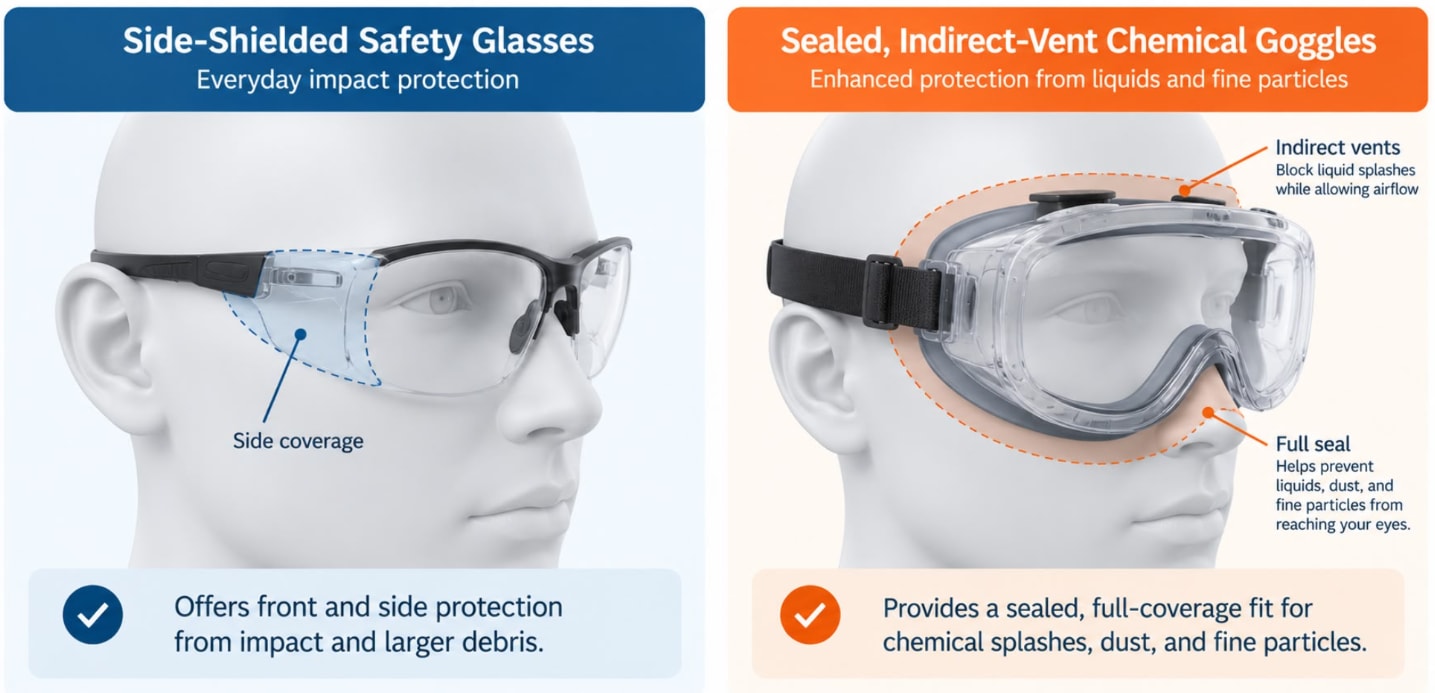
Lab work introduces a hazard that general-purpose safety glasses aren’t built for: liquid chemical splash. Standard spectacles, even with side shields, don’t create a seal around the eyes – they reduce the lateral gap but don’t stop a splash from reaching the eye from below or during a sudden spill.
For tasks that involve handling chemicals directly, indirect-vent goggles with a splash rating are generally the more appropriate choice, since the indirect venting allows some airflow – reducing fogging – while the goggle body still maintains a seal against liquid entry. The specific choice depends on the chemical involved and the task, so it’s worth confirming against your workplace’s hazard assessment or safety data sheet rather than assuming one goggle type covers every chemical splash scenario. For lab tasks that don’t involve direct chemical handling, such as general glassware use or observation, side-shielded safety glasses may be adequate, but again, the determining factor is the specific task and its hazard assessment, not the room label.
| Worth knowing: CDC/NIOSH guidance on eye protection notes that well-fitted, indirectly-vented goggles with an anti-fog coating are generally the most reliable practical choice for protecting against splashes, sprays, and droplets – more reliable than open safety glasses, which aren’t designed to form a seal. |
Welding: Radiation, Not Just Impact
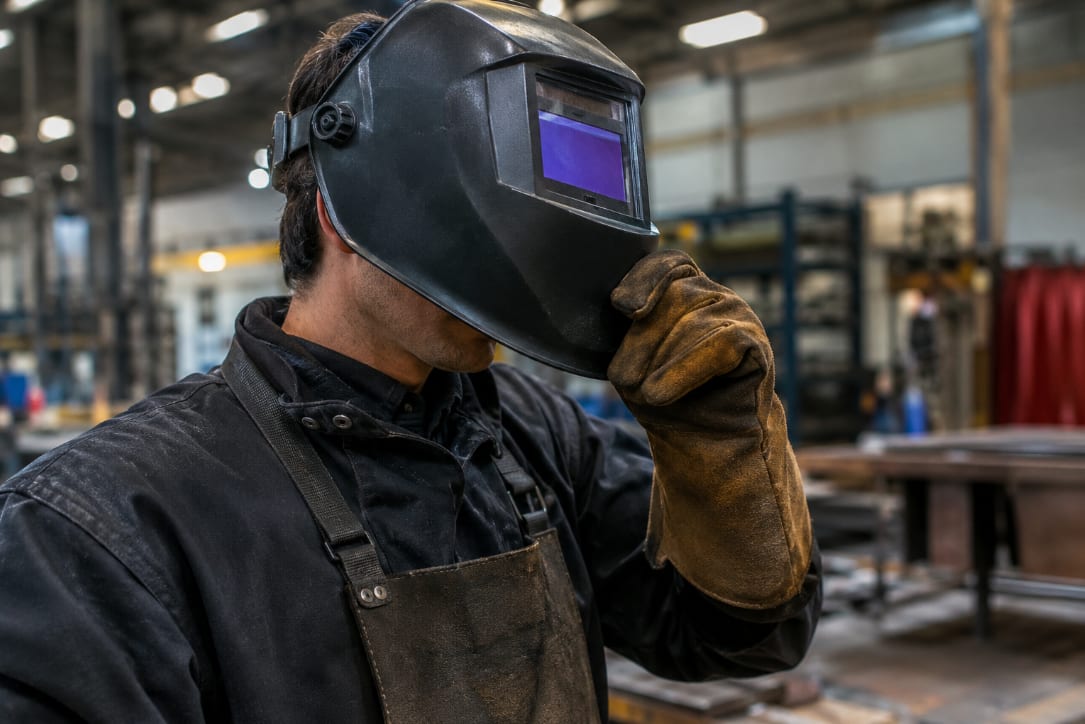
Welding introduces a hazard category that construction and lab work don’t: intense ultraviolet, visible, and infrared radiation from the arc itself, on top of the usual spatter and grinding debris. This means welding eye protection has two separate jobs, often handled by two separate pieces of equipment.
The welding helmet’s filter lens must have a shade appropriate for the specific welding or cutting process and operating conditions. The correct shade varies by process and current, so there is no single shade that is appropriate for every welding task. Workers should follow the applicable OSHA requirements and the equipment manufacturer’s guidance when selecting the filter shade.
Separately, OSHA guidance notes that where there’s also a risk of flying particles – slag chips, grinding fragments, wire brush bristles – workers using a welding helmet still need impact-rated safety glasses with side shields underneath it. The helmet’s filter lens handles the radiation; the glasses underneath handle the debris.
| Clinical note – Norman Saffra MD FAAO: It’s worth being specific about this distinction, because eyewear that looks protective isn’t automatically protective against the hazard actually present. A welder wearing only impact-rated safety glasses, with no filter lens or helmet in use, is protected from flying debris but not from the arc’s radiation – and the reverse is also true. Matching the equipment to the specific hazard, rather than assuming any “safety-looking” eyewear covers every risk in the room, is the core of this whole topic. |
Electrical Work and Arc Flash: A Common Point of Confusion
Arc flash is a different hazard from welding radiation – it’s a short, intense release of thermal energy and light from an electrical fault rather than a controlled welding arc – and it comes with its own standard, NFPA 70E, and its own common misunderstanding.
| Misconception: “Safety glasses can be arc-rated for arc flash protection, similar to how a face shield is rated.”What’s actually true: Arc-flash protection requires appropriately rated protective equipment for the specific electrical hazard. Safety glasses provide primary eye protection, while additional face and head protection may be required for arc-flash hazards. The specific requirements depend on the task and the applicable hazard assessment – consult your employer’s safety officer or a qualified electrical safety professional for guidance specific to your workplace. |
Matching Eyewear to Environment: A Quick Reference
| Environment | Primary Hazard | Relevant Marking / Rating | Generally Recommended Type |
| Construction | Flying debris, wood/metal fragments, dust | Z87+ | Wraparound or side-shielded Z87+ safety glasses |
| Laboratory (chemical handling) | Liquid chemical splash | D3 (splash) | Indirect-vent chemical splash goggles |
| Laboratory (general use) | Minor impact, dust | Z87 | Side-shielded safety glasses |
| Welding | UV/IR radiation, intense visible light | W + shade number | Helmet with process-appropriate filter shade, plus Z87+ glasses underneath |
| Grinding / machining | High-velocity particles | Z87+ | Wraparound Z87+ safety glasses or goggles |
| Heavy dust environments | Fine or coarse airborne dust | D4 / D5 | Sealed, indirect-vent dust goggles |
| Electrical / arc flash | Thermal energy, brief intense flash | ANSI Z87.1 glasses + separately arc-rated face shield (NFPA 70E) | Z87.1 safety glasses worn under an arc-rated face shield or hood |
| Outdoor / utility / landscaping | UV exposure, glare, general debris | Z87+ | Wraparound Z87+ glasses, tinted or photochromic |
The right safety eyewear for a given environment comes down to matching the equipment to the specific hazard actually present – impact, splash, radiation, or dust – rather than assuming one general-purpose pair covers everything. When a task involves more than one hazard, that generally means combining pieces of equipment (glasses under a helmet, or a face shield over goggles) rather than looking for one product that does it all.
FAQ’s
Can I use the same safety glasses for welding and general shop work?
Generally not for the welding itself. Ordinary impact-rated safety glasses don’t have a filter lens shaded for the process and amperage, so they don’t protect against arc radiation. Many welders wear impact-rated glasses underneath a welding helmet specifically for the debris and spatter risk, while the helmet’s filter lens handles the radiation – the two serve different purposes.
Do chemical splash goggles need to be indirectly vented?
Indirect venting is generally preferred for chemical splash protection, since it allows some airflow to reduce fogging while the goggle body still maintains a seal against liquid entry. Directly vented goggles allow more airflow but can also let splashes or fine particles through the vents, which is why indirect venting is the more commonly recommended choice for splash-heavy tasks.
Is a face shield alone enough for chemical splash or arc flash protection?
No. Face shields are generally intended to be worn over primary eye protection – safety glasses or goggles – rather than as a standalone substitute. For many workplace hazards, a face shield is used in addition to, rather than instead of, primary eye protection. They protect a broader area of the face, but they don’t reliably seal against splash entering from below or around the edges, or against the specific hazard type the underlying eyewear is rated for.
How do I know which category my job actually falls into?
Job titles are a rough guide at best – the same title can involve very different tasks depending on the specific workplace and equipment. The reliable way to determine which eyewear category applies is your employer’s hazard assessment for the specific task, not a general assumption based on the industry or job description.
| Disclaimer: This article is for informational purposes only and is not medical advice. The information presented is general in nature and may not apply to your individual circumstances. Consult a licensed eye care professional for personalized recommendations. Never disregard or delay professional medical advice based on this article. GlassesUSA makes no warranties regarding the information presented. Reliance is at your own risk. The eye care professional featured in this article is a paid spokesperson for GlassesUSA. All images in this article were generated using artificial intelligence (AI). |
Published October 18, 2026|Updated October 18, 2026
