
Safety Glasses Materials: Polycarbonate, Trivex, Anti-Fog, and Coatings
Updated OCT 18, 2026 • 5 min read

| Polycarbonate is the most widely used lens material for safety glasses, offering very high impact resistance, built-in UV protection, and light weight -it’s the practical default for most ANSI Z87.1-rated eyewear. Trivex offers comparable impact resistance with somewhat better optical clarity, at a similar or slightly higher cost. Beyond material, the coatings that matter most depend on your environment: anti-fog becomes especially valuable if you move between temperature zones or wear a mask, while scratch resistance matters most in dusty, abrasive environments like construction and grinding. Standard prescription plastic (CR-39) generally does not provide enough impact resistance on its own for most ANSI Z87.1-rated eyewear. |
Introduction
The lens material in a pair of safety glasses does most of the actual protective work -the frame keeps the lens in place, but the material determines whether it holds up under impact, and the coatings determine whether you can actually see clearly through it all day. This guide covers what the material and coating choices actually mean in practice, so you can match them to your specific work environment rather than defaulting to whatever’s cheapest or most heavily marketed.
For a broader look at lens materials generally, including how they apply to everyday prescription glasses, see our guide to lens materials, index, and coatings; for the full picture of choosing safety glasses, see our complete guide to choosing safety glasses.

Lens Material: Polycarbonate vs. Trivex vs. Standard Plastic
Impact resistance is a core requirement for safety eyewear, and lens material plays a major role in how well a lens performs under impact. But ANSI Z87.1 compliance depends on the tested eyewear configuration as a whole -lens, frame, and construction together -not on material alone.
| Polycarbonate | Trivex | CR-39 (Standard Plastic) | |
| Impact resistance | Very high | Very high -comparable to polycarbonate | Moderate -generally not used for high-impact safety eyewear |
| Weight | Light | Slightly lighter than polycarbonate | Medium |
| Optical clarity | Good; lower Abbe value means some peripheral distortion at stronger powers | Better peripheral clarity than polycarbonate at equivalent thickness | Excellent, but at the cost of impact resistance |
| UV protection | Built-in | Built-in | Requires added coating |
| Typical use in safety eyewear | The most common safety lens material | Common alternative, often chosen for comfort or optical quality | Generally not used for ANSI-rated protection |
Polycarbonate
Polycarbonate is the standard lens material for ANSI-rated safety eyewear, and for good reason: it’s significantly more impact-resistant than standard plastic, inherently blocks UV radiation without a separate coating, and is lighter than glass or standard plastic. Its main trade-off is a lower Abbe value, which means somewhat more chromatic distortion at the edges of the lens compared to some alternatives -noticeable mainly in stronger prescriptions, not a practical issue for most wearers.
Trivex
Trivex offers impact resistance comparable to polycarbonate, with generally better optical clarity and a slightly lighter weight. It’s a reasonable alternative where optical quality is a higher priority -for example, precision or detail-oriented work – though it isn’t universally available across every safety frame and can cost somewhat more.
Why Standard Plastic (CR-39) Generally Isn’t Used for Safety Ratings
Standard plastic offers excellent optical clarity, but it generally does not provide the impact resistance needed for most ANSI Z87.1-rated safety eyewear, and it doesn’t inherently block UV without an added coating. It remains an appropriate choice for many everyday prescription glasses, but it’s not the material typically specified when ANSI Z87.1 compliance is the goal.
Anti-Fog: When It’s More Than a Nice-to-Have
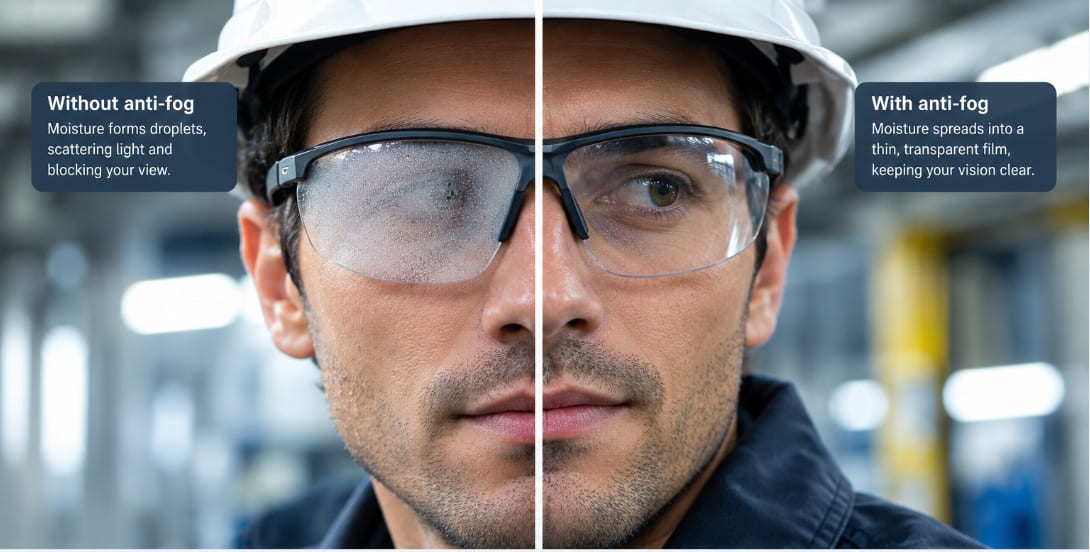
Fogging is one of the most commonly reported reasons workers remove safety glasses mid-task -which defeats the purpose of wearing them at all. Anti-fog coatings work by making the lens surface hydrophilic: instead of moisture forming visible droplets that scatter light, it spreads into a thin, transparent film.
- Permanent (factory) coatings: Bonded into the lens during manufacturing. These are generally more durable than temporary sprays or wipes and are typically the better choice for daily occupational use.
- Temporary treatments (sprays, wipes): Sit on top of the lens surface rather than being bonded into it. They provide short-term relief but typically wear off within weeks with normal handling and cleaning -reasonable as a stopgap, not a long-term solution for daily fogging.
- Single-sided vs. dual-sided coating: Most workplace fogging originates from the inside of the lens -body heat and breath -so a coating applied to the inner surface addresses the majority of cases. Dual-sided coating, applied to both surfaces, provides more complete protection when temperature-differential fogging (cold air on a warm lens, or vice versa) is also a factor.
| Worth knowing: Testing and marking criteria for anti-fog performance were added to the ANSI/ISEA Z87.1 standard as part of its 2020 revision, reflecting how significant a factor fogging is in real-world compliance. Not all safety glasses that mention “anti-fog” in marketing carry a verified, tested coating -checking the specific product’s documentation is worth the extra step if this matters for your environment. |
Anti-fog becomes especially valuable if you regularly move between temperature zones (a warehouse and a cold storage area, for example), wear a mask or respirator alongside your glasses, or work in humid or high-exertion conditions.
Scratch-Resistant Coatings
Polycarbonate and Trivex are both relatively soft materials compared to glass, which means they scratch more easily without a protective coating. This matters beyond appearance: OSHA’s eye and face protection guidance notes that pitted lenses can reduce vision the same way dirty lenses can, and that deeply scratched or excessively pitted lenses are more prone to breaking -meaning damaged lenses should be replaced rather than assumed to still perform at their original rating.
Scratch-resistant coatings are a practical priority in environments with abrasive dust or debris -construction, grinding, metal fabrication -and less critical in cleaner environments like most laboratory or office-adjacent settings. If a lens develops visible distortion, glare, or a haze from scratching, that’s a reasonable point to replace it rather than continue relying on its original impact rating.
Tints, Mirror Coatings, and Outdoor Use
The ANSI/ISEA Z87.1 standard sets minimum light transmittance requirements for tinted and filter lenses, since a tint that’s too dark for the situation reduces visibility rather than improving comfort. This is why lenses designed for bright outdoor use are generally not appropriate for indoor wear -the same tint that reduces glare outdoors can make an indoor space feel too dark to work in safely.
- Gray/smoke tints: A common general-purpose choice for reducing glare in bright outdoor conditions without significantly altering color perception.
- Amber/yellow tints: Filter blue light specifically, which can improve contrast in low-light or hazy conditions -a common choice for early morning, dusk, or overcast environments.
- Mirror coatings: Reflect a portion of incoming light, generally reducing visible light transmission further than a standard tint of the same base color -best suited to consistently bright conditions rather than mixed indoor/outdoor
- Indoor/outdoor (I/O) mirror tints: A lighter mirror tint specifically designed to reduce glare while remaining usable during transitions between indoor and outdoor environments -a practical middle ground for workers who move between both throughout a shift.
- Photochromic lenses: Darken automatically in UV light and clear indoors. These are compatible with ANSI impact ratings and can be a practical option for workers who transition frequently between indoor and outdoor tasks.
| Misconception: “A darker, more mirrored lens is always more protective.” What’s actually true: Tint darkness relates to visible light transmission and glare reduction -it doesn’t increase impact resistance, which comes from the lens material and construction. A heavily tinted lens worn in the wrong setting (indoors, at dusk, or in a dim work area) can reduce safe visibility rather than improve it. |
Decision Guide: Matching Coatings to Your Environment
| Environment | Anti-Fog Priority | Scratch-Resistance Priority | Tint/Coating Notes |
| Construction (outdoor) | Moderate -depends on exertion and climate | High -dust and abrasive debris are constant | Gray/smoke or mirror for bright sun; clear for overcast/indoor transitions |
| Laboratory | High -often paired with masks or fluctuating temperatures | Low to moderate | Typically clear; specialized tints only for specific procedures |
| Warehouse (mixed indoor/outdoor) | High -moving between temperature zones is a common trigger | Moderate | Indoor/outdoor (I/O) mirror tint is often suited to frequent transitions |
| Grinding/machining | Moderate | Very high -abrasive particulate is the primary threat to lens life | Clear or lightly tinted; visibility of fine detail matters |
| Outdoor utility/landscaping | Moderate to high depending on exertion | Moderate | Gray or amber tint for glare/contrast; consider photochromic for variable light |
| Clinical note – Norman Saffra MD FAAO: Coating choices are often treated as an afterthought compared to the headline impact rating, but they directly affect whether the glasses can perform in the work environment. A worker who removes fogged-up glasses to see clearly, even briefly, has created exactly the gap in protection the eyewear was meant to prevent. Matching the coating to the real conditions of the job is a meaningful part of the safety decision, not just a comfort upgrade. |
The right lens material and coating combination depends on what your specific work environment actually demands -not on which option sounds the most advanced. Polycarbonate remains the practical default for most situations, with Trivex as a reasonable alternative, and coatings chosen to match your specific climate, task, and exposure rather than added indiscriminately.
FAQ’s
Is Trivex better than polycarbonate for safety glasses?
Not universally -both provide comparable impact resistance suitable for ANSI-rated eyewear. Trivex generally offers somewhat better optical clarity, which can matter for detail-oriented work or stronger prescriptions, while polycarbonate is more widely available and often less expensive. The better choice depends on your specific priorities and what’s available for your frame.
Can I add anti-fog spray to safety glasses that don’t have a built-in coating?
Yes, temporary anti-fog sprays and wipes can be used on any lens and provide short-term relief. They’re a reasonable option for occasional fogging or as a stopgap, but they wear off with normal handling and cleaning and need to be reapplied regularly. For daily, reliable fog prevention, a factory-applied permanent coating performs more consistently over time.
Do scratched safety glasses still meet ANSI Z87.1 requirements?
ANSI Z87.1 impact ratings apply to lenses in their original, undamaged condition. Significant scratching, pitting, or surface damage can reduce a lens’s actual impact performance below its rated level, even though the original marking remains on the frame. If scratching is visibly affecting clarity or is extensive, replacing the lens is the safer choice rather than relying on the original rating.
Can I wear outdoor-tinted safety glasses indoors?
Generally, this isn’t recommended. Lenses tinted for bright outdoor conditions reduce light transmission enough that indoor spaces can feel too dark to work in safely. If your role involves moving between indoor and outdoor areas throughout the day, a lighter indoor/outdoor (I/O) mirror tint or a photochromic lens is generally a more practical choice than a single heavily-tinted outdoor lens.
| Disclaimer: This article is for informational purposes only and is not medical advice. The information presented is general in nature and may not apply to your individual circumstances. Consult a licensed eye care professional for personalized recommendations. Never disregard or delay professional medical advice based on this article. GlassesUSA makes no warranties regarding the information presented. Reliance is at your own risk. The eye care professional featured in this article is a paid spokesperson for GlassesUSA. All images in this article were generated using artificial intelligence (AI). |
Published October 14, 2026|Updated October 18, 2026
