
How to Clean and Maintain Safety Glasses
Updated OCT 18, 2026 • 4 min read

| Quick Answer Safety glasses generally hold up best with a simple routine: rinse with lukewarm water to remove grit before wiping, clean with mild soap or a lens-safe cleaner and a microfiber cloth, and avoid paper towels, tissues, alcohol- or ammonia-based cleaners, and high heat -all of which can degrade anti-fog and scratch-resistant coatings over time. In shared-use environments, disinfecting generally calls for an approved disinfectant rather than soap and water alone. Store safety glasses in a hard case rather than loose in a bag or pocket, and treat pitted, deeply scratched, cracked lenses, or coatings that are visibly peeling or hazing, as a reasonable prompt to replace the eyewear rather than continuing to rely on its original protection level. |
Introduction
Much of the general advice on cleaning eyeglasses is written with everyday wear in relatively clean conditions in mind. Safety glasses face a different set of demands – dust, grease, sweat, shared use between shifts, and coatings that have to keep working under real physical stress. This guide focuses specifically on what’s different about caring for safety eyewear, rather than repeating general glasses-cleaning basics.
For the fundamentals of choosing safety glasses generally, see our complete guide to choosing safety glasses.
The Basics: Cleaning Without Damaging Coatings
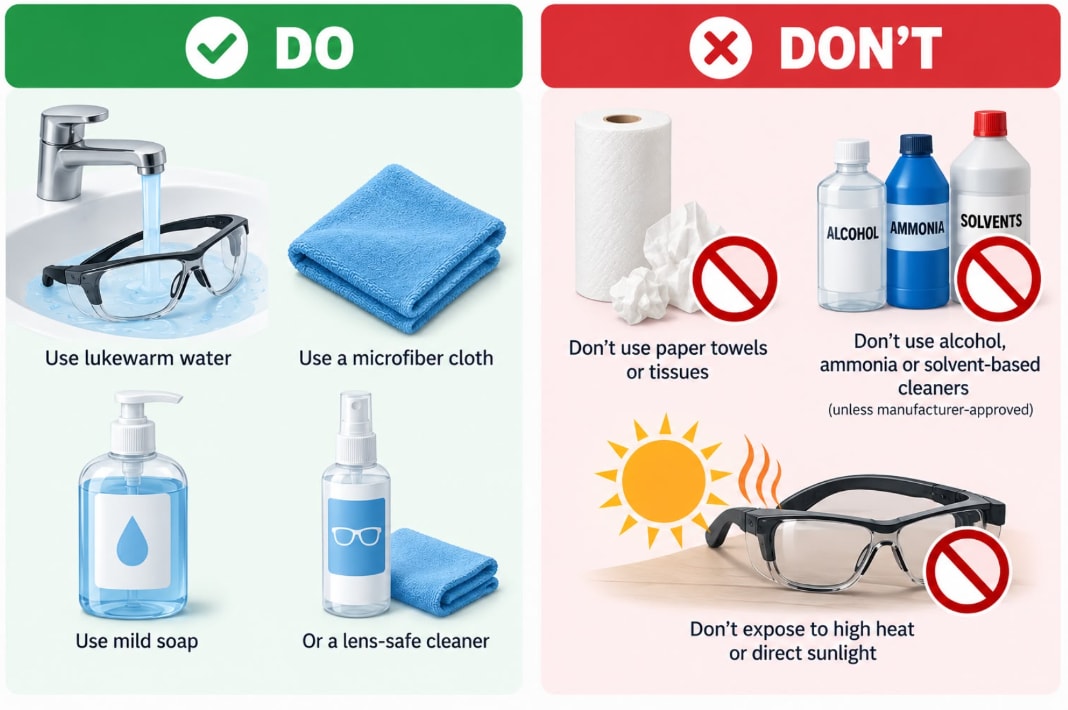
Rinsing lenses with lukewarm water before wiping removes grit and dust that would otherwise grind into the lens surface and cause fine scratches. From there, a small amount of mild soap or a lens-safe cleaning spray, applied with a clean microfiber cloth, generally handles most everyday dirt and oils without harming coatings.
A few materials and products are worth avoiding consistently: paper towels, tissues, and clothing are all abrasive at a microscopic level and can leave fine scratches over repeated use. For cleaning products, a reasonable default is to avoid alcohol-, ammonia-, or solvent-based cleaners unless the eyewear manufacturer specifically says they’re compatible with that lens and coating, since coating formulations vary by manufacturer and product. Hot water or high heat -including a hot dashboard or direct sunlight -is also worth avoiding, since several eyewear manufacturers specifically warn that prolonged heat exposure can damage coatings and warp frames even without any physical contact.
Anti-Fog Coatings Need Extra Care
Anti-fog coatings are often the first thing to degrade with rough handling, and fogging is one of the more common reasons workers end up removing safety glasses mid-task -which defeats the purpose of wearing them. A few habits make a meaningful difference: dry the lens gently by patting rather than rubbing or scrubbing, since manufacturer care guidance for coated lenses generally identifies friction as a leading cause of premature coating wear; avoid layering a separate anti-fog spray or wipe onto a lens that already has a factory-applied coating unless you’ve confirmed the two are compatible; and treat any noticeable haze or reduced anti-fog performance as a sign the coating has been damaged, rather than something a different cleaning product will fix.
| Worth knowing: Heat is a common but easy-to-overlook cause of coating damage. Manufacturer guidance for protective eyewear -3M’s product documentation, for example, specifically instructs against storing eyewear on a vehicle dashboard, noting that prolonged exposure to intense heat can damage eyewear -generally reflects this same caution across brands. Leaving safety glasses on a dashboard, near a heater, or in direct sun for extended periods can degrade anti-fog and other coatings over time, even if the lens is never touched or wiped during that time. |
Scratch-Resistant Coatings and General Lens Care
The same handling habits that protect anti-fog performance also protect scratch-resistant coatings: rinse before wiping, use a microfiber cloth rather than anything abrasive, and avoid dry-wiping over visible dust or grit. In dustier or more abrasive environments -construction, grinding, metal fabrication -it’s worth being more deliberate about rinsing frequently rather than wiping a dry lens out of convenience between tasks.
Handling the glasses by the frame rather than the lens also helps, since skin oils and residue from hands -particularly in industrial settings with grease, sunscreen, or other products in use -can transfer onto the lens and cloud it over time.
Disinfecting Safety Glasses in Shared-Use Environments
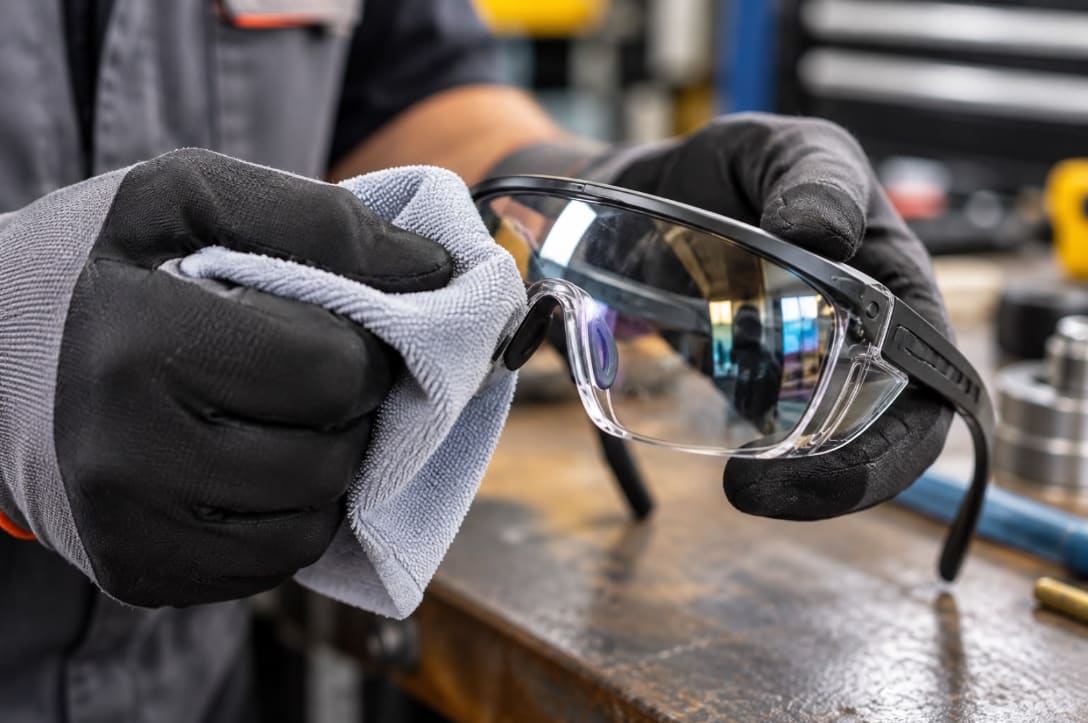
When safety glasses are used by more than one worker -loaner pairs, visitor stock, or shared equipment between shifts -cleaning with soap and water alone is generally not the same as disinfecting. CDC/NIOSH guidance on eye protection recommends that contaminated or shared eyewear be cleaned and disinfected using an approved disinfectant, and that eyewear be handled by the parts that secure it to the head -such as the temples -since the front and sides of the lens are more likely to have been in contact with whatever the eyewear was protecting against.
Where practical, CDC/NIOSH guidance generally favors each worker having their own assigned eye protection over shared use, specifically to reduce the risk of exposing the next wearer. If shared use is unavoidable in your workplace, following your employer’s specific disinfection procedure -rather than assuming a quick wipe is equivalent -is the more reliable approach.
| Clinical note -Norman Saffra MD FAAO: Disinfection and lens-coating care can pull in different directions: many general-purpose disinfectants are more aggressive than the mild soap recommended for everyday coating care. Following your employer’s specific approved disinfection procedure, rather than substituting a household product because it seems similar, protects both the coating and the actual disinfection outcome. |
Storage Between Shifts
A hard case is generally the more protective storage option between uses, keeping lenses away from contact with tools, keys, or other hard objects that can scratch the lens or bend the frame. Loose storage in a pocket, tool bag, or dashboard exposes the lenses to exactly the kind of incidental contact and heat that gradually degrades both scratch-resistant and anti-fog coatings. Storing glasses lens-down on a hard surface, even briefly, is also worth avoiding, since it puts the coated surface in direct contact with whatever’s underneath.
| Misconception: “As long as I can still see through them, a few scratches on my safety glasses are just a cosmetic issue.” What’s actually true: Surface damage isn’t purely cosmetic. Pitted or deeply scratched lenses can be a source of reduced vision on their own, and significant scratching or pitting can affect how a lens performs compared to its original, undamaged condition. If scratching is extensive or starting to affect clarity, replacing the eyewear is generally a more reliable choice than continuing to rely on its original rating. |
When to Replace Your Safety Glasses?
A few signs are generally worth treating as a prompt to replace rather than continue using a pair of safety glasses: lenses that are pitted, deeply scratched, or cracked; coatings that are visibly peeling, hazing, or no longer functioning (a formerly anti-fog lens that now fogs consistently, for example); frames with cracks, loose temples, or other structural damage; and any damage that noticeably affects clarity or fit. None of these require a formal inspection process to notice -they’re generally apparent during normal use, which is why a quick visual check before a shift is a reasonable habit in demanding environments.
Most of what keeps safety glasses performing well over time comes down to a few consistent habits: rinse before wiping, use a microfiber cloth, avoid heat and harsh chemicals, store them properly between uses, and treat visible damage as a prompt to replace rather than something to work around. None of this requires special equipment -just a routine that fits the conditions the glasses actually work in.
FAQ’s
Can I use regular eyeglass cleaner spray on safety glasses?
Generally, yes, provided it’s a gentle, ammonia-free lens spray intended for coated lenses. If your safety glasses have a specific factory-applied anti-fog or scratch-resistant coating, checking the manufacturer’s care instructions for that specific product is worth the extra step before assuming any lens spray is compatible.
How often should safety glasses be cleaned?
This depends on the environment and how visibly dirty or foggy the lenses get, rather than a fixed schedule. In dusty, greasy, or high-exposure environments, a quick rinse or wipe at the start or end of a shift is a reasonable habit; in cleaner environments, cleaning as needed when visibility is affected is generally sufficient.
Is it safe to share safety glasses between workers?
It’s generally preferable for each worker to have their own assigned pair where practical, according to CDC/NIOSH guidance, specifically to reduce exposure risk between wearers. If sharing is necessary, loaner or visitor eyewear, for example -disinfecting between uses with an approved disinfectant, rather than just wiping the lens, is the more reliable approach.
Can a damaged anti-fog or scratch-resistant coating be repaired?
Generally, no – once a coating is significantly scratched, peeling, or otherwise damaged, cleaning can’t restore its original performance. At that point, replacing the eyewear is typically the more practical option rather than trying to recover the damaged coating.
| Disclaimer: This article is for informational purposes only and is not medical advice. The information presented is general in nature and may not apply to your individual circumstances. Consult a licensed eye care professional for personalized recommendations. Never disregard or delay professional medical advice based on this article. GlassesUSA makes no warranties regarding the information presented. Reliance is at your own risk. The eye care professional featured in this article is a paid spokesperson for GlassesUSA. All images in this article were generated using artificial intelligence (AI). |
Published October 18, 2026|Updated October 18, 2026
