
How to Choose Prescription Safety Glasses for Work
Updated OCT 18, 2026 • 4 min read

| Quick Answer If you wear prescription glasses and work in an environment with eye hazards, you generally have two compliant options: prescription safety glasses built around your exact prescription, or OTG (over-the-glasses) safety eyewear worn over your regular glasses. Which one makes sense depends on how often you wear protection, the specific hazard you’re working around, and your prescription strength – very curved, wraparound safety frames can introduce distortion for stronger prescriptions, which affects which frame styles are realistic for you. If you need prescription-capable safety eyewear, look for the appropriate “Z87-2” marking; if high-impact protection is also required, that designation should include the “+” (Z87-2+) – the base Z87-2 marking alone does not confirm high-impact performance. |
Introduction
Choosing safety glasses is straightforward if you don’t wear a prescription. It gets more complicated the moment you do – because now the frame has to satisfy two separate jobs at once: protecting your eyes from whatever your work environment throws at them, and giving you clear, accurate vision through a lens that isn’t flat like a normal glasses lens.
This guide walks through the decisions specific to prescription wearers: whether OTG or dedicated Rx safety glasses makes more sense for your situation, how your prescription strength affects which frame styles are realistic, and what to expect industry by industry.
For the fundamentals of safety eyewear generally, see our complete guide to choosing safety glasses. For the compliance standards behind the markings mentioned in this article, see our guide to ANSI Z87.1, EN166, and OSHA requirements.

OTG (Over The Glasses) vs. Prescription Safety Glasses: The Core Decision
Under OSHA 29 CFR 1910.133(a)(3), employers must ensure that workers who wear prescription lenses while performing tasks involving eye hazards use protective eyewear that incorporates their prescription, or eyewear that can be worn over their prescription glasses without disturbing the proper position of either the prescription lenses or the protective lenses. Both options are permitted under the regulation, provided the applicable requirements are met; the most suitable choice depends on the workplace hazards, fit, comfort, and practical considerations.
- OTG (over-the-glasses) safety eyewear is designed to fit over regular prescription glasses. It can be a practical option for occasional use, visitors, or workplaces that need to provide protective eyewear to people with different prescriptions, provided the selected model fits properly and provides the required protection.
- Prescription safety glasses incorporate corrective lenses into safety eyewear designed for workplace protection. They may be more comfortable for some workers during full-shift, daily use because they eliminate the need to wear two pairs of glasses. Depending on the design, they may also reduce issues associated with wearing two sets of lenses. However, cost, production lead time, fit, and comfort vary by product and provider.
| A practical way to decide: if you wear safety glasses for a few minutes at a time, occasionally, OTG is usually the simpler and more economical choice. If you wear them for most of a shift, every shift, many workers find the comfort and clarity of a dedicated prescription pair worth the added cost over time – though this is ultimately a personal trade-off between upfront cost and daily comfort. |
How Your Prescription Affects Frame Choice
This is the part most generic safety glasses guides skip, and it matters a lot if your prescription is on the stronger side.
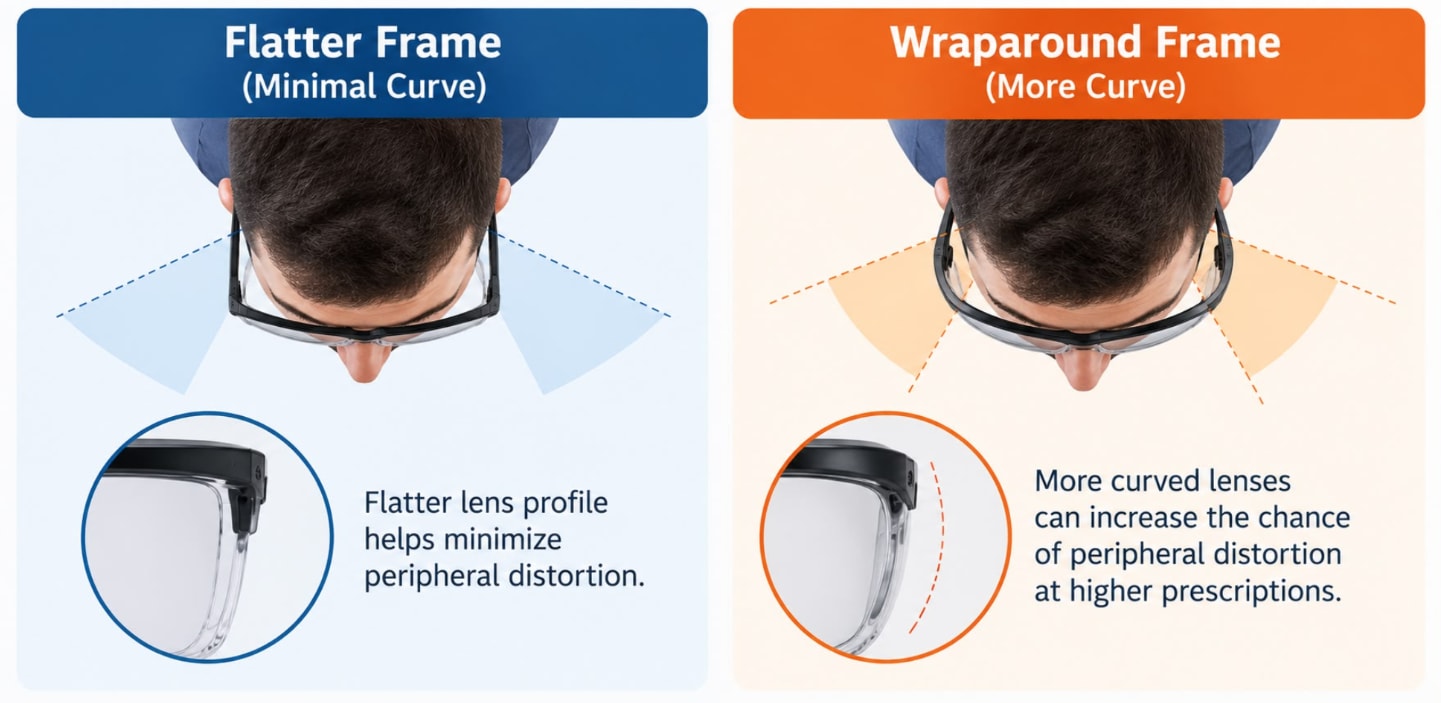
Safety frames – especially wraparound styles – are built with significantly more curve than a typical pair of everyday glasses, both for coverage and for style. That curve is exactly what can cause a problem: a standard prescription lens ground for a flat frame doesn’t behave the same way once it’s forced into a highly curved wraparound shape. The result can be peripheral distortion, a mild “swimming” sensation when you move your eyes away from center, or in some cases, difficulty fitting a thick lens into the frame at all.
Opticians who work with curved prescription eyewear generally advise that there’s no single cutoff that applies to every frame – it depends on the specific frame’s curve, your sphere and cylinder power, and the lens material and index used – but as a general pattern, stronger prescriptions and significant astigmatism correction tend to work better in flatter, less aggressively curved safety frames, while milder prescriptions have more flexibility to choose a highly wrapped style.
| Clinical note – Norman Saffra MD FAAO: Mild discomfort or eye strain reported with new safety glasses isn’t always a sign the prescription itself is wrong – it’s frequently the interaction between a strong prescription and a heavily curved frame. Before assuming the lenses were made incorrectly, it’s worth checking whether a flatter frame style resolves the discomfort. This could be a fit and frame-design question as much as it is a prescription question. |
If you have a strong prescription and want a specific wraparound style, it’s worth discussing directly with your optician or provider whether that particular frame can accommodate your prescription in single vision, or whether it’s better suited to a flatter alternative. Many providers can also tell you whether a given frame supports progressive lenses specifically, since some curved safety frames are limited to single-vision prescriptions only.
Industry by Industry Guide
Different work environments create genuinely different eyewear needs. This is a starting reference – always confirm the specific requirement for your role with your employer’s safety officer or hazard assessment, since exact requirements vary by task and facility.
| Industry | Primary Hazard | Frame Considerations | Lens Considerations |
| Construction | Flying debris, dust, sun exposure | Wraparound or side-shield frame; must fit under a hard hat | Polycarbonate; consider photochromic or tinted for outdoor glare |
| Laboratory | Chemical splash, fine particulates | Often requires goggles rather than spectacles for a sealed perimeter | Chemical-splash-rated goggles or other eye protection appropriate to the hazard (commonly marked D3); anti-fog coating strongly recommended |
| Warehouse | Falling objects, forklift/equipment traffic | Standard safety frame with side shields; good peripheral awareness matters | Polycarbonate; anti-fog if moving between temperature zones |
| Electrical work | Arc flash, flying particles | Nonconductive (non-metal) frames may be preferred or required for certain electrical tasks; follow the applicable electrical-safety requirements and your employer’s hazard assessment | Standard impact-rated lens in most cases – the applicable arc-rated PPE (often a separately-rated face shield or hood) is determined by the task-specific hazard assessment and incident-energy exposure, per NFPA 70E |
| Welding | UV/IR radiation, molten spatter | Frame must accommodate a shaded filter lens at the correct shade number for the process | Shade-rated filter lens (not standard tinted); prescription can often be integrated behind or within the shaded lens |
| On arc flash specifically: this is one of the most commonly misunderstood entries in the table above. Unlike welding, where the filter lens itself is selected by shade number, arc-flash protection is determined by the applicable electrical-safety requirements and task-specific hazard assessment – including incident-energy exposure under NFPA 70E. Depending on the task, this can involve standard protective eyewear together with an appropriately rated face shield or other arc-rated PPE, rather than a special shade or coating built into the safety glasses themselves. This is a detail to confirm with your safety officer based on the specific task, not something to assume from the eyewear alone. |
For a deeper look at hazard-specific requirements – including chemical splash, welding shade selection, and dust-sealed goggles – see our guide to safety glasses for specific work environments.
One general principle worth keeping in mind: the appropriate eye and face protection depends on the specific hazard assessment for a given task, not on job title alone. A single “construction worker” role can involve many different tasks with different hazards, each potentially calling for different protection.
| Clinical note – Norman Saffra MD FAAO: The table above is just a starting point, not a final answer for a specific situation, Individuals should always check with their employer re their job responsibilities and needs. Remember that – eyewear that looks most protective on paper isn’t always the one that actually protects a given worker best. A highly-rated frame that doesn’t fit well with a worker’s prescription, hard hat, or other PPE often ends up pushed onto the forehead or left in a locker. Protection that isn’t worn consistently doesn’t protect anyone. The right choice accounts for the hazard rating, but also for whether the specific worker can see clearly and wear it comfortably for a full shift. |
What Employers Are Actually Required to Provide?
Under OSHA’s general PPE standard, employers are generally required to provide required protective equipment at no cost to employees. However, 29 CFR 1910.132(h)(2) specifically exempts non-specialty prescription safety eyewear from this payment requirement, provided the employer permits the eyewear to be worn off the job site. This means employers are not universally required to cover the cost of standard prescription safety glasses, and coverage policies may vary by employer.
Specialty protective eyewear designed for specific workplace hazards may be treated differently. OSHA guidance identifies specialty eyewear, such as protection designed for laser or ultraviolet radiation, as an example of PPE that employers generally must provide and pay for when required for the job. Prescription eyewear inserts designed for welding or diving helmets are also identified as specialty PPE. Whether other specialized features, such as chemical-resistant treatments or arc-flash protection, fall into this category depends on the equipment and applicable requirements. If you’re unsure about coverage, check with your employer’s safety or HR team before purchasing the eyewear.
For a full breakdown of what the ANSI and OSHA markings on your eyewear actually mean, see our dedicated guide: safety standards for safety glasses.
Common Misconceptions Worth Clearing Up
Misconception 1: “Any glasses marked Z87 can be made into prescription safety glasses.”
What’s actually true: The base Z87 or Z87+ marking indicates impact resistance for the frame and lens as tested, but it doesn’t confirm the frame is rated to safely hold a prescription lens. Frames specifically rated for this carry a separate “Z87-2” marking. If prescription compatibility matters to you, that’s the marking to look for specifically – not just Z87 alone.
Misconception 2: “A more wraparound, curved frame is always more protective.”
What’s actually true: Wraparound coverage does generally improve peripheral protection against flying debris from the side. But for a wearer with a strong prescription, that same curve can introduce enough optical distortion to offset the benefit – a well-fitted, flatter frame with adequate side shields may provide more genuinely usable protection for that specific person than a curved frame they can’t see clearly through.
Our guide to prescription safety glasses for work walks through these decisions industry by industry, including how prescription strength can affect frame choice and what OSHA requires employers to provide.
| Clinical note – Norman Saffra MD FAAO: “As an eye doctor, I remind patients that safety glasses need to meet real world protective standards, not just look protective. Impact-resistant lenses combined with a correct prescription and correct frame help provide both the safety and the clarity your work demands.” |
Getting prescription safety glasses right is less about finding the most protective-looking frame and more about matching the frame, lens, and your specific prescription to how you’ll actually use them. The right choice for a warehouse floor is rarely the right choice for a chemistry lab – and the right choice for a strong prescription isn’t always the same as the right choice for someone without one.
FAQ’s
Can I just add my prescription to any safety glasses I like?
Not always. Some safety frames – particularly highly curved wraparound styles – are only rated to accept single-vision prescriptions within a certain power range, and may not support progressive lenses at all. Before ordering, it’s worth confirming with your provider whether your specific prescription and lens type (single vision vs. progressive) is compatible with the frame you have in mind.
Are OTG safety glasses as protective as prescription safety glasses?
When properly fitted and ANSI-rated, OTG safety glasses provide comparable impact protection. The trade-offs tend to be practical rather than protective: OTG designs can fog more easily since there are two lens surfaces instead of one, they add bulk, and they can interfere with other PPE like hard hats or earmuffs. For occasional use, these trade-offs are often manageable; for daily, full-shift wear, many people find dedicated prescription safety glasses more comfortable.
My safety glasses feel uncomfortable and I’m not seeing as clearly as I expected. What’s likely going on?
This is worth troubleshooting rather than assuming the prescription is simply wrong. Common causes include a frame curve that’s too aggressive for your prescription strength, a fit issue (frame sitting differently than your regular glasses), or genuinely needing a prescription check if it’s been a while since your last exam. Bringing the specific frame and your concern to your optician is the most direct way to sort out which factor is at play.
Does my employer have to pay for my prescription safety glasses?
Not necessarily. OSHA generally does not require employers to cover the cost of standard (non-specialty) prescription safety eyewear, as long as you’re permitted to wear the glasses outside of work as well. Many employers choose to cover this cost anyway as part of a safety program, but it isn’t a universal requirement – check your specific company’s policy.
| Disclaimer: This article is for informational purposes only and is not medical advice. The information presented is general in nature and may not apply to your individual circumstances. Consult a licensed eye care professional for personalized recommendations. Never disregard or delay professional medical advice based on this article. GlassesUSA makes no warranties regarding the information presented. Reliance is at your own risk. The eye care professional featured in this article is a paid spokesperson for GlassesUSA. All images in this article were generated using artificial intelligence (AI). |
Published October 18, 2026|Updated October 18, 2026
