
How Safety Glasses Should Fit: Nose, Temples, Side Shields, and OTG (Over The Glasses)
Updated OCT 18, 2026 • 5 min read

| Quick Answer Properly fitted safety glasses cover your eyes fully from the front and sides without gaps, and stay in place through normal head movement without pinching or sliding down. If you wear a prescription, that generally means either eyewear that builds the prescription directly into the safety lens, or eyewear specifically designed to fit over your glasses (OTG) without disturbing either pair. Side shields – whether built into a curved, wraparound lens or attached as a separate piece – are required under OSHA’s standard whenever there’s a hazard from flying objects. Adjustable nose pads and temples matter because a fit that pinches or slides is a fit that tends to get pushed up, adjusted, or removed mid-task. |
Introduction
A pair of safety glasses that meets every applicable standard on paper can still fail in practice if it doesn’t fit the person wearing it. Glasses that pinch at the temples, slide down the nose within an hour, or leave a gap at the brow don’t just feel uncomfortable – they’re also more likely to be pushed up, adjusted, or taken off entirely at exactly the moment they’re needed most.
This guide walks through what “fit” actually means for safety eyewear: how side shields work and why some are detachable, why nose pad and temple adjustability matters more than it might seem, and how OTG (over-the-glasses) eyewear differs from dedicated prescription safety glasses – two categories that get confused constantly, even though they solve the same problem in very different ways. For the fundamentals of choosing safety glasses generally, see our complete guide to choosing safety glasses.

Why Fit Is a Compliance Issue, Not Just a Comfort One
OSHA’s eye and face protection standard doesn’t just require that workers wear eye protection – it sets specific requirements for how that protection has to fit, especially in two situations that come up constantly in real workplaces.
Under 29 CFR 1910.133(a)(2), employers must ensure that workers use eye protection with side protection when exposed to hazards from flying objects. Detachable side shields may be used if they meet the applicable requirements for the protective eyewear.
Under 29 CFR 1910.133(a)(3), workers who wear prescription lenses and are exposed to eye hazards must use eye protection that either incorporates the prescription into its design or fits over their prescription lenses without disturbing the proper position of either the prescription lenses or the protective lenses. This requirement provides the regulatory basis for the OTG-versus-dedicated-prescription-safety-glasses decision discussed later in this guide.
| Worth knowing: CDC/NIOSH guidance on eye protection at work describes ANSI/ISEA Z87.1 as calling for wraparound coverage or side shields on impact-rated (Z87+) safety glasses – one reason nearly all compliant safety glasses include one or the other, whether or not the side shield is a separate, visible piece. For the precise requirement language, the ANSI/ISEA Z87.1 standard itself is the authoritative source. |
Side Shields: What They Do and the Types You’ll Encounter
Side shields exist to close the gap that a standard, flat-lens frame leaves open – the space between the edge of the lens and the temple, which is exactly where flying particles, dust, and splashes tend to enter from the side.
Wraparound Lenses with Built-In Coverage
Many safety glasses achieve side protection by curving the lens itself around toward the temple, so the coverage is built into the lens rather than added as a separate piece. From the outside, these can look like a single continuous lens with no visible “shield” at all – but the curve itself is doing the job of closing that side gap.
Detachable Clip-On or Slide-On Shields
Other frames use a flatter lens with a separate side shield that clips or slides onto the frame. OSHA has specifically confirmed, in a standard interpretation letter addressing this exact question, that detachable side shields don’t need to be permanently attached to meet the requirement – as long as they meet the same performance requirements as the rest of the eyewear. In practice, detachable shields are common on frames designed to double as OTG eyewear, or on styles meant to convert between looks.
Neither approach is inherently more protective than the other. What matters is whether the completed eyewear – lens, frame, and shield together, as actually worn – meets the applicable ANSI and OSHA requirements, not whether the shield happens to be molded into the lens or clipped on separately.
Nose Pads and Temples: The Adjustability That Keeps Everything Else Working
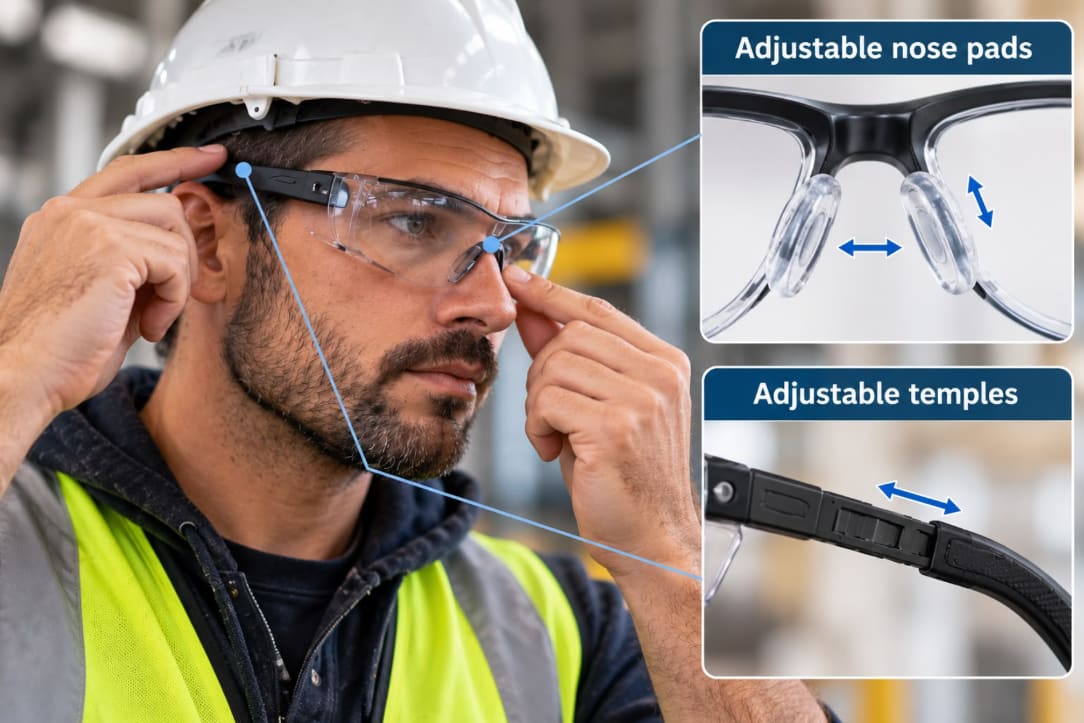
A frame can have the right lens material, the right impact rating, and full side coverage, and still underperform if it doesn’t stay in the right position on your face. Nose pads and temples are what keep it there – and how adjustable they are matters more than it might seem.
Fixed nose pads and temples work fine for many face shapes, but they distribute the weight of the frame in one set position regardless of the wearer. Adjustable nose pads – often soft silicone rather than rigid plastic – let that contact point move to spread weight more evenly, which matters more with heavier lenses, a strong prescription, or a full-shift wearing schedule. Adjustable or flexible temples serve a similar purpose against the sides of the head, and become especially relevant once other PPE enters the picture: a hard hat, earmuffs, or a respirator strap can all press directly on the same area the temples rely on for grip.
| Clinical note – Norman Saffra MD FAAO: A detail that’s easy to overlook: eyewear that needs constant readjustment isn’t just a minor annoyance – it’s a fit problem with a direct safety consequence. Every time a worker pushes their glasses back up or takes them off to relieve pressure, there’s a gap in protection during exactly the kind of task the glasses were issued for! If a pair consistently slides or leaves marks by the end of a shift, that’s an important prompt to seek a professional adjustment of either the nose pads or temples. Safety glasses that don’t fit properly can not protect you efficiently. |
OTG (Over-the-Glasses) Safety Eyewear Explained
OTG safety eyewear is purpose-built with extra interior depth and wider temples specifically designed to enclose an existing pair of prescription glasses, rather than simply being a larger version of a standard frame. The goal is for the OTG frame to fully cover the prescription glasses underneath without pressing them into the face or shifting their position – which is the specific outcome OSHA’s prescription-wearer requirement is asking for.
OTG eyewear generally falls into two broad styles. OTG spectacles use a lighter, wraparound design with some ventilation, and suit moderate hazards like general debris or dust. OTG goggles use a sealed perimeter instead, and are the more appropriate choice when chemical splash or fine dust is a real possibility, since a spectacle-style frame isn’t built to form that kind of seal.
Fit varies meaningfully between OTG models: a given design might comfortably clear a slim metal frame but pinch a thicker acetate one. It’s worth testing an OTG model with the actual glasses that will be worn underneath, rather than assuming any product labeled “OTG” will fit any prescription frame equally well. Because OTG eyewear stacks two lens surfaces in front of the eyes, fogging tends to be a more common complaint than with a single dedicated lens – worth factoring in if you’ll be wearing the combination for a full shift.
OTG vs. Dedicated Prescription Safety Glasses: Two Different Solutions, Not Two Names for the Same Thing
These two categories solve the same underlying problem – protecting a prescription wearer’s eyes – but they do it in different ways, with different trade-offs. The table below lays out the practical differences.
| OTG (Over-the-Glasses) Eyewear | Dedicated Prescription Safety Glasses | |
| What it is | Safety-rated eyewear sized and shaped to fit over your existing prescription glasses | A single safety-rated frame with your prescription built directly into the lens |
| Cost | Generally lower upfront; one design can accommodate any prescription, including future changes | Generally higher upfront; priced per prescription and per person |
| Daily comfort | Two frames stacked on the face; can feel bulkier over a full shift | One lightweight frame; many wearers find this more comfortable for daily, full-shift use |
| Fogging risk | Higher – two lens surfaces can each fog | Lower – a single lens surface |
| Best suited for | Occasional users, shared or loaner eyewear, visitors, or prescriptions that change often | Workers who wear safety glasses daily as part of their job |
| Misconception: “Any safety glasses roomy enough to wear over my regular glasses count as OTG.”What’s actually true: True OTG eyewear is purpose-built with extra interior depth and wider temples specifically designed to enclose a prescription frame without pressing it into the face or disturbing its position. Standard safety glasses that happen to be roomy enough to perch over regular glasses aren’t necessarily shaped for this, and may not satisfy OSHA’s requirement that the eyewear not disturb the position of either pair – checking that a product is actually labeled and designed as OTG is worth the extra look. |
Fit-Testing Your Safety Glasses: A Practical Checklist
A few simple checks, done while actually wearing the glasses rather than just trying them on in front of a mirror, cover most real fit problems:
- Coverage check: Look up, down, and side to side. There shouldn’t be a gap at the brow, temple, or lower rim that would let debris in from an angle.
- Stability check: Look down and shake your head gently, the way you might during actual movement on the job. Glasses that slide or shift noticeably aren’t providing consistent protection.
- Compatibility check: Put on any other PPE you’d wear alongside the glasses – a hard hat, earmuffs, a respirator – and check whether it pushes the temples into your head or interferes with the fit.
- Comfort-over-time check: If a pair leaves red marks, pinches, or needs constant readjustment by the end of a normal shift, that’s a fit problem that needs addressing rather than working around.
The right fit isn’t a single fixed answer – it depends on your face, your prescription situation, and how many hours a day you’re actually wearing the glasses. What matters is treating fit as part of the safety decision itself, not an afterthought to sort out once the glasses are already in hand.
FAQ’s
Are detachable side shields as protective as permanently built-in ones?
When both meet the same performance requirements, yes – OSHA’s standard specifically allows detachable clip-on or slide-on side shields and doesn’t require them to be permanently attached. What matters is whether the completed protective eyewear configuration meets the applicable ANSI and OSHA requirements, not whether the shield happens to be attached permanently or clipped on separately.
Can I just wear my regular safety glasses over my prescription glasses instead of buying OTG eyewear?
This generally isn’t a reliable substitute. Standard safety glasses aren’t built with the interior depth and wider temples that true OTG eyewear has, so they can press into your prescription frame, sit unstably, or leave gaps at the edges. If you need eye protection over your regular glasses, eyewear specifically designed and labeled as OTG is the more reliable option.
How do I know if my nose pads or temples need adjusting?
Common signs include glasses that slide down your nose during the day, red marks or soreness where the nose pads or temples make contact, or catching yourself pushing the glasses back up repeatedly. Any of these are reasonable prompts to adjust the fit or, for non-adjustable frames, to consider a different size or style.
Are OTG safety glasses less protective than dedicated prescription safety glasses?
Not inherently. When properly fitted and ANSI-rated, both provide comparable impact protection. The differences tend to be practical – fogging risk, bulk, and comfort over a full shift – rather than a difference in the underlying level of protection.
| Disclaimer: This article is for informational purposes only and is not medical advice. The information presented is general in nature and may not apply to your individual circumstances. Consult a licensed eye care professional for personalized recommendations. Never disregard or delay professional medical advice based on this article. GlassesUSA makes no warranties regarding the information presented. Reliance is at your own risk. The eye care professional featured in this article is a paid spokesperson for GlassesUSA. All images in this article were generated using artificial intelligence (AI). |
Published October 18, 2026|Updated October 18, 2026
